Get Full Government Meeting Transcripts, Videos, & Alerts Forever!
Get email alerts on the Elections Administration topic
No spam. Unsubscribe anytime.
Senate advances voting-centers bill after senators warn counties cannot implement it as written
Summary
Senator Koobbe provided county-level estimates of new polling sites and poll workers that would be required under House Bill 2017; county officials have told committees they cannot implement the bill as written. The committee recommended "do pass."
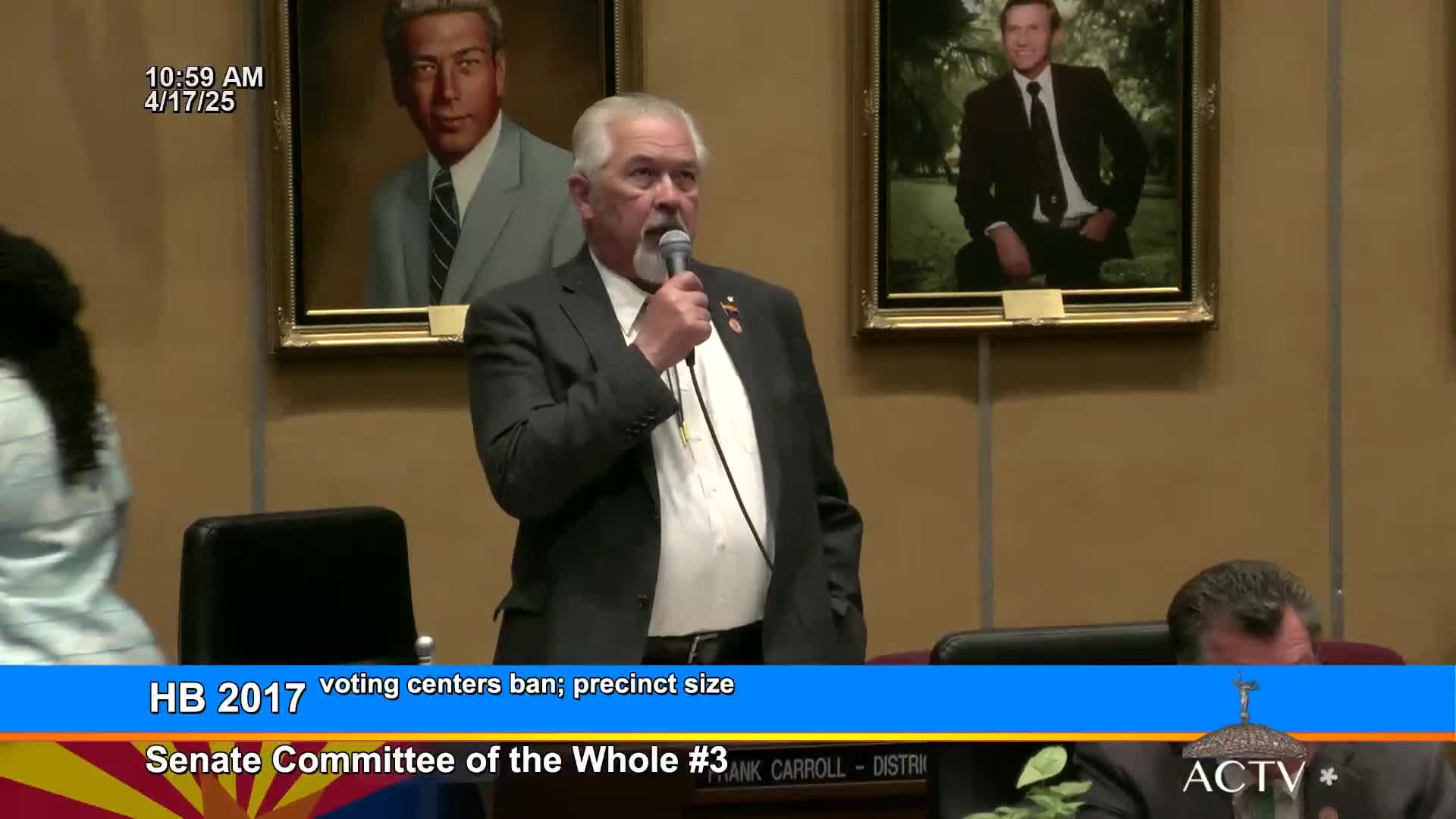
House Bill 2017, a measure affecting the operation of voting centers in Arizona, was advanced by the committee of the whole on April 17, 2025, after extended questioning on the floor about implementation capacity.
Senator Koobbe fielded repeated questions from colleagues about how many additional polling places and poll workers would be needed if the bill were enacted. She gave county-level estimates during the floor session: "Just Maricopa County alone 2,643 new polling sites and 10,000 extra poll workers," Koobbe said. She added that Pima County would need about 552 new polling places and roughly 2,000 extra poll workers, and Pinal County would need about 168 new sites and 800 extra poll workers.
Multiple senators noted testimony from county officials and recorders in committee that the counties could not implement the bill as written, citing physical and staffing limitations. One senator described the effect as adding an "immeasurable burden" on counties and potentially reducing access for voters who currently benefit from vote centers and vote-by-mail options.
The committee-of-the-whole motion to return HB 2017 with a due-pass recommendation was moved and adopted; the transcript records the committee report and the committee motion as carried. The record shows robust floor-level concern about operational feasibility in Maricopa, Pima and Pinal counties though the committee advanced the measure.
Why it matters: changes to voting-center rules affect how and where Arizonans can cast ballots and impose implementation costs on counties that administer elections. The senator's county estimates provide a concrete sense of the scale of the operational impact reported in committee testimony.