Get Full Government Meeting Transcripts, Videos, & Alerts Forever!
Get email alerts on the Land Development Regulations topic
No spam. Unsubscribe anytime.
North Miami planners begin LDR rewrite; commissioners press for clearer rules, stronger enforcement and infrastructure focus
Summary
City consultants outlined a 6–8 month rewrite of North Miami’s Land Development Regulations to implement the comprehensive plan; commissioners urged clearer overlay rules, better enforcement, and prioritized sewer, stormwater and tree maintenance.
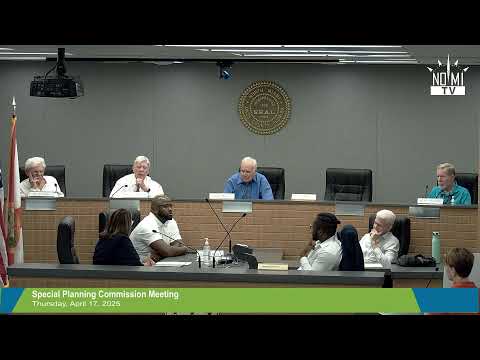
City of North Miami planning commissioners and the city’s consultants opened a facilitated discussion on updating the city’s Land Development Regulations (LDRs), the primary implementing tool for the comprehensive plan adopted in June 2024 and made effective in August 2024.
The meeting, described by consultants as a targeted “power‑user” session rather than a public hearing, reviewed the LDR update goals, timeline and draft policy drivers and solicited input from planning commissioners, developers and staff about problems to fix and gaps to address.
The rewrite is intended to align the code with the comprehensive plan, respond to recent state statutory changes and produce clearer, more user‑friendly rules. Consultant Sylvia Vargas said the team is in a discovery phase and expects to complete diagnosis and initial drafting over the next 6–8 months, with additional public workshops in early June, a return to stakeholders in September and an adoption sequence in October–November. “We have 4 phases,” the consultant said as she summarized the earlier planning process, and described the LDR update as a top immediate action from the plan’s action agenda.
Why it matters: the LDRs govern what gets built and where, how infrastructure costs are allocated, and how the city balances growth with neighborhood protection. Commissioners repeatedly described recurring ambiguity and enforcement shortfalls that they say slow approvals, let low‑quality projects proliferate, and leave older neighborhoods with deferred maintenance.
Key policy background and planner findings
- Consultants said the comprehensive plan projects assertive growth: the market analysis noted the delivery of more than 800 multifamily rental units in recent years, an expected annual absorption of about 300–350 units, and a development pipeline of roughly 4,000 units. The consultants also said the city consolidated and replenished the floating unit pool with nearly 8,000–9,000 units. - The consultants identified two priority growth areas for the coming years: the PCD (shown in yellow on the plan map) and the NMTSDO (shown in red). They also said the plan recommended eliminating the NRO overlay because it “was really not serving the purpose that it had been designed for and was actually harming more than it was providing a benefit.” (Carla Ewenbach, subconsultant) - Staff and consultants flagged statutory changes to track: the Live Local Act tweaks and a bill referenced as SB 184 (described in the meeting as requiring local governments to allow accessory dwelling units) and noted Miami‑Dade County’s new impervious surface ordinance as regulatory drivers for the LDR update.
Commissioner concerns and proposed code changes
Commissioners raised recurring, practical problems they want the LDR rewrite to address:
- Tree canopy and maintenance: Commissioner Each said, “Trees get knocked over. They're not replaced. That's the problem,” and urged provisions or enforcement tools to ensure planting comes with ongoing maintenance plans and staffing to replace dead street trees.
- Swales, on‑street parking and drainage: Commissioners described swales compacted by parked cars and asked whether the city should consider alternate cross‑section designs or use grants and incentives to retrofit streets for curbless, pervious on‑street parking. Debbie Love, development services director, noted the city’s mobility plan identifies street types and that mobility fee credits could be used to encourage developers to rebuild entire blocks rather than only frontages.
- Enforcement and staffing: Multiple commissioners said the code can be clear on paper but lacks follow‑through. “It's good to have requirements and LDRs and that kind of thing, but you have to have enforcement,” one commissioner said, urging coordination with Public Works, code enforcement and budget managers so rules are effectual, not just aspirational.
- Overlay complexity and clarity: Several commissioners called overlays confusing and inconsistent when they overlap. One commissioner summed up the frustration: “Overlays. Always cause a problem.” Commissioners asked for simpler, more uniform standards so that the underlying district rules and overlay adjustments are predictable.
- Design quality and incentives: Commissioners proposed new incentives for rooftop gardens, public‑facing amenities and stronger transitional standards between corridors and single‑family neighborhoods. One suggested a façade/design “extra credit” reward similar to a practice used in Coral Gables.
- Dumpsters, site cleanliness and construction controls: Commissioners urged that the code explicitly require screened/enclosed dumpsters and stronger routine construction‑site cleanliness enforcement; staff said pre‑construction meetings and stop‑work orders are already being used more frequently.
- Sewer and water infrastructure equity: Commissioners from the western part of the city pressed that aging water and sewer lines there break frequently and need prioritization. Vargas and Love said the comprehensive plan and its supporting infrastructure study identified prioritized remediation projects and cost estimates, but acknowledged funding and phasing constraints.
Emerging topics and district proposals
- Entertainment / cultural district: Multiple commissioners and staff discussed creating an entertainment or arts district (an overlay to replace the former Chinatown overlay) to attract evening activity, arts and small nightlife venues. Staff said work on a Northwest Seventh Avenue arts/cultural/entertainment overlay is underway and aimed for the May 6 Planning Commission agenda.
- North Miami Transit Station / transit‑oriented development (TOD): Staff reported that the transit stop site has regulatory work in place and that the primary delay to the rail service is the availability of train cars, with one staff member noting the delivery timeline now targets about 2032. Commissioners urged that the LDR rewrite include rules to enable future TOD and possible entertainment uses near the station.
- Commercial clustering and sensitive land uses: Commissioners flagged a proliferation of dollar stores, self‑storage, smoke shops, tattoo parlors and dispensaries in some corridors. Staff noted distance‑separation tools already exist for some uses and said the LDR update can evaluate expanding separation or location limits where state law does not preempt local controls (staff cautioned that some uses, such as medical marijuana dispensaries, are treated under state statute similarly to pharmacies).
Process, schedule and next steps
Consultants said the project timeline includes discovery (current), diagnosis (through May), drafting over the summer, stakeholder and public review in September, and an October–November adoption push. The team plans targeted technical meetings — a second “power user” meeting with developers and designers is scheduled for Monday at 6:30 p.m., and public workshops are planned for early June.
Debbie Love told the commissioners she is working to place an entertainment overlay on the May 6 agenda and that the housing department will bring the annual consolidated housing plan forward for review. Consultants said they will return with an annotated outline and draft LDR language for stakeholder comment.
Ending
The meeting closed with staff and consultants asking commissioners to send additional written input and examples of ambiguous code language; consultants said they will collect notes from tonight’s session and from the Monday meeting to shape the draft LDR package that will be returned to the commission and the public later this year.