Get Full Government Meeting Transcripts, Videos, & Alerts Forever!
Get email alerts on the Native Education Program topic
No spam. Unsubscribe anytime.
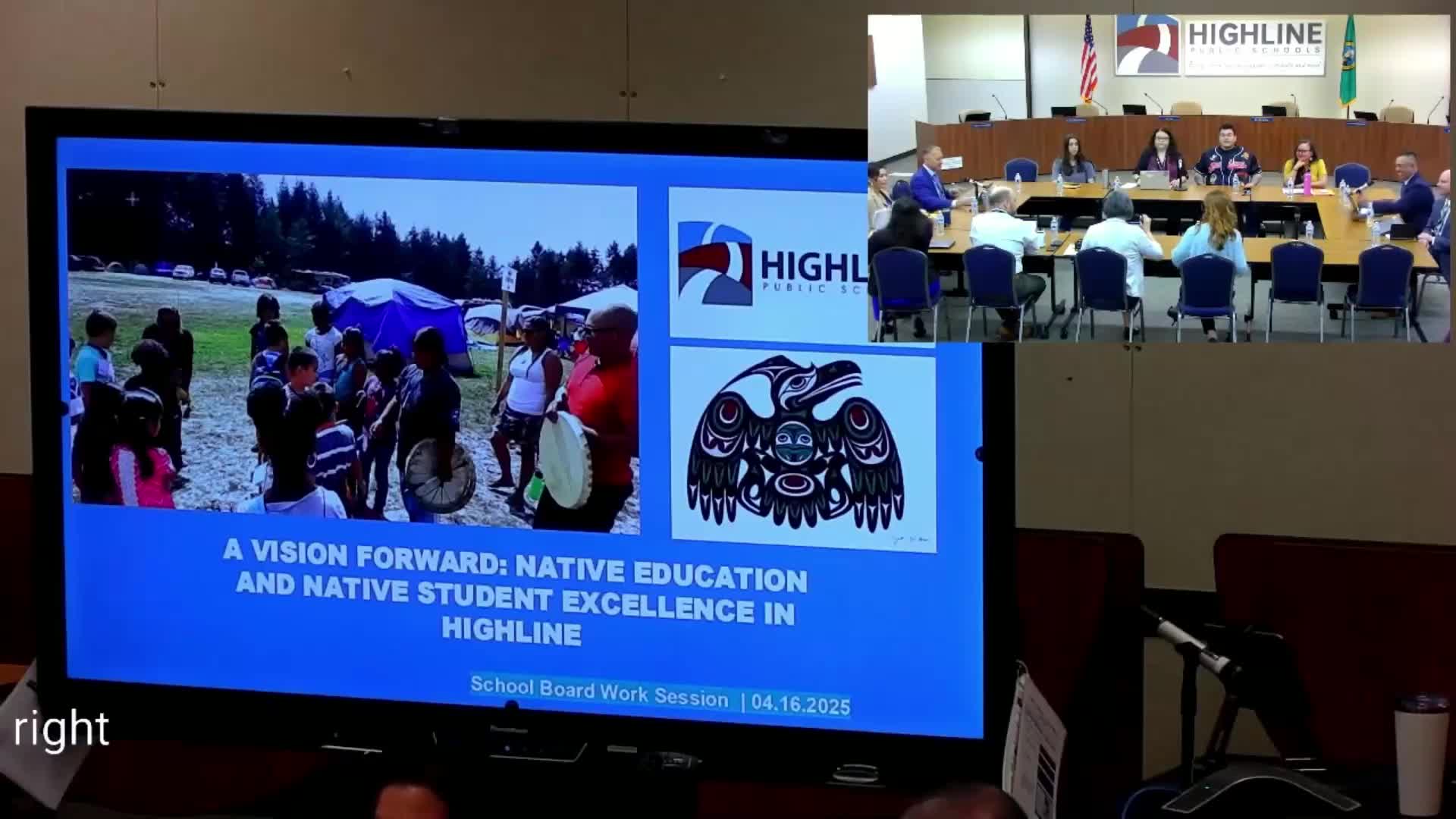
Highline highlights Since Time Immemorial curriculum, readies for tribal consultation
Summary
District staff briefed the board on the Highline Native Education program, the Since Time Immemorial (STI) curriculum and Board Policy 2197, described funding streams that support the work, and announced a tribal consultation scheduled for April 25.
Highline School District staff gave a one-hour work-session briefing on the district’s Native Education program, the hand-in-hand implementation of the Since Time Immemorial curriculum and Board Policy 2197, and an upcoming tribal consultation set for April 25 from 9 a.m. to 12 p.m.
The presentation, led by Lita O’Donnell, director of family and community partnerships, outlined program objectives, the district’s role in supporting American Indian and Alaska Native students, and how state and federal requirements shape curriculum and consultation work. “We are committed to continuing to serve our Native Education students,” said Keesa (on phone), referencing the district’s tracking of federal guidance and internal budgeting to sustain services.
Why it matters: Highline described STI and related policy as core curriculum and district priority rather than an add‑on. Staff said the work is connected to district strategic goals (belonging, innovative learning, bilingual/biliteracy and future readiness) and to legally required government‑to‑government consultation with tribal partners — primarily the Muckleshoot Indian Tribe in Highline’s account.
What staff told the board
- Program scope and services: John Reamer, native education literacy and culture specialist, described weekly, site-based supports across multiple schools (Highline High, Evergreen, Glacier Middle, Beverly Park, Big Picture, and Mar Vista) and year-round programming including a summer academy and student events. Reamer said staff provide tiered supports, co-teaching, culturally grounded literacy materials and opportunities such as a recent Native Student Day at UW and attendance at Native American Youth Leadership programs.
- Curriculum and accountability: Bernard Koontz, executive director for student learning, said Highline is implementing the Since Time Immemorial curriculum at specified secondary grade levels (seventh‑grade Pacific Northwest history, 11th‑grade U.S. history and 12th‑grade civics) this year and plans to extend systematic elementary‑level accountability next year. Koontz said the district has completed an interim report and will produce a year‑end report showing progress against targets.
- Policy history and redraft: Sarah Marie Ortiz, native education program manager (Pueblo of Acoma), reviewed Board Policy 2197 — passed in 2014 — and said the district is redrafting the policy with input from family leaders, legal partners and the Native Family Advisory Council. Ortiz said the original policy was developed with community partners and called the board policy an unusual but important district‑level commitment.
- Funding and federal context: Presenters described multiple funding streams that support native education work: the district uses Title VI (Every Student Succeeds Act), Title III, Title I, basic education funds, Local Effort Assistance (LAP) and sometimes one‑time private funds. Staff noted confusion in public discussion between Title VI of the Civil Rights Act and Title VI of ESSA; they stressed the Title VI grant under ESSA (Indian Education) is the federal grant that underpins many services and that the district is monitoring federal developments and state guidance closely.
- Tribal consultation: Staff explained consultation is a government‑to‑government federal requirement under ESSA and emphasized that consultation includes data requests from Muckleshoot and other specific metrics the tribe asks the district to provide. The district asked board members to attend the consultation and to participate in ongoing learning: “We ensure that it’s timely and meaningful,” Ortiz said of consultation work.
Student outcomes and family engagement
Staff highlighted gains on i-Ready literacy and math measures for identified Native students, while noting that identification and data visibility remain problems: the dataset shown included 53 students but staff said that figure likely undercounts the district’s Native population because of broader identification issues across the state. Staff also described student leadership pipelines and family engagement through the Native Family Advisory Council and community events such as the Native Student Success Summit at Highline College.
Board interaction and next steps
Directors thanked staff, praised student leaders who returned to work in the district and asked how board members can support the work. Staff asked directors to track required consultation training offerings and to join the April 25 consultation. Superintendent/Doctor Duran was named as the point of contact for follow-up questions; staff asked board members to send outstanding questions to Dr. Duran for response.
Votes and formal actions
The meeting concluded with a motion to adjourn that passed unanimously. The board recorded the motion to adjourn, a second, and a unanimous “Aye.”
Ending
Presenters said they will circulate additional consultation materials and resources compiled from OSPI (Office of the Superintendent of Public Instruction) and national partners. Staff requested continued engagement from the board as the district finalizes the Policy 2197 redraft and advances accountability measures for the STI curriculum.