Get Full Government Meeting Transcripts, Videos, & Alerts Forever!
Boston officials present $4.8 billion FY26 operating budget; pensions, property tax and salary savings drive growth
Summary
City finance officials told the Boston City Council Committee on Ways and Means on April 17 that the proposed $4.8 billion operating budget for fiscal 2026 would grow 4.4% driven mainly by pension, debt service and property tax receipts, while departmental spending is constrained and salary‑savings assumptions are increased.
Councilor Brian Worrell, chair of the Boston City Council Committee on Ways and Means, convened a hearing on April 17, 2025, at which Chief Financial Officer Ashley Grafenberger and Jim Williamson, director of the Office of Budget Management, presented the mayor’s recommended fiscal year 2026 operating budget and answered councilors’ questions.
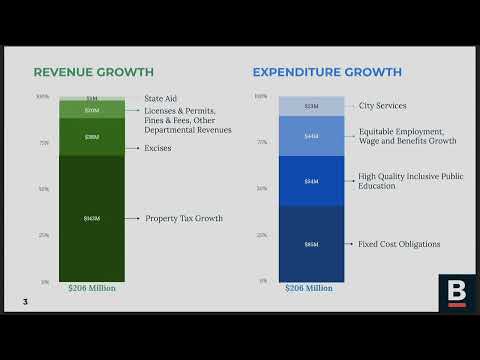
The fiscal year 2026 recommended operating budget is a thoughtful, responsible financial plan that honors the city's commitments as an employer, asset owner and service provider, Grafenberger said during the presentation. The administration projects overall general fund growth of 4.4%, with total appropriations of about $4.8 billion.
The administration told the committee the growth is concentrated in fixed, non‑discretionary costs and long‑term obligations. Grafenberger said property tax growth is the largest single revenue driver: the budget assumes the allowable 2.5% Prop 2½ levy increase plus a conservative $60 million estimate for new growth, producing a projected $143 million increase in property‑tax revenue. Excise revenues are projected to add about $38 million. On the expenditure side, more than half of the projected growth is tied to fixed costs: pension payments are budgeted to rise by about $45 million and debt service by roughly $34 million. Wage and benefit increases linked to recently settled contracts are estimated at about $44.3 million.
The administration emphasized revenue mix and risks. Grafenberger noted Boston relies heavily on property taxes (about 70% of general fund revenue) and that interest‑on‑investment receipts — which spiked in recent years as interest rates rose — are being budgeted more conservatively because that…
Already have an account? Log in
Subscribe to keep reading
Unlock the rest of this article — and every article on Citizen Portal.
- Unlimited articles
- AI-powered breakdowns of topics, speakers, decisions, and budgets
- Instant alerts when your location has a new meeting
- Follow topics and more locations
- 1,000 AI Insights / month, plus AI Chat