Get Full Government Meeting Transcripts, Videos, & Alerts Forever!
Get email alerts on the Municipal Budget topic
No spam. Unsubscribe anytime.
Boston officials present $4.8 billion FY26 operating budget; pensions, property tax and salary savings drive growth
Summary
City finance officials told the Boston City Council Committee on Ways and Means on April 17 that the proposed $4.8 billion operating budget for fiscal 2026 would grow 4.4% driven mainly by pension, debt service and property tax receipts, while departmental spending is constrained and salary‑savings assumptions are increased.
Councilor Brian Worrell, chair of the Boston City Council Committee on Ways and Means, convened a hearing on April 17, 2025, at which Chief Financial Officer Ashley Grafenberger and Jim Williamson, director of the Office of Budget Management, presented the mayor’s recommended fiscal year 2026 operating budget and answered councilors’ questions.
The fiscal year 2026 recommended operating budget is a thoughtful, responsible financial plan that honors the city's commitments as an employer, asset owner and service provider, Grafenberger said during the presentation. The administration projects overall general fund growth of 4.4%, with total appropriations of about $4.8 billion.
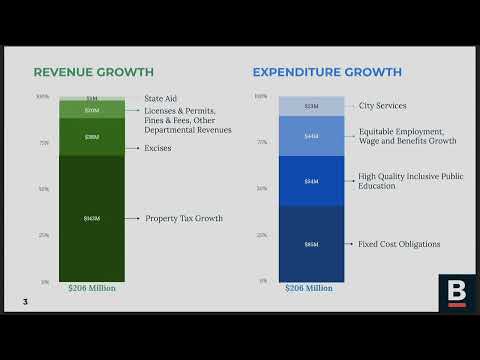
The administration told the committee the growth is concentrated in fixed, non‑discretionary costs and long‑term obligations. Grafenberger said property tax growth is the largest single revenue driver: the budget assumes the allowable 2.5% Prop 2½ levy increase plus a conservative $60 million estimate for new growth, producing a projected $143 million increase in property‑tax revenue. Excise revenues are projected to add about $38 million. On the expenditure side, more than half of the projected growth is tied to fixed costs: pension payments are budgeted to rise by about $45 million and debt service by roughly $34 million. Wage and benefit increases linked to recently settled contracts are estimated at about $44.3 million.
The administration emphasized revenue mix and risks. Grafenberger noted Boston relies heavily on property taxes (about 70% of general fund revenue) and that interest‑on‑investment receipts — which spiked in recent years as interest rates rose — are being budgeted more conservatively because that source is likely to decline. She also said net state aid is effectively lower this year after accounting for state assessments, with a roughly $7 million reduction in net state aid compared with FY25 and a negative shift in net education aid driven in part by charter assessments.
Councilors pressed finance staff on several points. Councilor Flynn pressed whether a 10% increase in the pension contribution this year is sustainable; Williamson and Grafenberger said the rise primarily reflects the city meeting a full‑funding schedule set with the retirement board and that after reaching the schedule (now targeted for 2028) pension cost growth should moderate, although market volatility remains a factor. Williamson told the committee, "The pension budget is growing by 45,000,000 or 10.7%." (Williamson's remarks were part of the presentation.)
Several councilors questioned staff about the budgetary assumption on personnel. The administration said departmental appropriations are being held to a 1.7% increase over FY25 and that the FY26 proposal does not include new permanent headcount beyond planned replacements. To reflect realistic hiring patterns, the budget increases its salary‑savings assumption by about $9 million compared with prior years; total salary savings across the general fund is roughly $40 million, a figure the administration said is equivalent to approximately 500 positions not being fully funded for a full year. Jim Williamson said the salary‑savings figure is "the aggregate of positions that will not be actively on the city payroll," and that the change reflects updated hiring and attrition assumptions.
Councilors also asked about line‑item changes called out in the presentation. Public‑works trash contracts are cited as a major departmental increase — roughly $12.8 million — tied to new collection and disposal contract terms that the administration says will provide more reliable equipment, additional contractor labor and greater accountability. DoIT (the municipal information‑technology office) is budgeted to grow by about $4.1 million for constituent‑service platforms and permitting systems. The budget includes continued investments in public safety recruitment (police and an inaugural fire cadet program), public health programs (including ongoing opioid response funded in part from settlement dollars) and senior services through the Age Strong program.
Housing programs discussed during the hearing include several initiatives financed outside the recurring operating base: the Acquisition Opportunity Program (AOP), the Housing Acquisition Fund (seeded in FY25 with one‑time operating and ARPA dollars), and a $110 million Housing Accelerator appropriation approved in winter 2025. Finance staff described the accelerator as a one‑time, non‑recurring appropriation intended to jump‑start approved mixed‑use housing projects; the administration said it will be managed outside the FY26 general‑fund baseline.
Councilors raised several operational and policy concerns in questioning: the effect of downtown office vacancy on future property‑tax burdens and local economic activity; whether increased salary savings will reduce frontline service capacity for departments such as inspectional services, public works and transportation; how trash contracts were procured and whether the city could increase supplier diversity; and whether some programs funded in prior years (for example, a community syringe‑cleanup workforce) are being shifted from city staff to contracted, neighborhood workforce models. On the syringe pickup program, finance staff said the Public Health Commission plans to replicate existing neighborhood workforce models (for example, the Newmarket model) in other areas and that some of those efforts are contract‑based rather than city‑employee driven.
No formal votes were taken at the hearing. Finance staff said the city will continue daily monitoring of federal‑grant flows and revenue receipts and will provide the Council with ongoing updates. Grafenberger noted the city remains well reserved — the certified fund balance as of the most recent state certification was reported at roughly $1.4 billion and the most recent certified free cash was cited at about $515 million — and that the city’s AAA bond rating has reflected multiyear fiscal discipline. Staff also said the collective bargaining reserve in the FY26 proposal includes funded amounts for recently settled civilian contracts; the incremental cost of settled civilian contracts included in the FY26 budget was reported to be about $6.5 million, and the BTU (Boston Teachers Union) settlement will require a supplemental transfer into BPS’s appropriation once finalized.
The committee was told the council’s budget review will continue through June with dedicated public‑testimony hearings (virtual April 22, 6 p.m., and in‑person May 28, 6 p.m.) and department hearings scheduled on the council’s budget site.
Budget figures cited in the hearing and this report are those the city’s CFO and budget director provided to the committee and are summarized here as presented to the Ways and Means Committee.