Get Full Government Meeting Transcripts, Videos, & Alerts Forever!
Get email alerts on the Capital Plan topic
No spam. Unsubscribe anytime.
Boston unveils $4.5 billion five-year capital plan as debt approaches policy limit
Summary
City officials presented a $4.5 billion, 390-project five-year capital plan to the City Council committee, and warned the city will approach its 7% debt-service policy limit if projected borrowing continues.
Boston officials on April 17 laid out a five-year capital plan that totals $4.5 billion and covers roughly 390 projects across neighborhoods, while stressing the city is nearing its self-imposed debt-service limit.
The presentation to the City Council Committee on Ways and Means said the plan, for fiscal years 2026–2030, is financed primarily with general obligation bonds, supplemented by other city funds and federal and state grants. “This 5 year capital plan totals $4,500,000,000 and includes investments across 390 projects in all neighborhoods,” Ashley Grafenberger, the city’s chief financial officer, told the committee.
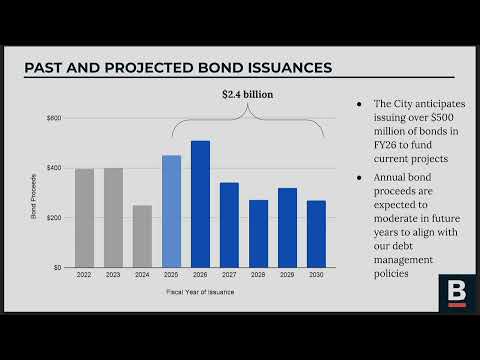
The plan relies heavily on borrowing. Grafenberger said roughly 80 percent of the plan’s revenue will come from general obligation bonds and that the city anticipates issuing more than $2.4 billion in bonds over the coming years, with just over $500 million expected in fiscal 2026. “The bonds are direct general obligation debt for the city and are backed by the full faith and credit of the city of Boston,” she said.
Why it matters: The Office of Budget Management said it expects the city to approach its debt-service policy limit — the policy states debt service shall not exceed 7 percent of operating budget expenditures — within the five-year window. Officials cautioned that getting close to that limit reduces flexibility in the operating budget and can force trade-offs with salaries and programmatic spending.
Grafenberger described the city’s debt-management practice: principal is repaid rapidly, with 35–40 percent repaid within five years and 65–70 percent within 10 years, and no variable-rate debt outstanding. She said the 7 percent figure is a limit, not a target, and that “there really are practical consequences to being at that limit,” including reduced ability to maintain projects at the margin.
Details and trade-offs: City staff told the committee the plan decreased compared with the prior five-year plan because several large projects finished and were removed from the new plan. Federal grants account for a smaller share of revenue (about 9 percent) but are important for coastal resilience and certain street projects; officials warned the loss of such grants would affect those programs.
City officials described the capital plan as a roadmap that aligns with revenue assumptions. They emphasized that projected expenditures in the plan may require additional investment later — “a project may need increasing investment to fully actualize,” Grafenberger said — and that loan and appropriation orders approved by the council and mayor authorize debt against specific projects.
What to watch: Officials said they are not actively planning to change the debt-policy limit but noted such a decision would require explanation to rating agencies and could affect the city’s AAA credit standing. The council’s review process continues through June, and the plan will be updated as projects move through design, bidding and construction phases.