
Judge Stephanie Boyd hears dozens of misdemeanor and felony dockets; bond, GPS and sentencing decisions issued
Get AI-powered insights, summaries, and transcripts
Sign Up Free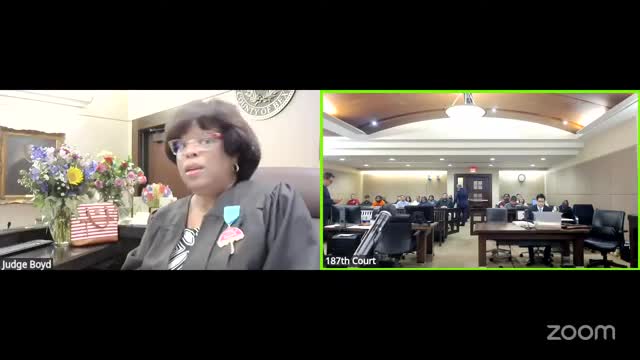
Summary
The 187th District Court heard a packed docket April 18, with Judge Stephanie Boyd setting multiple plea‑deadline and trial dates, ordering a $40,000 bond and full GPS for one defendant, denying a restitution request for another, and imposing sentences or deferred dispositions in several cases.
Judge Stephanie Boyd opened the court’s April 18 docket and handled a long series of arraignments, plea‑deadlines, contested hearing resets and sentencing matters in the 187th District Court in Bexar County.
The session produced a mix of procedural orders and final outcomes. The court set or confirmed future plea‑deadline and trial dates across many files, granted one defendant bond with a GPS condition, declined to order restitution in a separate case after the victim could not produce an itemized, out‑of‑pocket damage list, and imposed prison or probationary sentences in several matters. "If the state proves their case beyond a reasonable doubt, you're going to get found guilty," Boyd told a defendant at a plea‑deadline hearing, underscoring the court’s repeated admonition about the consequences of proceeding to trial with insufficient defenses.
Why it matters: the docket captured both routine case management and final, enforceable court actions that affect defendants’ custody status, supervision terms and next court dates. Several outcomes include conditions—GPS monitoring, TAP (treatment and assessment program) evaluations, restitution orders or their denial— that will govern defendants’ liberty and supervision going forward.
The most consequential rulings recorded on April 18 included:
- Bond and monitoring: In State v. Monica Teresa Wade (case 20238093) the court set bond at $40,000 and ordered full GPS monitoring with fees waived; the court set a contested date of May 12 and said the GPS must be installed at the jail rather than delayed because of the holiday. The court explicitly denied partial or limited GPS that would permit continued unmonitored activity.
- Restitution denied for lack of documentation: At a restitution hearing in State v. Kevin Curiel (2024CR3419), the court declined to order restitution after the victim, Ines Leal, and counsel were unable to present an itemized, out‑of‑pocket accounting separate from insurance payments. Judge Boyd told the parties she could not order restitution without a final, itemized list of damages.
- Guilty findings and sentences: The court accepted pleas or found defendants guilty and imposed sentences in several matters: Juan Carlos Castaneda was found guilty on revocation, the court revoked supervision and sentenced him to 180 days in the Bexar County Jail with credit for time served and noted restitution had been paid in full; Karen Garnica entered a plea and the court sentenced her to 10 years, suspended and probated for 6 years with multiple conditions including intensive outpatient treatment, GPS for a short term in lieu of jail, ignition interlock where applicable and community service; Romero Guzman (filed as two related cause numbers) entered pleas that the court accepted and imposed two‑year sentences to run concurrently, with fines and no‑contact orders noted.
- Case management and referrals: The court repeatedly set discovery and plea‑deadline dates (notably the weeks of May 12 and June 9 or June 23 for several files) and directed probation or defense counsel to obtain TAP evaluations, CPS records, or medical records where those materials were missing. In several matters the court referred defendants to treatment options including felony drug court or mental‑health screenings when appropriate.
Courtroom instructions and practice reminders: Judge Boyd reminded gallery attendees and counsel that the docket would be cut off at 11:30 a.m. to allow breaks after multi‑day trials, and she reiterated courtroom procedures—attorneys must confer with the state and their clients before approaching; request interpreters through the clerk and do not leave the courtroom once an interpreter has been requested; and attorneys must bring incarcerated clients when ordered. The judge also urged clear communication between defendants and counsel, warning that poor client–attorney communication can lead to withdrawals of counsel and appointment of new counsel.
What’s next: Many matters were reset for mid‑May and June calendar slots for discovery completion, contested hearings or plea deadlines. Parties were ordered to provide missing discovery, medical records or itemized damage lists before those return dates. Several defendants received directions to appear for TAP or mental‑health evaluations in custody if the court required them.
Police‑ and corrections‑related logistics: The court repeatedly instructed deputies to hold or not transport certain defendants and directed jail staff to install GPS units at the jail when ordered. Fees for GPS monitoring were waived in at least one instance.
The session closed with routine administrative scheduling and reminders from Judge Boyd about upcoming local events and court holidays; the court adjourned for the day.