Get Full Government Meeting Transcripts, Videos, & Alerts Forever!
Get email alerts on the Civic Center Future topic
No spam. Unsubscribe anytime.
Mayor, Parks and Rec Present Options as Rock Springs Civic Center Faces Major Repairs
Summary
City staff and residents discussed large, uncertain repair costs for the Rock Springs Civic Center, possible funding sources including AML insurance and grants, and the prospect of either significant investment or phased divestment; council scheduled further deliberation for May 6.
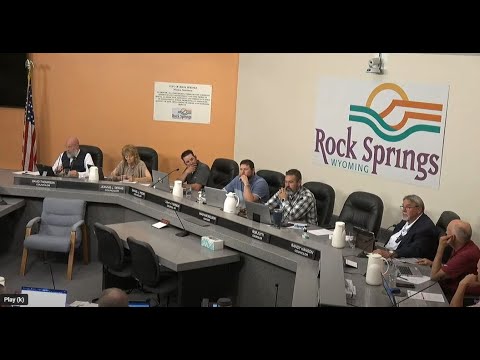
Rock Springs — City officials, Parks and Recreation staff and residents met in a workshop to review the deteriorating condition of the Rock Springs Civic Center and to discuss whether the city should invest in major repairs or transition programs to other facilities.
Parks and Recreation Director JJ Seabird told the Rock Springs City Council that deferred maintenance has pushed the Civic Center to a “tipping point,” citing a failing roof, water intrusion that has caused mold and crumbling walls, an aging pool and other systems near the end of their life. “We need a commitment to investment or commitment to divestment,” Seabird said, urging council to choose between directing funds to the building or redirecting services elsewhere.
The recommendation from staff was to evaluate program transitions and to consider the citywide parks and recreation footprint before deciding how to allocate scarce funds. Seabird described a range of estimated costs produced by consultants and contractors: short-term roof work and mitigation already running into the hundreds of thousands of dollars, pool foundation and rebuild estimates that contractors suggested could range from about $5 million to $9 million, and broader renovation scenarios with low-end to high-end estimates in the mid- to high- tens of millions. Seabird said preliminary estimates had placed a total rebuild or full rehabilitation in a broad range up to roughly $15 million–$26 million, and that an outlying figure of $30 million had been cited in a consultant discussion.
Seabird said additional pressures include a roughly 40% reduction in full‑time staff at the facility since 2012, aging mechanical and safety systems (including the fire panel, pool filtration and HVAC), and unknown structural conditions under the pool that require forensic engineering to assess. He warned of the risk that unexpected failures could force abrupt closure of the building for safety reasons.
Residents and stakeholders who spoke during the public-comment period urged the council to pursue outside funding and preservation options before deciding to close or demolish parts of the facility. Heidi Humphreys of the Rock Springs Historic Preservation Commission said the Civic Center and the adjoining Old Timers building carry deep community heritage and urged the council to pursue Abandoned Mine Land (AML) funding and other grants. “The Civic Center has a connection to the city that runs much deeper than any other park and rec facility in this city,” Humphreys said.
Councilors asked staff about potential external funding. Seabird said staff had contacted the state AML office and that the AML program would first perform an assessment (drilling) to determine whether subsidence from historic mining is a contributing cause; Seabird said AML’s insurance cap for a qualifying loss is $275,000 per loss and that AML pays only for subsidence-related repairs. He noted that AML support would be helpful but would not cover major electrical, HVAC or fire‑system work.
Speakers including longtime residents urged the council to consider public-private partnerships, naming rights or large donations; other commenters suggested pursuing federal resilience or historic‑preservation grants and pursuing phased solutions tied to a multi‑year forecast. Mike Scores, a lifelong resident, said the Civic Center is heavily used for lessons and programs and that closure would be “a huge disservice to our city.”
Council members and staff emphasized that the estimates presented to date were preliminary ranges and not the result of a full forensic engineering study. Staff described a stepwise approach: (1) determine the most urgent safety and mitigation work, (2) obtain forensic/structural engineering reports and contractor bids (which will incur additional upfront cost), and (3) use those findings to decide whether to invest in a long-term renovation, pursue demolition of the newer addition, or reallocate programs and staffing.
Mayor Mickelson said the council will consider the topic again at its May 6 meeting and that the choice before the city is whether to continue investing in the Civic Center and accept the resulting tradeoffs across other city priorities or to close and transition services. “If the choice is to keep the Civic Center open, then I need to know from the community, what are we getting rid of in order to afford that? Because we don't have excess funds,” the mayor said.
No formal action or vote was taken during the workshop; councilors instructed staff to continue exploring funding options, refine cost estimates through engineering studies, and return with additional information for the May 6 meeting.