Get Full Government Meeting Transcripts, Videos, & Alerts Forever!
Get email alerts on the Flood Insurance topic
No spam. Unsubscribe anytime.
Ithaca staff: CRS application could cut federal flood-insurance premiums modestly; mitigation project may reduce net benefit
Summary
City staff told the Common Council that applying for FEMA’s Community Rating System would likely yield a small reduction in federally backed flood-insurance premiums (about 5–15%), but a successful local flood-mitigation project that removes properties from the floodplain could shrink or eliminate net citywide savings.
Sam, a city staff member, briefed the Ithaca Common Council on the Community Rating System (CRS), a Federal Emergency Management Agency (FEMA) program that can lower premiums for federally backed flood insurance, and the likely financial trade-offs for the city and residents.
The presentation explained that CRS is “a points based program” in which municipalities earn credit for activities — from record-keeping to public outreach to regulatory changes — that reduce flood risk and therefore reduce premiums for policyholders. “CRS only applies to federally backed insurance,” Sam said, adding that CRS discounts apply only to federally backed policies issued under the National Flood Insurance Program (NFIP).
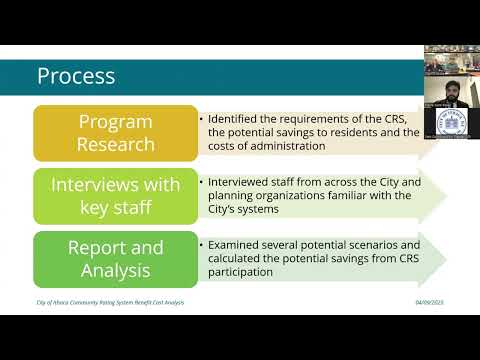
City staff and a consultant reviewed the new FEMA flood maps and performed a benefit–cost analysis to compare the city’s administrative costs against projected savings to policyholders. The presentation noted FEMA’s new maps expand the number of residential properties in the floodplain from about 100 on the old maps to roughly 750 on the 2025 maps — an increase of roughly 650 properties added to the mapped floodplain. Staff used FEMA’s estimate of about $1,800 annually for federal flood-insurance premiums in the local ZIP code as a baseline; third-party estimates vary widely, up to $2,000–$5,000 for some properties.
The analysis found Ithaca already performs a number of CRS activities and could likely apply immediately for a low tier (class 9 or class 8), which generally yields a 5–10% discount for federal policies. With existing practices the consultant and staff estimated the city could plausibly reach class 8 (about a 10% reduction). If the city adopted additional, feasible activities it might reach class 6; the analysis concluded higher CRS classes were not feasible under current local conditions.
Staff modeled two scenarios over a 20-year period. In a scenario that assumes the flood-mitigation project does not remove significant parcels from the floodplain, the citywide reduction in premiums for policyholders could total about $1.5 million over 20 years (savings received by policyholders, not the city). By contrast, a scenario in which the city’s flood-mitigation project removes 75% of affected properties from the floodplain would reduce the number of policyholders eligible for CRS discounts and, in the staff model, could produce a net loss when comparing city administrative costs against smaller aggregate savings.
Sam summarized the trade-off: the CRS yields per-policy discounts, but the fewer policies that exist after successful mitigation, the smaller the citywide aggregate savings. He also noted CRS participation requires an application, annual reporting, and a five-year recertification, and that administering the program will require ongoing staff time. Staff modeled the workload as part‑time (ranging from roughly a quarter-time to a half‑time effort depending on whether the city only applies with current practices or pursues higher classes that require cross-department coordination).
Councilmembers asked for additional detail and next steps. Councilmember Preston Litterman thanked staff and said, “I love a good cost benefit analysis,” then asked how much extra staff time and money would be required to reach higher discount tiers; staff said that would require more targeted interviews and planning. Councilmember Alderson Brown asked whether pursuing CRS remains sensible if FEMA funding or programs were reduced; Brown asked, “why are we even going through… why we’re not looking at other avenues,” prompting staff to confirm that CRS is a FEMA program but that other structural or grant‑funded interventions could be pursued in parallel.
Staff recommended two immediate options: (1) pursue CRS application at the level supported by current practices (apply for class 9 or 8), assigning part‑time staff to compile the application and manage annual reporting; and (2) pursue targeted mitigation or regulatory activities that could generate additional CRS points over time, recognizing many of the higher‑value activities (for example, large open‑space preservation or highly restrictive development controls) were not feasible in the city’s assessment. Staff also offered to share the underlying spreadsheet and consultant report used for the analysis so councilmembers could review the full list of current and potential CRS activities.
The presentation noted several clarifying technical points: federal flood insurance caps building coverage at $250,000; banks may require supplemental private insurance (sometimes called gap coverage) beyond that cap; approximately 70% of parcels currently mapped in the ZIP code buy federal flood insurance (the adoption rate used in the models); and FEMA’s public materials and local GIS mapping are part of the points assessment. Staff also noted that private-market premiums and adoption vary substantially by street and property, which is why the analysis used FEMA’s conservative baseline.
Councilmembers asked about potential cooperative approaches (a consortium of municipalities or pooled purchasing) and whether CRS points are awarded for upstream or watershed-scale actions; staff said the city’s watershed coordinator and county planning department were interviewed and that watershed work is included in the activity inventory. Several councilmembers requested the consultant report and the city’s activity spreadsheet for follow-up.
The meeting closed without a formal decision on whether to apply; staff left the council with options to (a) approve assigning staff time to prepare a CRS application based on current activities and (b) pursue additional policies or projects to attempt higher CRS classes over time.