Get Full Government Meeting Transcripts, Videos, & Alerts Forever!
Get email alerts on the Cdbg topic
No spam. Unsubscribe anytime.
Lancaster County reviews CDBG priorities and eligibility as staff seeks project ideas
Summary
Lancaster County Council heard a public presentation on the county—s Community Development Block Grant needs assessment and discussed potential CDBG projects, including fire apparatus, water/sewer extensions and historic courthouse work.
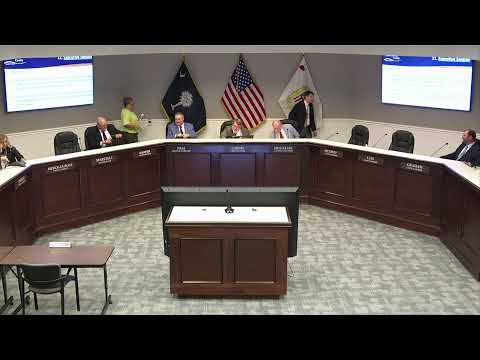
Lancaster County Council heard a public presentation on the county—s Community Development Block Grant (CDBG) needs assessment and funding priorities, then discussed which municipal and county projects could be packaged for upcoming state CDBG rounds.
Elizabeth Morgan of the Catawba Regional Council of Governments reviewed Lancaster County—s citizens participation plan, CDBG eligibility rules and the county—s 2024 prioritized needs list. Morgan said CDBG funds are federal HUD grants administered in South Carolina by the Department of Commerce, Division of Grants Administration, and that only local governments (cities, towns and counties) may apply. She explained projects must meet a national objective (for example, principally benefit low- and moderate-income persons) and be an eligible activity such as water/sewer, streetscapes, infrastructure and certain public facilities.
The presentation outlined application timing: a spring request-and-application schedule with application requests due March 21 and complete applications due April 21, and a fall round with requests due Aug. 15 and applications due Sept. 15. Morgan also reviewed program caps and common project limits, noting the community infrastructure maximum commonly cited is $1,000,000 and that a 10% local match is required; she advised that many project types require evidence that at least 51% of beneficiaries are low- and moderate-income (LMI), which for unincorporated areas typically requires household income surveys.
Why it matters: CDBG awards can pay for water and sewer extensions, demolition and neighborhood revitalization in LMI areas, and are a primary federal resource for local infrastructure and public-facility improvements where municipal budgets are limited.
Council members pressed staff on which projects had been completed and which were active. County staff said the county itself did not currently hold an active CDBG project but that the City of Lancaster is a subrecipient on two projects (a Municipal Justice Park upgrade and Arch Area sidewalk work), and that Kershaw and Heath Springs each have CDBG projects in the region. Staff and Morgan noted several priority sites from the county—s list: the King Circle area, Kershaw Mill area, Dobson School area and Emerald Estates.
Discussion focused on how to make likely projects eligible: councilmembers and staff discussed targeting projects that lie inside HUD-designated LMI census areas (the city of Lancaster and Heath Springs are citywide LMI designations) or else conducting income surveys in non-incorporated areas to document a 51% LMI benefit. Councilmembers asked about candidate projects staff has discussed internally, and staff said possibilities included a fire truck purchase to serve LMI areas, upgrades to the historic courthouse, and an EMS station in Marion/Bonefields. Morgan emphasized that projects such as transportation-related services are more difficult to qualify unless survey data demonstrate that at least 51% of ridership or direct beneficiaries are LMI.
Council members also asked procedural questions about competitive scoring and readiness: Morgan explained the program is competitive statewide, projects that are —ready to go— (environmental review, design and permits completed) are more likely to score well in the —Ready-to-Go— category, and the —Local Priorities— category supports locally defined eligible activities including historic preservation, parks, energy conservation and resiliency projects.
Council direction and next steps: staff invited council members to submit suggested priority lists and told council they could provide updates by the following Wednesday or over the coming week. Staff said they will continue to confirm eligibility questions (for example whether a fire truck serving LMI blocks that also serves non-LMI areas can be eligible) and will bring suggested CDBG application project packages back to council for consideration.
Council members asked staff to consider projects that would relieve concentrated needs in the northern panhandle of the county and to explore pairing county matching funds, in-kind contributions or other local matches to improve competitiveness.
Ending: staff said they will accept council priority lists in the coming days, will continue eligibility work with the Catawba Regional Council of Governments and will present proposed application packages for council review ahead of the spring and fall application deadlines.