Get Full Government Meeting Transcripts, Videos, & Alerts Forever!
Get email alerts on the Tribal Justice Vawa 2022 topic
No spam. Unsubscribe anytime.
Presenters tell Alaska committee VAWA 2022 gives tribes new criminal jurisdiction pathway; speakers cite high rates of violence against Alaska Native women
Summary
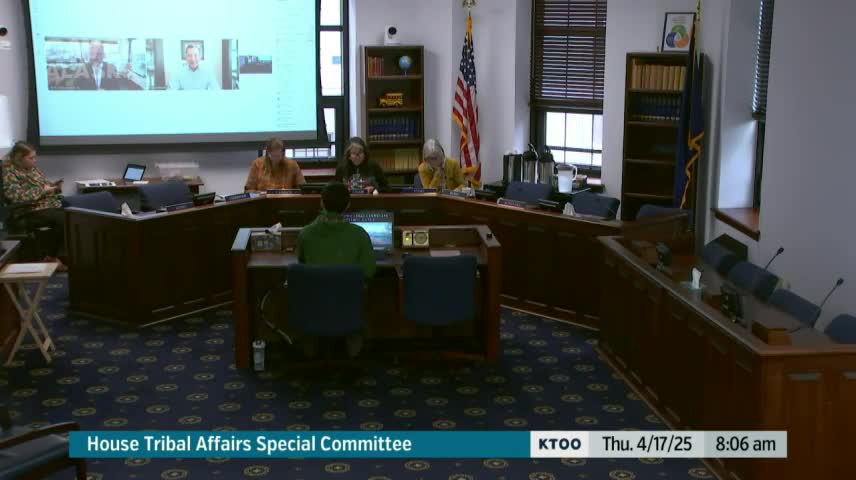
At an April 17, 2025 hearing of the Alaska Legislature Tribal Affairs Committee in Capitol Room 106, Rick Haskins Garcia, director of law and policy for the Alaska Native Women’s Resource Center, and Alex Cleghorn, chief operating officer of the Alaska Native Justice Center, told lawmakers that the Violence Against Women Act reauthorization enacted in 2022 affirms tribal authority in village territory and creates a pilot pathway for Alaska tribes to exercise criminal jurisdiction over certain non‑native offenders.
At an April 17, 2025 hearing of the Alaska Legislature Tribal Affairs Committee in Capitol Room 106, Rick Haskins Garcia, director of law and policy for the Alaska Native Women’s Resource Center, and Alex Cleghorn, chief operating officer of the Alaska Native Justice Center, told lawmakers that the Violence Against Women Act reauthorization enacted in 2022 affirms tribal authority in village territory and creates a pilot pathway for Alaska tribes to exercise criminal jurisdiction over certain non‑native offenders.
The presenters framed the change as part of a broader effort to restore tribal justice systems and address exceedingly high rates of violence against Alaska Native women. "Alaska is experiencing a prolonged epidemic of deadly violence against all women," Haskins Garcia said, citing research from the Violence Policy Center showing Alaska had the nation’s highest female homicide rate in 2020. He told the committee Alaska’s rate in 2020 was about 3.43 per 100,000 women, compared with a U.S. rate of 1.34, and said American Indian and Alaska Native women in Alaska experienced a rate of 12.63 per 100,000 in 2020.
Why it matters: Haskins Garcia and Cleghorn said geographic isolation, limited local law enforcement, communications gaps and overlapping jurisdictions have left many rural communities without timely accountability. "More than 40% of all federally recognized tribes live in Alaska — 229 of 574 —" Haskins Garcia said, adding that local authority could shorten response times and allow culturally specific, restorative approaches to justice.
The presenters placed the VAWA changes in historical context. Haskins Garcia described the long‑term effects of colonization, the Russian and U.S. imposition of non‑tribal legal systems and U.S. Supreme Court decisions such as Oliphant v. Suquamish (1978), which the presenters said restricted tribal criminal jurisdiction over non‑Indian offenders. Cleghorn summarized the statutory developments that followed, describing a timeline that included Public Law 280, the Alaska Native Claims Settlement Act (ANCSA), John v. Baker (Alaska Supreme Court, 1999), earlier VAWA pilot projects for lower‑48 tribes (2013) and the 2022 reauthorization that explicitly included Alaska.
"Congress is not giving anything," Cleghorn read from the 2022 law. "It’s recognizing and affirming the inherent authority of Alaska tribes occupying a village to exercise criminal and civil jurisdiction over all native people in the village." He emphasized that VAWA 2022 does not create ‘‘Indian country’’ as a new land category in Alaska but recognizes village territory for purposes of tribal authority and establishes procedural standards tribes must meet to exercise special criminal jurisdiction over non‑native perpetrators for specified violent crimes.
Cleghorn and Haskins Garcia described the procedural safeguards required by the VAWA pilot: publicized tribal criminal laws, recorded proceedings, availability of licensed defense counsel for indigent defendants, trained tribal judges, the offer of jury trials, and the right for a non‑Indian defendant to seek habeas review in federal court. They said those standards are intended to protect defendants’ rights while allowing tribes to prosecute a defined set of violent offenses under tribal law.
Committee members asked about implementation and outcomes. Haskins Garcia and Cleghorn said Alaska needs Alaska‑specific technical assistance and that the Department of Justice has supported an Alaska intertribal working group (ITWIG) to share peer technical support. Cleghorn said the Alaska Native Justice Center leads the Alaska ITWIG with partners including the Alaska Native Women’s Resource Center, Tanana Chiefs, ABCP and the University of Alaska Fairbanks. He said the first two Alaska tribes admitted to the VAWA pilot project tracks were Chickaloon Native Village and the Native Village of Dot Lake and that the Central Council of Tlingit & Haida and Kake Tribal Association (as noted by presenters) also signed up for track‑2 participation.
Both presenters highlighted examples of tribal restorative and diversion practices. Haskins Garcia pointed to ongoing tribal court programs that prioritize restoration and community healing, and representatives referenced a juvenile diversion partnership in Juneau between Tlingit & Haida and state juvenile services as a locally noted example.
Several committee members also asked for follow‑up data: how many tribes in the lower 48 have used the VAWA pilot path to prosecute non‑native suspects and how many non‑native offenders had been prosecuted under tribal jurisdiction. Cleghorn said he did not have a complete count in the hearing but offered to supply that information after the session. Haskins Garcia agreed to follow up on questions about year‑to‑year variations in homicide rates.
The presentation closed with committee appreciation and announcements that the committee would hear Chickaloon Native Village at a future meeting and that the group expected continued conversations on tribal governance and courts. Haskins Garcia and Cleghorn urged further legislative and administrative attention to funding, cross‑jurisdiction coordination and Alaska‑specific training to support tribes seeking to exercise new authorities under VAWA 2022.
Ending: The presenters asked for additional committee engagement and offered to return with more detailed information; the committee adjourned after brief housekeeping and scheduling remarks.