Get Full Government Meeting Transcripts, Videos, & Alerts Forever!
Get email alerts on the Budget Tax Rate Fund Balance topic
No spam. Unsubscribe anytime.
Lewiston council debates using fund balance, TIF for $400,000 homeless shelter request as tax-rate talks continue
Summary
Councilors at a Lewiston budget workshop debated whether to set a target tax rate or use portions of the city's fund balance and TIF to lower the proposed tax increase; staff will re-run line-item analyses and return with updated recommendations.
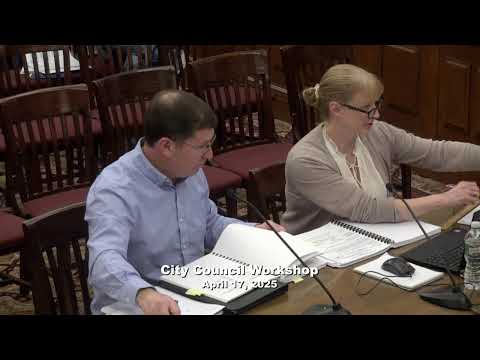
Lewiston's City Council spent the bulk of a budget workshop debating whether to set a target tax rate for fiscal 2026 or instead use fund balance and other one-time resources to reduce the proposed increase.
The discussion matters because the city is currently showing a 4.06% overall tax increase (a total tax rate of $1.29 per $1,000 of assessed value) and a city-only portion of 79 cents; councilors differed on whether to draw down reserves or hold the line and revisit line items. "We're here to talk about the budget," Mayor said as the meeting resumed from an earlier executive session, and then asked colleagues how they wanted to proceed. "We're at 4.06 right now?" the mayor asked; Director Roy confirmed the figure and that it corresponds to a $1.29 total tax rate.
Councilor Gallant urged a clear, consumer-facing number rather than a percentage, saying, "I'd like to see a number, 97'¢," to help residents understand the impact on individual tax bills. Gallant also asked that $40,000 for a public-works training/garage program and support for a homeless shelter be reconsidered for restoration. Several councilors pushed back on using one-time funds for recurring operating expenses.
Councilor Nejean and Councilor Herman both warned that dipping into fund balance to cover recurring operations would require the city to make up the shortfall next year. Herman said the city is "not anywhere near a cliff," noting unfilled positions and unfinished projects will return some dollars to reserves on July 1, but urged caution about treating reserves as an ongoing revenue source.
Director Roy, the city's finance director, told councilors she had already moved items that could reasonably be paid from fund balance onto the fund-balance list and proposed to take another pass on the budget using third-quarter financials. "I would prefer going back and looking at every single line and seeing if there's anything I can reduce instead of using fund balance," she said, and offered to return with updated line-item suggestions on Tuesday.
A central unresolved request in the workshop was a $400,000 ask to help start a homeless shelter. Nate Libby, the city's director of economic and community development, advised the council that some TIF (tax increment financing) dollars and the assessor's May valuation could change the calculus: "I think we'll have greater clarity in the May on the exact number that will hit the tax rolls for 04/01/2025," Libby told the council, and he recommended underwriting the shelter operator before committing TIF funds. Director Roy confirmed council could appropriate fund-balance money later in the year if the council preferred to reserve it now and allocate later.
Councilors debated concrete reserve levels. The budget packet proposed a 10% general-fund reserve target, up from slightly under 9% the prior year. Staff said lowering reserves to 9% would free roughly $1,792,500; council discussion included a narrower reduction to 9.5% (about $850,000) as a compromise. One councilor proposed earmarking $400,000 of fund balance for the shelter and another $400,000 to reduce the city portion of the tax increase from 79'¢ to about 60'¢.
Credit-rating context featured in the discussion. Staff who participate in S&P conversations warned that rating agencies watch volatility in reserves and will factor sustained draws below policy levels into future ratings. As one staff member read from a recent S&P memo: rating agencies consider whether a municipality "will likely maintain very strong cash reserves through balanced operations" and could downgrade if reserves are consistently drawn down.
Other budget items discussed but not decided included municipal LCIP (capital) projects, potential one-time software costs of $13,009.16 that Director Roy flagged as movable to fund balance, and whether some maintenance lines (building repairs, supplies) could reasonably be treated as one-time in the short term. The council asked staff to return with updated estimates and suggested candidates for reclassification before the next meeting.
No new tax-rate target was formally adopted at the workshop. Instead, the council signaled it would begin from the current 4.06% figure and the corresponding $1.29 total/$0.79 city portion while staff performs a fresh review. Director Roy said she would revisit third-quarter financials and return Tuesday with line-item recommendations.
The meeting also produced a formal procedural vote earlier in the evening to enter executive session under state law to discuss real-estate negotiations; council later resumed open session and launched the budget discussion.
Looking ahead, councilors asked staff for updated detail on fund-balance sensitivity, a formal underwriting approach for any TIF grant to a shelter operator, and a prioritized list of candidate reductions or reclassifications staff could present at the next meeting.