Get Full Government Meeting Transcripts, Videos, & Alerts Forever!
Get email alerts on the Broadband Broadband Deployment topic
No spam. Unsubscribe anytime.
Council approves use of Sebring right-of-way for county-backed broadband project funded with $4.5 million in ARPA dollars
Summary
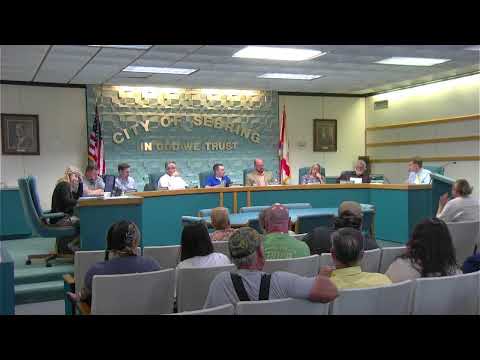
The City of Sebring City Council on April 15 approved a request from Highlands County to use city right-of-way for a county-funded broadband build that uses $4.5 million in ARPA funds.
The City of Sebring City Council on April 15 approved a request to use city right-of-way for a Highlands County broadband project funded with $4.5 million in American Rescue Plan Act (ARPA) dollars. County staff and contractors told council the project will connect two county buildings to dark fiber and extend service to nearby downtown residences and businesses.
Sarah Beth Murphy, executive manager of business and economic development for the Highlands County Board of County Commissioners, told council the county allocated $4.5 million in ARPA funds for broadband in Highlands County and that IBT Group USA won the county contract and has subcontracted construction to PCS Fiber. The project footprint includes downtown Sebring as part of a county-wide feasibility study completed in 2021.
Contractors described the installation methods: buried fiber in conduit using directional boring for long runs, minimal open trenching in non-paved areas, and microtrenching in the most congested portions of downtown (the Wall Street area and the outer edge of the downtown circle). Presenters said microtrenching typically uses a narrow slot — roughly three-quarters of an inch — cut into pavement, with conduit placed and the slot filled and sealed; project staff said they prefer conduit placed about 12 inches deep and no deeper than 18 inches where feasible.
Rick Arnold of PCS Fiber and Brooke Swint (project lead) said microtrenching limits disruption in areas with tight utility congestion and that crews use vacuum collection of spoils and rolling work patterns to avoid long blockages. The project team estimated typical microtrench/directional-bore production in unconstrained environments at up to 2,500 feet per day but said downtown Sebring would be slower.
A resident, Mercedes Munoz, asked whether the work would interfere with access to apartments and alley parking behind downtown properties. Project staff said crews plan a rolling work pattern that they described as minimally disruptive and that they would notify adjacent property owners in advance of when crews would be working in a given alley slice.
Murphy said the county has a deadline to spend the ARPA dollars by the end of 2026. Presenters said IBT Group USA (the county’s awarded provider) will offer residential and business service plans after activation; specific commercial rates were not finalized at the council meeting.
Council voted to approve the use-of-right-of-way request as presented. Staff said the permit application process will proceed and the county and contractors plan to coordinate restoration and scheduling with the city and property owners.
The vote authorizes the county-contracted team to apply for utility permits and to use city right-of-way under the conditions described in the presentation.