Get Full Government Meeting Transcripts, Videos, & Alerts Forever!
Get email alerts on the Pension Investments topic
No spam. Unsubscribe anytime.
Glynn County investment adviser recommends holding equity positions amid tariff-driven volatility
Summary
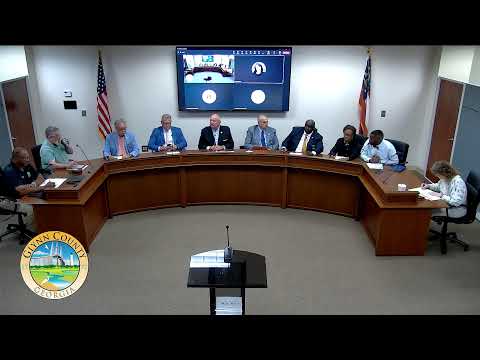
At the April 17 Glynn County Pension Committee meeting, Bowen, Haines and Company reviewed the pension fund's quarterly performance, noted recent tariff-driven market volatility and advised maintaining a domestic-equity tilt while incrementally using cash for select purchases.
David, an investment adviser with Bowen, Haines and Company, told the Glynn County Pension Committee on April 17 that the firm's recommendation is to "stay equities, stay more domestic" and to avoid market timing despite recent tariff-driven volatility.
The firm presented the fund's quarterly profile and holdings, showing a mix of stocks, bonds and cash and describing recent trades and sector performance. "We manage 4 and a half billion dollars ... our decision right now is to stay equities, stay more domestic," David said, adding that pension money is long term and the board should avoid short-term market timing.
Why it matters: The pension fund's returns affect long-term solvency and benefit payments for retirees. Committee members heard that the fund has returned strong multi-year performance but has registered a down period early in the current fiscal year, and managers outlined the rationale for remaining invested.
Bowen, Haines reported portfolio composition and recent activity. David said the portfolio includes about $32,000,000 in corporate bonds and roughly $97,000,000 in stocks, with cash of approximately $1,000,000 available to deploy. He noted bond purchases with coupons near 5 percent and highlighted an upcoming AbbVie corporate bond maturity that will produce roughly $500,000 in principal return. David said recent purchases included defensive and cyclical names and that the firm had "bought a little bit" in several names as opportunities arose.
The investment adviser reviewed specific securities and performance drivers. David said Eli Lilly and Company announced positive phase-3 data for a diabetes/obesity drug and that the fund's position produced about a $500,000 gain on that day. He also mentioned newer positions such as Rolls-Royce, and names the firm is monitoring including Tesla and KKR. He noted holdings in smaller names such as Badger Meter and a short-term position in a Canadian precious-metals licensing firm that had rallied since purchase.
David tied recent volatility to trade policy, saying tariffs created significant uncertainty and that the market reacted when tariff talks paused. "The tariffs were pushed out 90 days. A little bit [of] uncertainty went away. Market liked it," he said, describing swings in major indexes during that period.
On performance, David provided multi-year context: he said the plan's five-year annualized return is near 9.78 percent and that the fund's longer-term objective is a 7 percent target (a "bogey" referenced during the presentation). He acknowledged the current fiscal-year drop early in the year but said the plan remains substantially funded compared with six years ago, when the fund was about $93,000,000 at the time the adviser was hired.
Committee members asked questions about who benefits when markets fall and whether the fund holds specific local employers' securities. A committee member asked "If we're losing money, who's making money?" David explained that when stocks fall, most long shareholders lose value and only those shorting stocks or holding hedges would profit. A commissioner asked about indirect exposure to General Dynamics through Rolls-Royce's engine business; David replied the fund's Rolls-Royce position provides indirect exposure to Gulfstream engines because Rolls-Royce supplies roughly half of those engines.
The adviser framed the strategy as defensive but long-term: maintain equity exposure, add selectively from the $1 million in cash if appropriate, and rely on a blend of stocks and bonds to approach the plan's return target. "This is a 40, 50 year plan. So it's long, long term and so we're not going to get super defensive," David said.
The committee did not take any formal votes during the presentation; discussion was a briefing and Q&A with the investment adviser.
Looking ahead, the adviser said he expects market clarity to improve as trade negotiations progress and geopolitical risks evolve. He encouraged the committee to review quarterly reports and reiterated that the firm will continue to monitor holdings and rebalance as necessary.
Sources: Presentation and remarks by David of Bowen, Haines and Company at the April 17, 2025 Glynn County Pension Committee meeting.