Get Full Government Meeting Transcripts, Videos, & Alerts Forever!
Get email alerts on the Zoning Pheasant Caf O topic
No spam. Unsubscribe anytime.
Joint governing bodies uphold zoning administrator: proposed Vermillion pheasant operation must seek conditional use permit
Summary
At a joint meeting, the Clay County zoning administrator's finding that Patrick Mansour’s proposed pheasant operation near 1700 West Main Street meets the county’s definition of a concentrated animal feeding operation (CAFO) was upheld; the applicant may apply for a conditional use permit (CUP) or abandon the project.
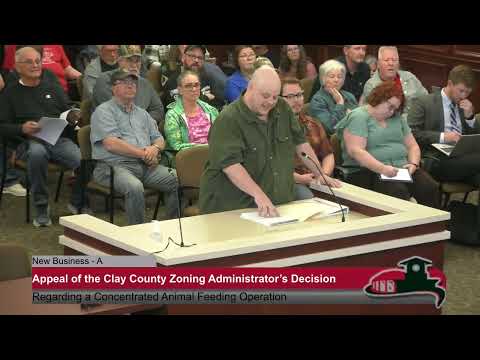
At a joint meeting of the Clay County Commission and the Vermillion City Council, the governing bodies voted to uphold Clay County Zoning Administrator Drew Gunnerson’s decision that a proposed pheasant operation near 1700 West Main Street qualifies as a concentrated animal feeding operation and therefore must apply for a conditional use permit before beginning operations.
Gunnerson summarized his written memo to the governing bodies, saying the county had concluded the proposal met the local definition of a CAFO. "We are here tonight to hear the appeal of my decision that Mr. Mansour's proposed pheasant operation is a concentrated animal feeding operation and would have to apply for a permit before he could commence," Gunnerson said.
The ruling matters because it requires a formal review process — including public notice, a planning-and-zoning hearing and possible permit conditions — before the operation can begin. Supporters of requiring a CUP said the review lets the county evaluate public-health, nuisance and floodplain risks; opponents said the requirement would stop a small local business.
Applicant Patrick Mansour described his plans during the meeting. He said he intended to use the site "for egg purposes" and to build two pens, each about 100,000 square feet, initially housing roughly 5,000 birds. Mansour said he expected to sell birds after the rearing period and that some elements of the operation would be portable to reduce flood risk.
Residents and nearby property owners raised a range of concerns during public comment. Suzanne Skirm, who gave an address in Vermillion, said the Vermillion River floodplain and existing pollution were a worry: "The Vermillion River is already so polluted that we can't swim in it," she said, and she argued the operation could add more pollution. Sandy Peterson cited recent highly publicized avian influenza outbreaks and said she was concerned about locating a large bird operation close to town. Todd Beckley, who said he had worked on confined livestock operations, told the bodies, "They stink," expressing concern about odor and other impacts.
Officials and attorneys at the meeting discussed two technical questions that shaped the decision: (1) whether pheasants are a species the state treats as requiring CAFO permitting and (2) how the county's zoning thresholds interact with state and federal rules. Meeting participants noted that federal and state guidance sets a 45‑day threshold for temporary confinement in certain definitions (the county’s ordinance had language referencing 90 days); the bodies emphasized they cannot adopt standards less restrictive than state or federal law but can be more restrictive on other points. County staff advised that if the county classifies the operation as a CAFO, the state could become involved in compliance enforcement.
Councilors also debated how to translate the county's numeric thresholds for different bird species to pheasants. Gunnerson and several councilors described how the county uses species-specific tables: classified as equivalent to ducks, Mansour’s stated 5,000 birds would cross the threshold into a large CAFO, which is prohibited in the joint jurisdiction zone; if treated as poultry/chickens or a dry-manure system, the operation’s size and manure-management approach could change the permit pathway. Officials said those classification details would be resolved through the CUP process if Mansour files an application.
After deliberation, an official motion to uphold the zoning administrator’s CUP requirement was made and seconded; the motion carried. The governing bodies did not state a final numeric vote tally in the meeting record excerpt provided, but the chair announced that the motion passed and that the conditional use permit requirement applies to the proposed operation.
The applicant was told that his practical options are (a) to apply for a conditional use permit and pursue the required planning review or (b) to abandon the proposal. Several councilors said the CUP process does not foreclose an applicant’s ability to present mitigation measures but does create a formal forum for neighbors, staff and elected officials to examine manure handling, flood mitigation and other concerns.
What’s next: Mansour may file for a conditional use permit; if he does, the county’s planning procedures would set notice, hearing and appeal steps. The county staff and councilors discussed how the permit application would need to address manure management, confinement duration, floodplain safeguards and infrastructure (power, temporary buildings for storage), but no final permit conditions were set at the meeting.
Ending: By upholding the zoning administrator’s determination, the two governing bodies deferred the project’s future to the conditional use review process; neighbors who testified said they would monitor any application and planned to present technical and nuisance concerns during that later review.