Get Full Government Meeting Transcripts, Videos, & Alerts Forever!
Get email alerts on the Short Term Rentals topic
No spam. Unsubscribe anytime.
Hot Springs debate fails to expand short‑term rental cap for permanently disabled veterans
Summary
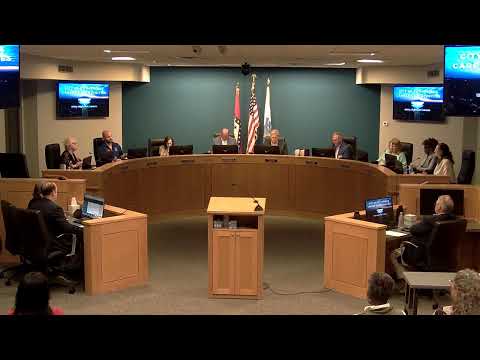
The Hot Springs Board of Directors debated an ordinance that would have added 25 short‑term rental licenses reserved for U.S. veterans with service‑connected permanent and total disability ratings. After debate and failed amendments, the ordinance did not pass on a 3‑3 vote.
The Hot Springs Board of Directors on April 15 considered Ordinance O‑25‑13, a proposal to amend Ordinance No. 64‑54 (Hot Springs Code §16.10.2) to create an exception to the 400‑license cap on short‑term residential rentals by reserving up to 25 additional licenses for U.S. veterans with service‑connected permanent and total disability ratings.
Supporters said the measure would help disabled veterans access housing income; opponents warned it would reopen pressure on the city’s long‑term rental supply and asked for other ways to assist veterans without raising the cap. After debate and several failed amendment attempts, the board deadlocked 3‑3 on final adoption and the ordinance failed.
City Attorney Bridal Albright summarized the proposal for the board, saying it would keep the existing 400‑license cap for residential zones and create an additional pool of 25 licenses available only to veterans who submit a Department of Veterans Affairs letter showing a service‑connected permanent and total disability rating. “With respect to disabled veterans, this would provide for an additional 25 licenses that would be available to those U.S. veterans that have a service connected permanent total disability rating,” Albright said during the staff report.
Director Karen Garcia moved to delete the section that would create the 25‑license exception; Director Erin Holliday seconded the motion. Garcia told the board she had heard from constituents “that are overwhelmingly against raising the cap” and argued the city’s stated goal of increasing affordable long‑term housing could be undermined if more short‑term units returned to the market. Several board members raised alternatives, including offering non‑licensing forms of support for veterans such as targeted resource or housing programs.
Jacqueline Fleming of District 4, the lone member of the public to speak on the item, addressed the board in favor of the ordinance: “I just wanted to take a moment to come up here and say thank you all for giving this topic the time of day,” she said.
Director Dudley Webb, who moved for adoption, and other supporters argued the additional licenses would be a modest, targeted accommodation. Webb cited staff data presented in the meeting showing 399 active residential short‑term rental licenses had been renewed so far this year and said the additional 25 licenses would represent a small portion of the city’s veteran population: “Here in Hot Springs, there are 2,500 veterans here in Hot Springs. Out of that 2,500 veterans here in Hot Springs, it is estimated that there are between 4 and 600 who are disabled,” he said, and argued the change would help some veterans avoid falling below the poverty line.
Board members questioned the scope and precedent of creating a category limited to one group. Director Phyllis Beard asked whether the city should set written criteria for appointments and positions generally; Director Garcia and Director Erin Holliday said they support veterans but preferred other forms of assistance rather than raising the licensing cap. Directors also debated whether a smaller number than 25 might address concerns; an effort to amend the ordinance to reduce the 25 to five failed for lack of a second.
The board took a final roll‑call vote on the ordinance after debate. The result was three votes in favor (Director Dudley Webb, Director Phyllis Beard, and Mayor Pat McCabe) and three votes opposed (Director Karen Garcia, Director Steve Trustee, and Director Erin Holliday), producing a 3‑3 tie. The ordinance therefore failed to pass. The transcript records that one director announced a recusal earlier in the item; the meeting proceeded with six voting members present.
The short‑term rental licensing cap and its exceptions remain as codified at Hot Springs Code §16.10.2 and Ordinance No. 64‑54. Board members again suggested staff pursue alternatives to support veterans — for example resource‑center referrals, fee waivers, or other programs — rather than changing the cap immediately.
The Board moved on to other agenda items after the vote; no further action on O‑25‑13 was recorded at the April 15 meeting.
Votes at a glance: Ordinance O‑25‑13 — Amend Ordinance No. 64‑54 to add up to 25 short‑term rental licenses for U.S. veterans with service‑connected permanent and total disability ratings. Final vote: failed, 3 yes, 3 no (recusal recorded earlier).