Get Full Government Meeting Transcripts, Videos, & Alerts Forever!
Get email alerts on the Tax Policy topic
No spam. Unsubscribe anytime.
Proposed B&O tax changes draw wide support and opposition over scale and scope
Summary
A proposed substitute to SB 5815 would raise core B&O tax rates, expand surcharges on advanced computing and financial institutions, add a top‑tier surcharge and limit an investment‑income deduction; staff estimated multi‑billion dollar revenue gains while industry groups warned of steep effective increases.
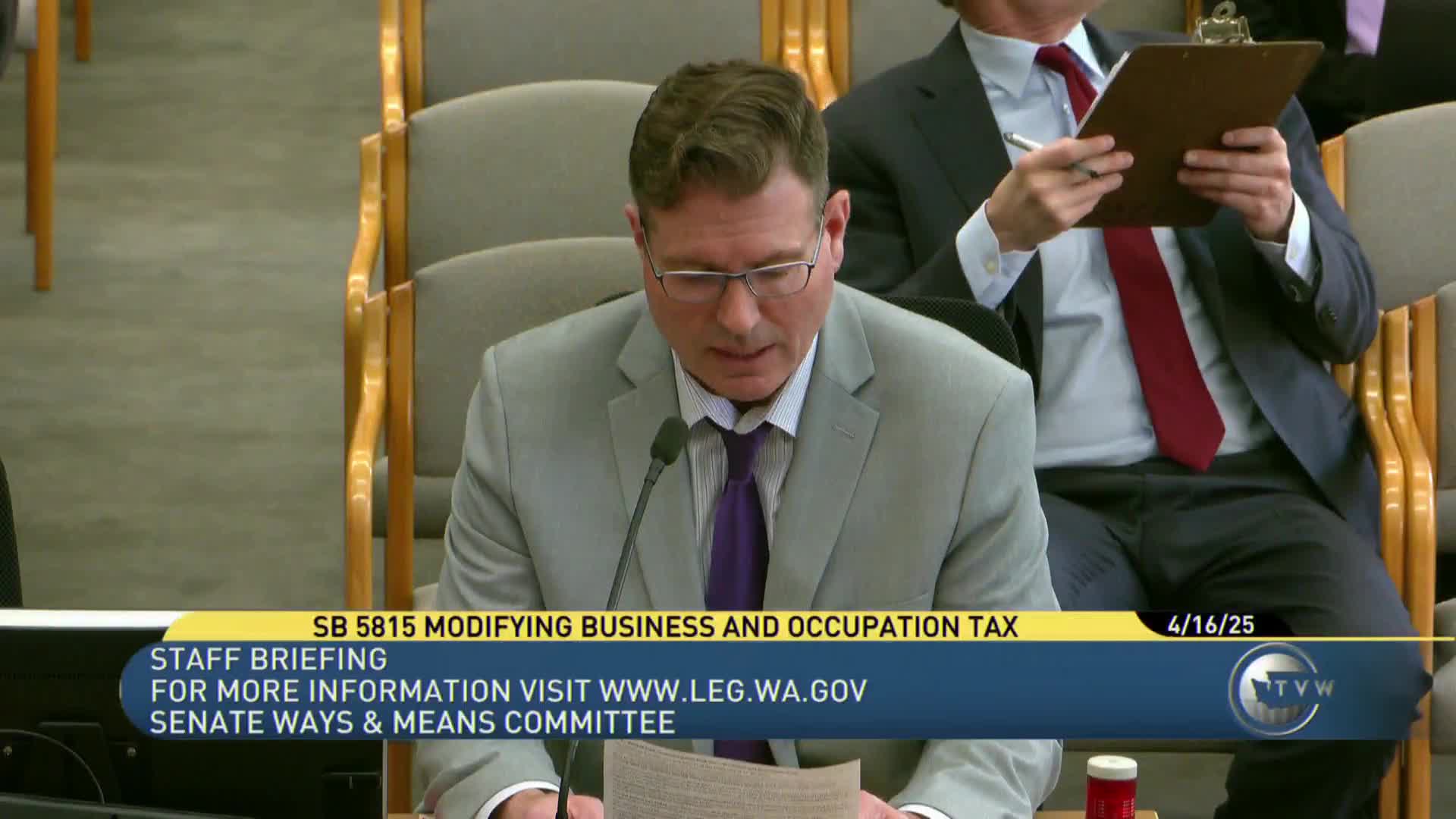
Senate Bill 5815, in a proposed substitute, would change Washington’s business & occupation (B&O) tax structure by increasing base rates for major B&O classifications, expanding and raising certain surcharges, and limiting an investment‑income deduction to incidental income, Ways & Means staff told the committee at a briefing on April 16.
Staff explained four main components: modest increases to base B&O rates for retailing and manufacturing; an increase to the financial‑institution surcharge and a substantially larger increase to the advanced‑computing surcharge (with a cap raised from $9 million to $50 million); creation of an additional 0.5% surcharge on taxpayers with more than $250 million in Washington taxable income applying to amounts above that threshold (with enumerated exemptions); and codifying the Antioch/Anteo court interpretation so the investment‑income deduction applies only when investment income is incidental to the main business (with exceptions for nonprofits and collective investment vehicles).
Jeff Mitchell, committee staff, presented the fiscal estimate: a multi‑year revenue impact in the billions of dollars (staff estimated about $6.4 billion over four years, with about $5.2 billion to the general fund). Supporters at the hearing said the changes would create progressive revenue to protect services, higher education and safety‑net programs. Speakers in favor included higher‑education representatives who supported increases to the advanced‑computing surcharge, labor groups, anti‑poverty organizations and nonprofits concerned about an Anteo clarification.
Opposition was strong from industry groups that would face large percentage increases in rates under the substitute. Bankers, healthcare providers, pharmacists, retailers, contractors, distributors and hospital associations urged the committee to reconsider, saying the effective rate increases in some categories exceed 100% and would drive up prices, reduce investment, and harm small and mid‑sized businesses. Specific concerns included impacts to pharmacies and hospitals, the effect on fuel wholesaling and retailing, and the competitiveness of Washington’s tax climate. Several witnesses asked for carve‑outs or mitigation for small businesses and for sectors with thin profit margins.
Staff and witnesses also discussed the legal and administrative effects of narrowing the investment‑income deduction after a state supreme‑court decision. Nonprofit organizations asked for explicit clarifications and exemptions to avoid unintended tax liability for endowments or reserves.
Why it matters: Staff projected substantial revenue increases, but the policy raises distributional and competitiveness questions. The bill would touch many sectors and prompted immediate requests for carve‑outs, clarifications, and offsets for small businesses and health‑care providers.
The committee accepted oral and written testimony and asked stakeholders to submit technical language and suggested amendments for committee consideration.