Get Full Government Meeting Transcripts, Videos, & Alerts Forever!
Mayor’s office outlines overhaul of boards and commissions, proposes membership, transparency and attendance changes
Summary
A mayor’s office working group presented recommendations to the Rules, Confirmations & Public Elections Committee to standardize board sizes and terms, tighten attendance rules, and offer guidance on councilmember participation; council legislation implementing parts of the plan has advanced in recent votes.
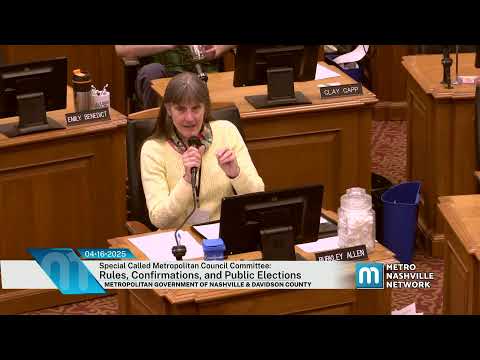
Metro Nashville’s mayoral working group presented a package of recommendations to the Rules, Confirmations & Public Elections Committee on Wednesday aimed at strengthening the city’s more than 80 boards, commissions and advisory bodies.
Dave Rosenberg of the mayor’s office told the committee that boards and commissions — “in so many ways a volunteer run government” — vary widely in size, term structure, staffing and transparency and that the mayor asked for a review “to strengthen boards and commissions in the areas of structure, operations, support, and transparency.”
The working group’s structural recommendations include standardizing typical membership to seven to nine seats with flexibility up to 11; fixing term-clustering so staggered terms behave as intended; adjusting quorum rules where membership changes require them; renaming a difficult-to-fill body to the Board of Licensing for Adult Entertainment and Safety; and developing uniform posting and meeting practices to increase transparency. Rosenberg said the effort also recommended criteria for when a Metro Council member could serve on a board in a nonvoting capacity and suggested a 24-month sunset for point-in-time inclusions.
Why it matters: Metro depends on roughly 800 volunteer members across more than 82 boards and commissions to deliver programs and advise departments. The administration says inconsistent rules, outdated code language and uneven support have hampered some bodies’ effectiveness. Standardizing structure and improving training and posting could change…
Already have an account? Log in
Subscribe to keep reading
Unlock the rest of this article — and every article on Citizen Portal.
- Unlimited articles
- AI-powered breakdowns of topics, speakers, decisions, and budgets
- Instant alerts when your location has a new meeting
- Follow topics and more locations
- 1,000 AI Insights / month, plus AI Chat