Get Full Government Meeting Transcripts, Videos, & Alerts Forever!
Get email alerts on the Boards And Commissions Reform topic
No spam. Unsubscribe anytime.
Mayor’s office outlines overhaul of boards and commissions, proposes membership, transparency and attendance changes
Summary
A mayor’s office working group presented recommendations to the Rules, Confirmations & Public Elections Committee to standardize board sizes and terms, tighten attendance rules, and offer guidance on councilmember participation; council legislation implementing parts of the plan has advanced in recent votes.
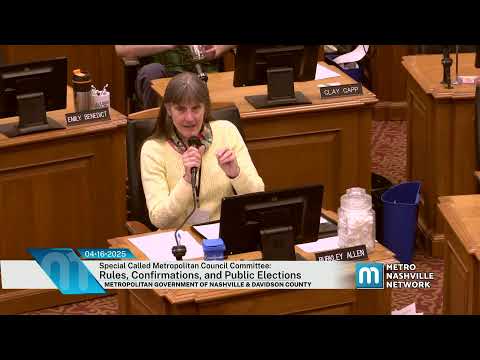
Metro Nashville’s mayoral working group presented a package of recommendations to the Rules, Confirmations & Public Elections Committee on Wednesday aimed at strengthening the city’s more than 80 boards, commissions and advisory bodies.
Dave Rosenberg of the mayor’s office told the committee that boards and commissions — “in so many ways a volunteer run government” — vary widely in size, term structure, staffing and transparency and that the mayor asked for a review “to strengthen boards and commissions in the areas of structure, operations, support, and transparency.”
The working group’s structural recommendations include standardizing typical membership to seven to nine seats with flexibility up to 11; fixing term-clustering so staggered terms behave as intended; adjusting quorum rules where membership changes require them; renaming a difficult-to-fill body to the Board of Licensing for Adult Entertainment and Safety; and developing uniform posting and meeting practices to increase transparency. Rosenberg said the effort also recommended criteria for when a Metro Council member could serve on a board in a nonvoting capacity and suggested a 24-month sunset for point-in-time inclusions.
Why it matters: Metro depends on roughly 800 volunteer members across more than 82 boards and commissions to deliver programs and advise departments. The administration says inconsistent rules, outdated code language and uneven support have hampered some bodies’ effectiveness. Standardizing structure and improving training and posting could change how citizens and officials interact with those bodies.
Key details
- Legislation referenced: Rosenberg said the council has passed about 10 pieces this term affecting boards and commissions and identified BL 2024-582 as a recent ordinance that (1) aligned councilmember participation with the charter by clarifying nonvoting status where required, (2) dissolved inactive “zombie” bodies created only to produce reports, (3) fixed term-clustering so late confirmations do not push subsequent terms forward, and (4) created a council review process for chronically absent members. Rosenberg described BL 2024-582 as already passed by the council.
- Recent votes: Rosenberg said a stormwater management commission bill “was passed as amended on second reading last night,” and that a separate piece of boards-and-commissions legislation had cleared first reading the previous night. He said Entertainment Commission legislation remains in a holding pattern.
- Outreach and survey data: The working group surveyed sitting board members and staff. Rosenberg estimated roughly 200 survey responses out of about 600 email addresses, or about one-third response rate, with wide variation by body. He also said the group did a narrower staff survey of those who work with code-created boards to inform structural recommendations.
- Conflict-of-interest and vetting recommendations: The group provided draft criteria to guide when a councilmember may serve in a nonvoting capacity on an advisory board and urged caution when the board receives direct budget allocations or when council members’ memberships could create a conflict. Rosenberg recommended allowing any councilmember to serve (nonvoting where the charter requires) and suggested sunsetting point-in-time inclusions after 24 months so the council can reassess.
Committee discussion and concerns
Committee members pressed for clearer vetting and disclosure of conflicts of interest on the nominee questionnaire. Vice Chair McCash said nominees often mark “N/A” on conflict questions and recommended more explicit wording so the committee is not surprised at confirmation hearings. Councilmember Allen asked for more precision on the survey response rate; Rosenberg said there were “probably about a third” responses and that newer advisory committees returned more responses than others.
Members also urged attention to minutes, recordings and accessibility. Councilmember Weiner and others urged consistent posting of minutes and better meeting recordings or low-cost transcription tools so the public and council can follow board activity. Chair Evans asked for the MHRC (Metro Human Relations Commission) conciliation file to be shared with the full council; Rosenberg said the conciliation document is a public attachment to the conciliation agreement and can be provided as a PDF.
Rosenberg described the work ahead in three buckets: (1) structural code changes (membership size, term staggering, quorum and names); (2) best practices for operations and transparency including agendas, minutes, video and materials; and (3) new-member training. He said Metro Legal has produced a helpful booklet already and that more operational improvements will be addressed in subsequent phases.
Votes at a glance (as described to the committee)
- BL 2024-582 — described by Rosenberg as passed by council; changes include aligning councilmember participation with the charter (nonvoting where required), dissolving inactive bodies, fixing term-clustering, and creating attendance review procedures. (Details: ordinance reference given as BL 2024-582; vote tally not specified in the meeting.)
- Stormwater management commission bill — described as passed as amended on second reading the previous evening; originated with Metro Water to update representation and correct an outdated commission name in code. (Vote tally not specified.)
- Boards-and-commissions omnibus (unnamed piece) — referenced as having passed first reading the previous evening; final action pending. (Vote tally not specified.)
What the committee asked next
Committee members requested: clearer, more specific vetting questions on conflicts; wider distribution of training materials to nominees before confirmations; public copies of the MHRC conciliation materials; and continued updates from Rosenberg’s group as operational recommendations and technical code edits are drafted. Rosenberg said the group will continue to provide materials to the committee and invited feedback.
Ending
Rosenberg closed by asking committee members to share ideas and criticisms and offered to provide follow-up materials; the committee adjourned after members thanked staff for the update.