Get Full Government Meeting Transcripts, Videos, & Alerts Forever!
Get email alerts on the Nuisance Ordinance Amendment topic
No spam. Unsubscribe anytime.
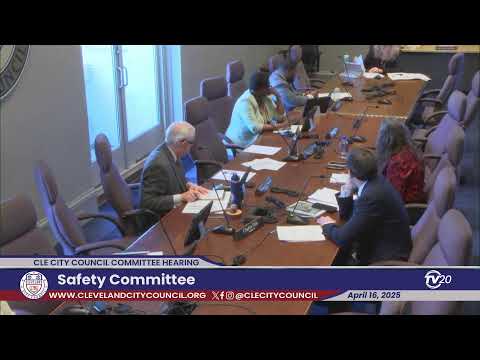
Council committee amends criminal-nuisance ordinance, mandates abatement plans and sets new fines
Summary
The Safety & Justice Committee approved ordinance 228-2025 with amendments that make abatement plans mandatory after repeated criminal-nuisance activity, impose a $250 fine at nuisance declaration and change the accumulation window from six to 12 months.
Cleveland’s Safety & Justice Committee approved amendments to the city’s criminal-nuisance ordinance that require property owners to submit abatement plans after repeated criminal activity on their properties, create an immediate $250 fine when a property is declared a nuisance and change the accumulation window for nuisance incidents from six months to 12 months.
Ordinance 228-2025, as amended, revises sections 630.01 and 630.02 of the codified ordinances (as amended by ordinance 574-18). Assistant Director Schachner, representing the Department of Public Safety, summarized the administration’s changes and told the committee the revisions are intended to strengthen enforcement tools for “problem properties” where police repeatedly respond.
Under the amended ordinance, the city may declare a property a nuisance after a pattern of criminal-activity calls for service (the committee approved changing the counting period to incidents on separate calendar days within any 12-month period). Once the third qualifying nuisance activity has occurred, the owner must submit an abatement plan to the director of public safety within 10 days; failure to submit the plan triggers a $100-per-day penalty until the plan is filed. At the fourth qualifying incident in the counting window a property is formally declared a nuisance and a $250 fine is imposed immediately; subsequent responses carry escalating fines ($500, $750 and then $1,000 for each additional qualifying call). If fines are not paid they can be submitted to the county and assessed on property tax bills in September, staff said.
Schachner described how the city will document incidents: responses are pulled from the CAD (computer-aided dispatch) record and officers may count probable-cause observations and witness statements rather than relying solely on citations or arrests. “Previously, citations or arrests were necessary for a nuisance declaration. The change allows for no citation or arrests required. It's a probable cause standard,” Schachner said. The department also added “person associated with the property” to the list of actors whose conduct can count toward a nuisance declaration, allowing evidence about trespassers or other non-invitees to be considered.
Staff explained that the ordinance includes due-process protections: investigations are reviewed by a supervising sergeant before a declaration, property owners can appeal to the director of public safety, and there is a further administrative appeal to the Board of Zoning Appeals. Assistant directors told the committee the city will exercise discretion in cases involving elderly homeowners or family members and will coordinate with social-services and housing teams when appropriate.
Council members pressed for stronger enforcement and simpler processes. Several members said the existing ordinance had not been enforced adequately and urged the administration to make enforcement consistent and visible to affected neighborhoods. Councilman Jones, who described repeated nuisance problems in his district, urged a longer oversight period for clearly flagged properties; council members debated options including a 12-month or two-year window for counting incidents. The committee ultimately adopted an amendment replacing references to a six-month counting period with 12 months.
The committee approved ordinance 228-2025 as amended and asked the administration to publicize the enforcement process and reporting channels for residents. Staff reiterated that residents should report nuisances through emergency and nonemergency dispatch lines so incidents generate CAD records the city can use for investigations and potential nuisance declarations.
Votes at a glance: ordinance 228-2025 (amending Codified Ordinances sections 630.01 and 630.02), approved as amended (motion passed in committee; tally not specified).