Get Full Government Meeting Transcripts, Videos, & Alerts Forever!
Get email alerts on the Consent Decree Data Contract topic
No spam. Unsubscribe anytime.
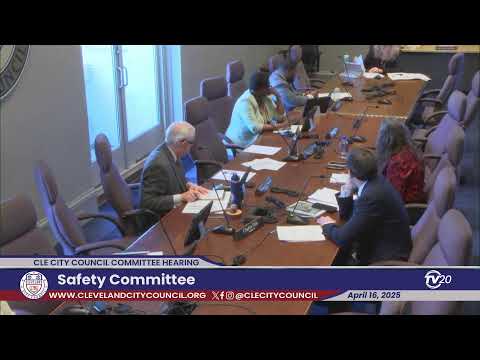
Committee renews Case Western data contract as city says consent-decree reporting remains incomplete
Summary
The Safety & Justice Committee approved renewal of a Case Western Reserve professional-services contract to continue police data collection and analysis tied to the city's federal consent decree while officials told council one paragraph of the decree remains noncompliant and other sections are still being assessed.
The Cleveland City Council Safety & Justice Committee voted to renew a professional-services contract with Case Western Reserve University to continue collecting and analyzing police data tied to the city's federal consent decree, while city officials said one paragraph of the decree remains in noncompliance and additional assessments are pending.
Committee members approved ordinance 330-2025 to renew the contract; the measure was recorded as approved as read. City and Case Western staff described recent public releases of use-of-force and crisis-intervention data and said the teams are working through outstanding data fields and monitoring requests.
The work matters because the consent decree — a court-ordered settlement arising from a Department of Justice investigation — requires regular, documented data collection and public reporting on use of force, crisis intervention and other policing activities. Council members pressed administration and Case Western staff for a timeline to move sections of the decree from “partial” or “noncompliant” to higher compliance ratings and for clearer guidance from the federal monitoring team.
Dr. Rania Issa, who leads the Case Western team, told the committee the data effort has produced public datasets and dashboards and said the work supports the city’s monitoring process. “I can attest to the impactful and effective work that I've seen the data analysis piece. So I think that it's a great return on the investment for the city of Cleveland, specifically within the area of the consent decree,” Issa said.
Officials said the Case Western engagement dates to 2016. Staff and council repeatedly discussed a cluster of consent-decree paragraphs (referred to in the meeting as paragraphs 2.57 through 2.68) that specify how the division must collect and analyze data; committee members and staff singled out paragraph 2.65, which directs an annual assessment and report, as currently listed in the monitoring documents as noncompliant.
Dr. Issa and Dr. Anderson described the city’s work to populate public datasets. Use-of-force and crisis-intervention data have been published on the city’s open data portal, officials said; Issa recounted a six-month investigatory-stops report for 2021 and a full 2022 stop report, and said the teams are working on 2023–24 stop data. Dr. Anderson said some required fields for the investigatory-stop reporting only began collecting in 2021–22, which affects the ability to produce a complete historical annual report for every year since 2016.
The monitoring process and communications with the federal monitor drew repeated questions. City staff said they have requested “paragraph meetings” with the monitoring team — targeted sessions to clarify the monitor’s methodology for judging compliance on discrete consent-decree paragraphs — and that only one such meeting had taken place to date. The city has filed a court motion asking the monitor to explain its methodology so the city can correct specific deficiencies rather than guess at the monitor’s standards.
Director Drummond praised frontline officers while stressing administrative follow-through. “We are doing everything within our power to collect the data so we can put out an annual report,” Drummond said, adding the city’s goal is to produce accurate, reliable reports for monitors and the public.
Committee members pressed for concrete timelines. Staff said the monitoring team already has access to the systems and that the monitor will present publicly before the judge and to council in a scheduled court date; staff said they are coordinating when the monitor will brief council and confirmed the monitor presents to the judge in court (the meeting record cited a court date with Judge Oliver in late April). City officials also said federal technical-assistance resources for one community program had been paused recently by the Department of Justice.
What happens next: the committee approved the contract renewal so the Case Western team can continue data work. City staff said they will press for more paragraph meetings with the monitoring team, continue publishing datasets, and attempt to produce the outstanding annual assessments required by the consent decree.
Votes at a glance: ordinance 330-2025 to renew the Case Western Reserve professional-services contract — approved as read (tally not specified in the committee record).