Get Full Government Meeting Transcripts, Videos, & Alerts Forever!
Get email alerts on the Oral History topic
No spam. Unsubscribe anytime.
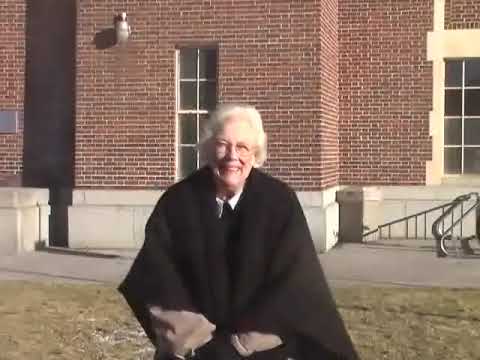
UM alumna Patty Cornishas recalls college life in wartime Missoula
Summary
Patty Cornishas, who attended the University of Montana from 1944 to 1948, described subdued campus life during World War II: limited social events, a strong ROTC presence, shifting gender ratios, a student prank involving a moose head, and tuition about $120 a year.
Patty Cornishas, a University of Montana student from 1944 to 1948, recalled on the Tales of Our Elders TV show that campus life during World War II was subdued, with small dances, a dominant ROTC presence and rapidly changing enrollment ratios.
Her recollections offer a firsthand view of daily life on the Missoula campus during the war years, including costs, student pranks and how the return of servicemen changed campus spirit after 1945.
Cornishas said the campus social scene was “pretty dull” during the war and that “spirit was gone.” She described ROTC cadets who came from California — “a lot of them from San Francisco” — and recalled that in her first year, 1944, “there were twice as many girls as boys,” shifting to parity the next year and then increasing male enrollment thereafter: “in my junior year, there were twice as many boys, and fourth year 3 times as many boys.”
She also described a student prank associated with the Forestry School in which students took a mounted moose head and kept it at her family home until it was returned at the Foresters Ball. Cornishas said Lou Burton, identified in the interview as head of the student body, was involved in that incident.
Cornishas noted the cost of attendance at the time: “tuition was running about a hundred and $20 a year.” She spoke warmly of campus buildings she remembered by their wartime names — Newhall (later Turner Hall) and Main Hall — and of hiking and swimming near Missoula.
She recalled seeing returning students with visible wartime trauma: while studying on the Main Hall steps “an airplane came over and all of a sudden he threw himself down and crouched up, started shaking and moaning, shell shock from World War 2.”
Host Scott Rezvani introduced the interview and asked questions that prompted Cornishas’s memories. The program’s closing narration noted that after graduating Cornishas “worked for 2 years, then married a Montanan man, and raised 7 children,” and that she currently lives in Montana.
Cornishas named several classmates and acquaintances from her years on campus, including Lou Burton, Allen Lewis, Yvonne Bennerby, Maple Ringlings, Ernest Hemmings and a cadet captain she identified as King Kramer. She said some classmates went on to live in San Francisco after graduation.
The interview provides oral-history detail on student life, gender balance fluctuations during wartime, campus traditions sustained or altered by the war and the postwar return of veterans to the University of Montana.