Get Full Government Meeting Transcripts, Videos, & Alerts Forever!
Get email alerts on the Arts Theater Playwriting topic
No spam. Unsubscribe anytime.
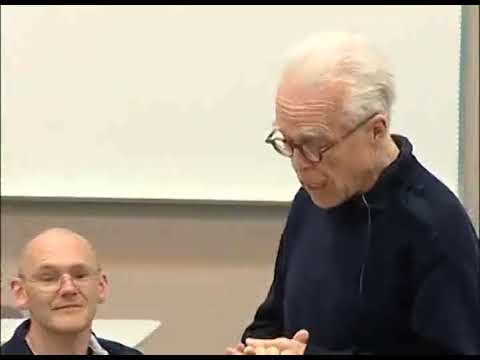
Playwright John Guare on finding subjects, trusting the unconscious and teaching in Missoula talk
Summary
Playwright John Guare told a Missoula audience that his plays grow from life experience and chance, describing how travels, letters and memories sparked works including The House of Blue Leaves and Six Degrees of Separation and summarizing his approach to teaching playwriting.
Playwright John Guare spoke in Missoula (date not specified) about how he finds ideas, his career milestones and his approach to teaching playwriting, telling the audience that much of his work comes from travel, memory and “waiting for your unconscious to deliver.”
Guare said the seeds of major plays often arrive by chance. "I started writing The House of Blue Leaves that day in Cairo," he said, describing a 1965 trip during which newspaper clippings about the pope’s visit to New York prompted the play’s subject. He later described writing Six Degrees of Separation in one intense burst in 1989 after hearing friends’ troubling anecdote and then researching a public figure he referenced in the script.
Why it matters: Guare’s talk gave local students and theatergoers direct insight into the creative process behind American plays staged on major stages. He linked practical instruction about craft to concrete examples from his own work, offering context for current productions and for students studying playwriting.
Guare outlined three recurring lessons from his career: go looking for material, keep working daily, and learn to live with the unpredictable role of the unconscious in the creative process. He recounted early life episodes that shaped him — performing neighborhood plays as a child and receiving a typewriter at age 12 — and described training at Georgetown and the Yale graduate program (he later received a fellowship and taught playwriting). He said a short notebook found years after a hitchhiking trip supplied an opening that eventually fit a later play, underscoring his point about the role of chance and archival fragments in creative work.
On teaching, Guare urged students to discover their own voice rather than imitate fashionable modes of speech. “What you try to teach…is to have them write their own voice, to find out how they are speaking,” he said, advising writers to preserve the parts of themselves that produce authentic material rather than polishing to a public persona.
He also discussed the relationship between comedy and tragedy in contemporary theater, arguing that serious subject matter often needs the energy of comic elements to become fully dramatic. He cited Tony Kushner’s Angels in America as an example of a work that found a fresh expressive form for a devastating subject.
Guare described episodes in the life of a play after it leaves the writer’s desk: directors’ cuts that alter meaning, productions that reframe a playwright’s intent, and reviews that can haunt or free authors. He offered an anecdote about a director who drastically reduced a long script into a successful production and the playwright’s subsequent sense of being misunderstood — a caution about collaboration’s power to transform a text.
Practical details and examples in the talk included: House of Blue Leaves (begun in Cairo in 1965), Six Degrees of Separation (written in 1989), earlier works including Bosoms and Neglect, Landscape of the Body and Musica, and later dramaturgical projects set on Nantucket (Gardenia; later Bullfinch’s Mythology; Women in Water). He referenced workshops and theaters associated with his work, including the Eugene O'Neill Theater Center in Waterford, Conn., Lincoln Center and regional houses such as the Berkshire Theatre Festival and the Mark Taper Forum. Guare noted that Blue Leaves was being staged in Missoula and in Portland, and that a production was planned for Los Angeles.
Quotes in the talk were primarily from Guare and centered on craft and process: “A writer’s life is waiting for your unconscious to deliver,” and “You’ve gotta keep writing and writing and writing,” reflecting his emphasis on persistent daily work and openness to accidental inspiration.
The session ended with a question-and-answer period during which audience members asked about historical inspiration, theatrical tragedy, and how to identify untrustworthy themes in one’s own writing. Guare responded with practical advice — write through the cleverness, then re-read with new eyes — and personal anecdotes from his career.
Local interest: the lecture brought together students and residents and connected the Missoula audience to plays that have circulated nationally. Guare’s remarks emphasized craft and the long arc of a writer’s career rather than policy or institutional decisions.
Guare (identified in the talk as the speaker) was introduced from the stage; several unnamed audience members asked questions during a brief Q&A. No formal votes or policy actions took place at the event.