Get Full Government Meeting Transcripts, Videos, & Alerts Forever!
Get email alerts on the Park Impact Fees topic
No spam. Unsubscribe anytime.
Monroe council reviews update to park impact fees and signals support for bedroom‑based method
Summary
City staff and a consultant outlined a state‑required methodology update to Monroe’s park impact fees, showing proposed per‑unit charges by bedroom count; council members voiced tentative support for using bedroom count rather than square footage and asked staff for follow‑up data.
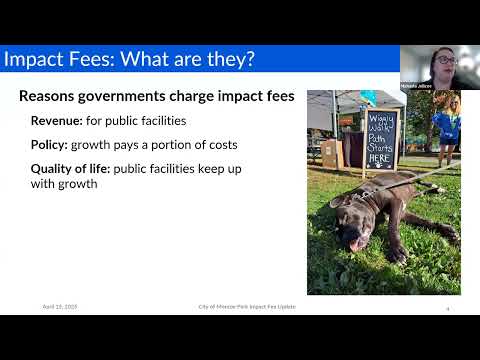
Monroe City Council reviewed proposed amendments to Chapter 3.52 of the Monroe Municipal Code on Tuesday, April 15, 2025, as consultants and staff presented an updated methodology for park impact fees required by recent Washington state changes to the RCW.
The change matters because the state now directs impact fees to reflect the “proportionate impact” of new housing by factors such as bedrooms, trips or square footage; the consultant’s analysis translates the city’s capital plan and population forecast into maximum allowable fees that vary by bedroom count.
Mikayla Jellicoe, senior economist with Community Attributes, summarized the methodology and key numbers. She said, “Impact fees are one‑time payment that's paid by new development for the cost of capital facilities that are needed by new development.” Jellicoe walked the council through the calculation: the city’s level of service for parks (16.56 acres per 1,000 people), a future gross parkland demand of about 360.35 acres, a growth‑related demand of roughly 57.5 acres and a 20‑year capital cost projection of $92,600,000. Applying the state‑required reduction factor in the methodology left a net growth‑driven capital need of roughly $10,300,000, which the consultant converted into a per‑capita net demand of about $2,980 and then into per‑dwelling‑unit fees by bedroom count.
Under the consultant’s model, estimated maximum fees range from roughly $3,346 for a studio/unit with no bedroom designation up to about $10,393 for a four‑bedroom (or larger) unit. Jellicoe cautioned these are the maximum allowable results under the adopted methodology and that the council may choose to set lower rates and offset the revenue from other funding sources.
Council members focused on the methodology’s practical effects. Councilmember Fulcher asked for clarification on “group quarters population,” which was defined in the presentation; Fulcher said, “Group quarters population. What does that mean? Correctional facility. Thank you.” Councilmember Gamble urged staff to examine how nonresident park users affect revenue and asked for comparative data from other jurisdictions that use resident/nonresident distinctions for fees. Gamble said the city has “a large amount of people that use the parks that don't put money towards the parks” and requested that the topic be scheduled for future study.
Staff and the consultant said the bedroom‑count approach was recommended because it aligns with the state’s updated guidance to produce proportionally lower fees for smaller units; Ben Swanson (staff member) and Mikayla Jellicoe asked the council for feedback and said staff would return with updated data and slides at a subsequent regular meeting. Swanson noted this mirrors an earlier update the city did recently for transportation impact fees and that jurisdictions across the region are updating methodologies now.
No formal vote was taken during the study session. Council members expressed no objection to using the bedroom‑based breakout for the methodology; staff said they would update the analysis with the latest data and bring the ordinance and fee schedule back for consideration at a future regular business meeting.
Next steps include staff updating the data and rate slides, preparing code amendments and a fee schedule for first reading at a business meeting, and providing additional comparative research on resident vs. nonresident fee structures at a future study session.