Get Full Government Meeting Transcripts, Videos, & Alerts Forever!
Get email alerts on the Property Tax topic
No spam. Unsubscribe anytime.
Workshop presenters warn House Bill 389 and follow‑up laws will reduce future property‑tax capacity for Nampa
Summary
City and county presenters told a Nampa workshop that House Bill 389 and related legislation have reduced how much of new construction the city may add to its property‑tax budget, creating a multi‑million‑dollar gap that will compound over time unless addressed.
City of Nampa officials and Canyon County representatives used Thursday’s workshop to explain how recent state legislative changes — primarily House Bill 389 (2021) and related follow‑up measures — alter how new construction and land‑use changes are counted for municipal property‑tax budgeting, and to outline the fiscal implications for the city.
Presenters described two linked changes. First, HB 389 modified the “new construction” increment used to compute the additional property‑tax capacity that a growing city can budget: local governments now receive 90% of the new‑construction increment (and lower percentages in some special cases) instead of the prior 100%. Second, later legislation removed the land‑use‑change component (the increase in land value when land is rezoned from, for example, agricultural to residential or industrial) from the new‑construction increment that cities could add to their budgets.
Steve Onofrey, chief deputy in the Canyon County treasurer’s office, and Doug Racine (finance staff) explained that the two changes together reduce the tax capacity that would otherwise accompany growth. Onofrey and county staff ran retrospective scenarios showing that in Nampa’s historical average the land‑use portion represented a meaningful share of the prior new‑construction increment. Rick (mayor’s office chief of staff) summarized the combined effect as a roughly double reduction: the land‑use increment was removed and the remaining value is reduced by 10% at budget time.
Fiscal illustration: presenters showed model runs and examples intended to quantify the gap. Using the city’s recent patterns, staff estimated that the combined changes reduce the city’s annual property‑tax capacity by multiple millions of dollars compared with the pre‑HB‑389 approach. One presenter showed a cumulative difference on the order of several million dollars across recent years (a cited per‑year shortfall figure of roughly $3.3 million appeared in workshop slides), and staff warned that the gap compounds over time as budgets and service demands grow. Presenters also noted smaller but related changes — for example, later adjustments that altered foregone and homeowner‑exemption timing — that add complexity and can create one‑year tax cancellations or offsets when exemptions are filed late.
“House Bill 389 changed the new‑construction formula so you don't get as much of that increment,” said Rick (mayor’s office chief of staff), describing the legislation’s intent to limit year‑to‑year property‑tax increases. Presenters argued the policy shifted more of the cost of municipal services onto existing taxpayers or into foregone balances, rather than letting new construction pay fully for the incremental service demands it creates.
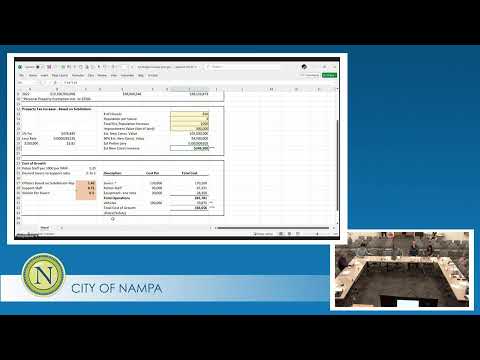
Public‑safety example: finance staff presented a simplified scenario to show how growth‑funding compares with the cost of providing services. In the example — a hypothetical 350‑home subdivision with an improvement value of roughly $300,000 per home — the modelled property‑tax increment (before additional adjustments) yielded an estimated annual tax revenue in the low hundreds of thousands of dollars; projected recurring police and support costs to serve the new population were larger. Staff said the gap in the example widens if the new‑construction capture is reduced (as it has been by recent legislation) and if inflation and personnel costs are included.
Council reaction and next steps: elected officials in the workshop raised two consistent themes: (1) a need for broader outreach to state legislators and regional partners because the fiscal effects are statewide and (2) a need to examine local policy responses (for example, using foregone, adjusting impact fees, or reconsidering approval pace on some projects). Council members suggested inviting the city’s state legislators to a follow‑up briefing and urged county and city staff to refine the modelling and share the underlying data.
Staff cautioned that some of the relief lawmakers have provided in the 2024 session (one‑time or temporary state credits) may not be durable and that budgets should be prepared for longer‑term effects. “This is not felt in year one or two,” said Doug Racine; presenters said the compounding effect becomes more visible in years three to five and substantial over a decade.
Ending: No policy decision was made at the workshop; staff said they would finish refinements to the financial model, provide the underlying data to council, and consider next steps that could include local budget decisions, outreach to legislators, and joint regional advocacy.