Get Full Government Meeting Transcripts, Videos, & Alerts Forever!
Get email alerts on the Comprehensive Plan topic
No spam. Unsubscribe anytime.
Evanston Land Use Commission continues comprehensive plan deliberations, approves multiple chapter edits and holds key items for May draft
Summary
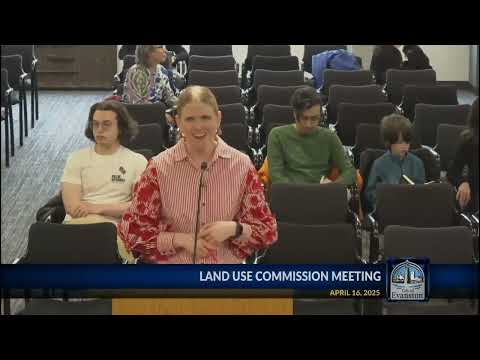
The Evanston Land Use Commission continued deliberations on the city’s draft comprehensive plan on April 16, approving multiple chapter edits while pulling several items for further work and asking staff and commissions to draft refined policy language for the next public draft.
The Evanston Land Use Commission continued deliberations on the city’s draft comprehensive plan on April 16, approving multiple chapter edits while pulling several items for further work and asking staff and outside commissions to draft or refine specific policy language ahead of a May 21 continued public hearing. Erin Baines, the city’s planning and policy supervisor, opened the session by reminding attendees, “we will not be taking public testimony this evening,” and explained the commission’s goal of finalizing edits so staff can prepare an updated draft for the next meeting.
Why this matters: The comprehensive plan will guide land use, housing, infrastructure and preservation choices across Evanston for the next two decades. The commission’s votes on edits and direction to staff determine what appears in the next public draft and shape the scope of later zoning and implementation steps.
Commission business and outcomes: The commission first approved a consent package of low‑controversy edits but explicitly pulled items 1.6, 1.7, 1.8, 8.1 and 14.1 for separate discussion. Commissioners then moved through the document chapter‑by‑chapter. Major formal outcomes recorded at the meeting included:
- Preservation (Chapter 14): Commissioners voted to approve the items listed for discussion in Chapter 14. The commission also approved adding the previously pulled item (14.1) — language safeguarding historic resources — and directed the Preservation Commission to draft a companion policy and actions that explicitly state the balance between “safeguarding the integrity of the city’s historic resources” and allowing “increased flexibility for routine types of work as well as innovative materials and technologies.” During the discussion, a preservation representative asked commissioners to note that “that’s just not how the preservation ordinance works,” stressing that the ordinance does not freeze buildings in place but provides a process for managing change. The motion to add the 14.1 text and request preservation to draft the balancing policy passed on a roll call (yes:5, no:2).
- Neighborhoods and Places (Chapter 5): The commission approved the listed discussion edits for Chapter 5, including revised wording to clarify incentives for downtown businesses and suggested new language to encourage development that supports living, working and operating businesses near transit and in mixed‑use areas.
- Community Systems (Chapter 6): The commission approved changes in Chapter 6 while holding two specific bullets and the packet item labeled CS 4.6 for staff redrafting; the vote kept the chapter language about city buildings but asked staff to provide more generalized language on broadband/digital access and to reframe two specific facility recommendations so those items can be returned in a future draft for clearer consideration.
- Environment and Parks (Chapters 8 and Parks/Rec): The commission approved the proposed environment items and asked staff to add action statements for lakefront protection. It also approved an action to advance a deconstruction ordinance and voted to add a preservation‑sourced policy calling for the city to consider the historic and cultural significance of parks and open spaces when planning.
- Health & Well‑Being (Chapter 11): The commission approved revised language that separates a short policy to “increase community access to mental health care and trauma‑informed services” from a separate statement about bringing diverse residents together. On environmental health, the commission approved revised policy text to “engage in efforts to eliminate environmental hazards that impact health” and passed a related action (TLW 5.6) to “work to mitigate the impact of brownfields and environmentally contaminated sites on their surroundings” (roll call result recorded as yes:7, no:1).
- Housing (Chapter 10): Commissioners extensively debated proposed alternative phrasings for housing goals (how to balance increased supply versus preserving housing diversity). The body debated several precise edits and votes; the meeting record shows multiple motions and roll calls on wording changes. Commissioners also approved several implementation‑oriented ideas, including continuing to explore an ADU financing/technical assistance program and a down payment assistance program concept (to be developed in collaboration with local lending partners) and authorized study of property‑tax relief mechanisms aimed at income‑eligible residents.
Process directions and next steps: The commission repeatedly instructed staff to incorporate agreed changes into a new draft and to return more generalized language where specific facility recommendations or implementation mechanisms would require additional analysis (for example, broadband approaches, police/civic center facility options, and the last two bullets of the Chapter 6 list). The Preservation Commission was asked to draft the balancing policy/action language requested for Chapter 14 and to return it for the May 21 hearing.
Public comment sampled: Members of the public who addressed the commission after the hearing urged greater transparency in the planning procurement and revision process and raised local concerns. Public speakers included Sarah Peterson, who said, “I am in favor of affordable housing, but I am not in favor of inside track,” and preservation and neighborhood advocates who urged visible protections for historic resources and clearer data on parking and brownfields. Resident speaker Dave Galloway emphasized walking and “walkability” as a cross‑cutting priority. Several commenters also asked that staff post the updated draft online with adequate review time before the next hearing.
What the commission asked staff to provide to the next meeting: a) an updated draft incorporating voted edits; b) redrafted, generalized language on broadband/digital access (CS 4.6) and the two held Chapter 6 bullets; c) a preservation‑drafted policy and actions to capture the balance between safeguarding historic resources and allowing appropriate flexibility; d) additional coverage of proposed action statements for lakefront protection; e) follow‑up on brownfields/environmental hazard language and any available inventories or study plans; and f) an earlier public posting of the next draft so the public can review before the May 21 continuation.
The hearing was continued to May 21 for the commission to consider staff’s updated draft and any additional refinements. Commissioners and staff repeatedly encouraged continued public comment during the May 21 hearing; Erin Baines reiterated the process objective earlier in the evening: the session’s goal is to move the draft forward for a clearer set of policy and action statements for future consideration by the City Council and for later zoning and implementation work.