Get AI Briefings, Transcripts & Alerts on Local & National Government Meetings — Forever.
Caucus reviews dozens of bills; sharp debate on police service animals, chiropractic board, DDD monitoring and marijuana grants
Loading...
Summary
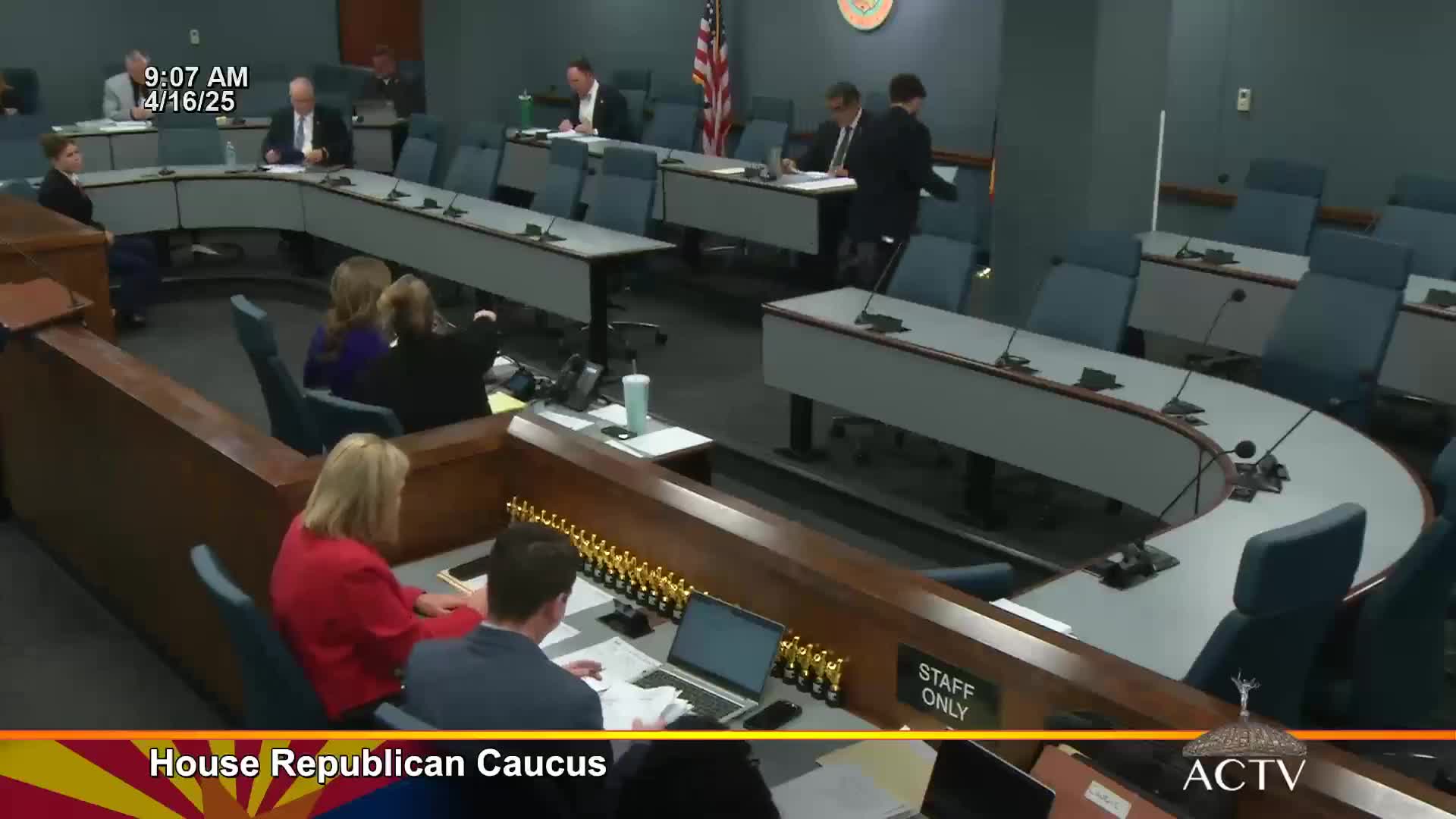
At a Republican caucus meeting of Arizona legislators, members reviewed a broad slate of bills moved toward the consent calendar and debated several items that drew substantive pushback from members.
At a Republican caucus meeting of Arizona legislators, members reviewed a broad slate of bills moved toward the consent calendar and debated several items that drew substantive pushback from members.
Lawmakers discussed criminal penalties tied to working and service animals, major changes to the state chiropractic board's authority, a proposed extension of a developmental disabilities group-home monitoring program, and a provision to direct $2 million in biomedical research funds to medical-marijuana clinical trials. Other topics raised included creation of a Department of Natural Resources, a wind-farm permitting bill for Northern Arizona and a proposed study committee on obesity coverage.
Why it matters: several of these measures would alter regulatory authority or state expenditures and drew sustained floor discussion rather than the routine approvals typical of a consent calendar.
Debates that drew the most attention
Working/service animals (Senate Bill 1198) Representative Blackman expressed a safety concern about the bill's draft language raising penalties for serious harm to a working animal and said he worried it could "overcriminalize someone who is protecting" a third party when a police or working dog is involved. Blackman asked, "if you shoot the dog, are you gonna be charged with that?" (transcript comment). Committee staff and another member said the bill targets police and service dogs and that an amendment under consideration would create a defense if a dog exerts force exceeding that allowed by law.
Chiropractic board overhaul (Senate Bill 1588) One member sharply criticized SB1588 as an attack on the Arizona Board of Chiropractic Examiners, saying the measure "eviscerates the chiropractic board" by removing many conduct standards and shortening response times for complaints. That speaker recommended not supporting the bill, arguing it raises ethical and potential legal concerns. Other members said they supported parts of the bill that affect the naturopathic board and suggested the measure might be amended.
Developmental-disabilities group-home monitoring (Senate Bill 1356) SB1356 would extend a three-year pilot monitoring program for group homes serving persons with complex developmental disabilities until Jan. 1, 2031, require the Department of Economic Security to contract with a designated entity to run protection-advocacy monitoring, and post reports online. Several members said they would withhold support until they reviewed reports and fiscal impacts: one member said there was no fiscal note and another said they wanted to see monitoring results before extending the pilot. Committee staff said the designated entity had issued a report and offered to forward it to members.
Medical-marijuana clinical trials funding (Senate Bill 1230) As amended, SB1230 would direct the Arizona Biomedical Research Center to award $2,000,000 in competitive grants for marijuana clinical trials by July 1, 2026, and authorize an additional $2,000,000 by July 1, 2028 if fund balances permit. Multiple members opposed the expenditure on principle or questioned whether additional research would add new information; others noted the funding would come from medical marijuana registry fees rather than the general fund.
Obesity treatment study committee (Senate Bill 1711) Members debated creating a 10-member study committee to evaluate the cost and effectiveness of extending Access (the state's coverage program) to include comprehensive obesity treatments. One legislator gave a back-of-envelope cost example saying a year of an obesity drug (Ozempic) costs about $10,000 and estimated very large potential program costs if broadly covered, arguing against creating the study/coverage. Others with health or clinical backgrounds expressed concerns about long-term costs and clinical risks and called the committee premature.
Department of Natural Resources (Senate Bill 1278) and other fiscal questions Committee staff relayed a JLBC (Joint Legislative Budget Committee) note that personnel and operational costs for a new Department of Natural Resources could not be estimated because the amount of state land the department might oversee is unknown. Supporters said the department would be positioned to manage lands that might revert to state control from federal agencies; critics asked for clearer fiscal estimates.
Wind farm permitting (Senate Bill 1150) Members from districts affected by Northern Arizona wind projects said the bill would add "guardrails" on who may construct and operate wind farms, require public hearings and siting considerations and address liabilities when projects cease operation. Staff noted a related House bill (House Bill 2223) is nearly identical.
Other business and consent items The caucus moved many bills to consent or noted committee amendments for bills ranging across education, public safety, health licensing compacts, and local government technical fixes. Most of those items were advanced without extended floor discussion.
What the meeting produced - Multiple committees' strike-everything amendments and committee-reported summaries were acknowledged on a long list of bills. - No formal recorded roll-call votes or final passage tallies were recorded in the transcript excerpt supplied; most items were reported out of committee or placed on consent calendars.
Next steps Several members asked for follow-up materials from staff: reports on the group-home monitoring pilot, a fiscal estimate for the proposed Department of Natural Resources, and clarifications on specific bills described as having technical or drafting issues. Sponsors and staff offered to provide those materials.
Ending note Members repeatedly emphasized committee follow-up: staff repeatedly offered to circulate reports and fiscal notes to caucus offices before the measures are advanced further in the legislative process.