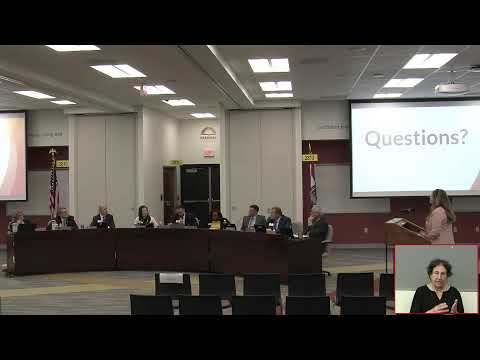
Parkway board hears comprehensive review of world languages; recommends common resources and virtual ASL
Loading...
Summary
District staff presented a seven-year program evaluation of Parkway’s world languages offerings, recommending a districtwide resource adoption, retention of the current 6–12 model, expanded proficiency testing and temporary virtual delivery for American Sign Language amid certification shortages.
Lauren Fairley, Parkway’s world languages curriculum lead, told the Board of Education on April 16 that a year-long program evaluation found strengths in student outcomes and a “deeply invested” teacher cohort but persistent staffing and resource gaps that limit equitable delivery across schools.
The evaluation — conducted by a leadership team of secondary teachers and guided by district staff — recommended adopting a common French, German and Spanish resource in 2025–26, retaining the current middle- to high-school 6–12 structure until elementary scheduling permits expansion, creating a proficiency-pathway testing system, and moving the American Sign Language (ASL) program to a virtual model until Missouri issues a certification path for ASL instructors.
The review matters because district leaders say it would reduce uneven curriculum implementation, free teachers from creating all materials, and provide clearer proficiency pathways that can translate into college credit. Fairley said the district’s Seal of Biliteracy program and credit-by-assessment options already offer routes to college credit for multilingual students.
Fairley described program background and findings. Parkway shifted roughly a decade ago from grammar-driven instruction to a thematic, communicative approach; teachers built materials in-house because commercial resources lagged behind pedagogical change. The evaluation found that while Latin, French and ASL show strong retention once students begin a sequence, Spanish and French implementation varies by building. The evaluation also flagged extreme staffing shortages for German and ASL.
Fairley provided several data points. She said 371 students applied for the Missouri Seal of Biliteracy this year; 214 students earned the Missouri seal and 31 students earned the distinguished seal, for a total of 245 Parkway students receiving Seal recognition this year — more than double the prior year’s total. Fairley said 15 Parkway students used credit-by-assessment for language credit from spring 2024 to spring 2025.
The review documented current staffing: 18 high-school Spanish teachers and eight middle-school Spanish teachers; six high-school French and five middle-school French teachers; three high-school Latin teachers; two high-school ASL teachers, one middle-school ASL teacher, one virtual ASL teacher and an out-of-district virtual option; and one high-school German teacher. Fairley said those staffing patterns constrain options for adding elementary language immersion or in-person ASL instruction.
Key recommendations in Fairley’s report included: - Adopt a districtwide, research-aligned resource for French, German and Spanish at the start of 2025–26 to provide a common scope and sequence, common assessments and authentic materials. - Retain the 6–12 world-language model until elementary schedules permit adding a world-language special; if elementary offerings are added, favor focused FLES (foreign language in the elementary school) exposures rather than immediate dual-immersion models. - Continue French and Spanish at middle school, and French, Spanish and Latin at high school; expand virtual learning options for languages without in-person instructors. - Move ASL to St. Louis Virtual Campus until Missouri certifies ASL teachers, to preserve student access while in-person staffing lags. - Create a proficiency-pathways program with standardized testing at multiple levels to award milestone recognition and potential college credit without requiring AP exams. - Eliminate language-specific lead-teacher stipends if a common resource is adopted (those stipends currently compensate teachers who created district materials).
Board members asked about Latin enrollment and ASL certification timelines. Fairley said Latin enrollment has dipped at some sites but the three high-school Latin teachers keep the program “robust” at certain schools; she emphasized monitoring trends rather than immediate elimination. On ASL she said, “We’ve been told they’ve been working on it for years now, and there hasn’t been a lot of progress,” and that moving to a virtual delivery through St. Louis Virtual Campus is a stopgap to keep the program available.
Fairley and other presenters noted equity concerns if the district were to offer a single elementary-language model that favored Spanish; several department groups urged exposure to multiple languages at early grades rather than a Spanish-only rollout. The report also recommended reconvening a subcommittee to align middle-school credit requirements with high-school expectations, including whether middle-school students must complete a subsequent course to earn high-school credit.
The board did not vote on recommendations at the meeting; members praised the thorough review and asked staff to return with implementation details and budget implications for the recommended resources and testing programs.
For context, Fairley said Parkway’s language program last underwent a formal evaluation in 2015–16; the district operates on a seven-year rotation for program reviews.