
Pennsylvania timber industry urges $270,000 to create Southern hardwood utilization group
Get AI-powered insights, summaries, and transcripts
Sign Up Free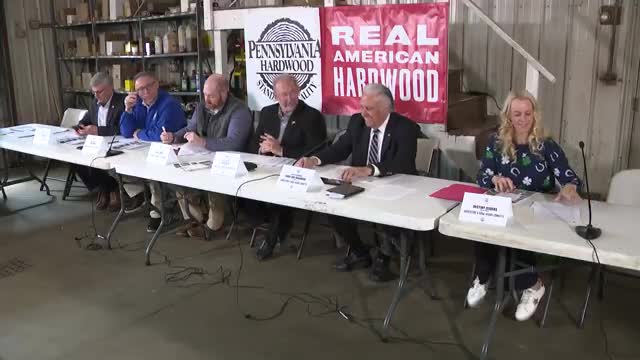
Summary
Industry groups and state officials told the House Agriculture & Rural Affairs Committee that creating a southern Hardwood Utilization Group (HUG) and adding $270,000 to the hardwood research and promotion line item would extend technical assistance, workforce development and market access to 33 southern counties.
The House Agriculture & Rural Affairs Committee heard unified testimony requesting a $270,000 increase in the Department of Agriculture’s hardwood research and promotion line item to establish a Hardwood Utilization Group (HUG) serving southern Pennsylvania.
The proposal would expand the existing statewide network — the Hardwoods Development Council (HDC) and three HUGs that now cover the northern and central parts of the state — to provide technical assistance, workforce development, marketing and export support for 33 southern counties. "If we want to ensure that Pennsylvania remains a national leader in hardwood production, we must extend this model to the southern third of the state," Jonathan (John) Geyer, executive director of the Hardwoods Development Council, told committee members.
Why it matters: Pennsylvania is the nation’s largest hardwood producer by volume, and witnesses cited the sector’s sizable economic footprint and employment. Testimony said the forest products sector supports more than 60,000 jobs and produces a multi‑billion dollar economic impact in the Commonwealth. Proponents said a southern HUG would expand workforce pipelines, help manufacturers access innovation and federal grants, and improve in‑state export options through ports such as Philadelphia.
Secretary of Agriculture Russell Redding said state investments and the HUG model are critical for easing market shocks such as tariffs and changing international demand. "We have an opportunity to support it in the current budget," Redding said, describing HUGs and the HDC as "connective tissue" for the industry and noting the department’s core appropriation and leveraging of federal funds.
Speakers representing the existing HUGs described boots‑on‑the‑ground services. Amy Shields, executive director of the Allegheny Hardwood Utilization Group, highlighted training that brought the National Hardwood Lumber Inspector certification to Pennsylvania at lower cost and without out‑of‑state travel; that program credentialed nearly 25 inspectors over three summers. Stephanie Phillips Taggart of the Keystone Wood Products Association and Shelby Chorba of the Northern Tier Hardwood Association described outreach, school programs and local events that link students and jobseekers to manufacturing careers.
Industry leaders from southern Pennsylvania said they want a local HUG to address regional needs. Philip Smith, COO of Stoltzfus Hardwoods, said a southern hub could spearhead public education about sustainable forestry, bolster workforce recruitment and work with ports to make in‑state export channels more viable. Conestoga Wood Specialties President and CEO Anthony Hahn said a regional HUG would help recruit and train people for manufacturing careers and broaden market opportunities for companies that now focus on kitchen and bath components.
Speakers also flagged export and logistics problems. Several witnesses described bottlenecks and cost increases after the Baltimore port disruption and said Philadelphia has not reliably served key export markets, notably China. John Geyer and other witnesses said roughly half of U.S. hardwood exports go to a single country, and the industry needs better local port options and freight handling to avoid routing through out‑of‑state ports.
Funding and programs mentioned: testimony described the department’s core HDC appropriation (noted as $725,000 by one speaker), a proposal to raise an Innovation Fund from $10 million to $25 million, USDA wood innovation awards that HUGs helped secure (about $4 million across several projects), and state agriculture innovation grants that funded hardwood projects. NDS Design founder Neda Dorshalgi told the panel she received a $300,000 Pennsylvania agriculture innovation grant and is planning an 80,000 sq. ft. manufacturing facility in the Lehigh Valley expected to create 300 jobs over six years.
No formal vote or appropriation was taken at the informational meeting. Committee members asked detailed questions about workforce pipelines, average wages for sector jobs, port logistics and how a single southern HUG might be structured (one regional hub versus multiple, smaller hubs). Witnesses said the southern HUG project is a first step; the number and footprint of any southern HUG(s) would be defined after outreach to local businesses and stakeholders.
The session concluded with committee members thanking testifiers and planning a tour of the host facility, Stoltzfus Forest Products. Committee members said they will continue the budget and policy conversations during the department’s appropriations and outreach process.