
MDOT officials outline aeronautics funding, airport projects and drone integration
Get AI-powered insights, summaries, and transcripts
Sign Up Free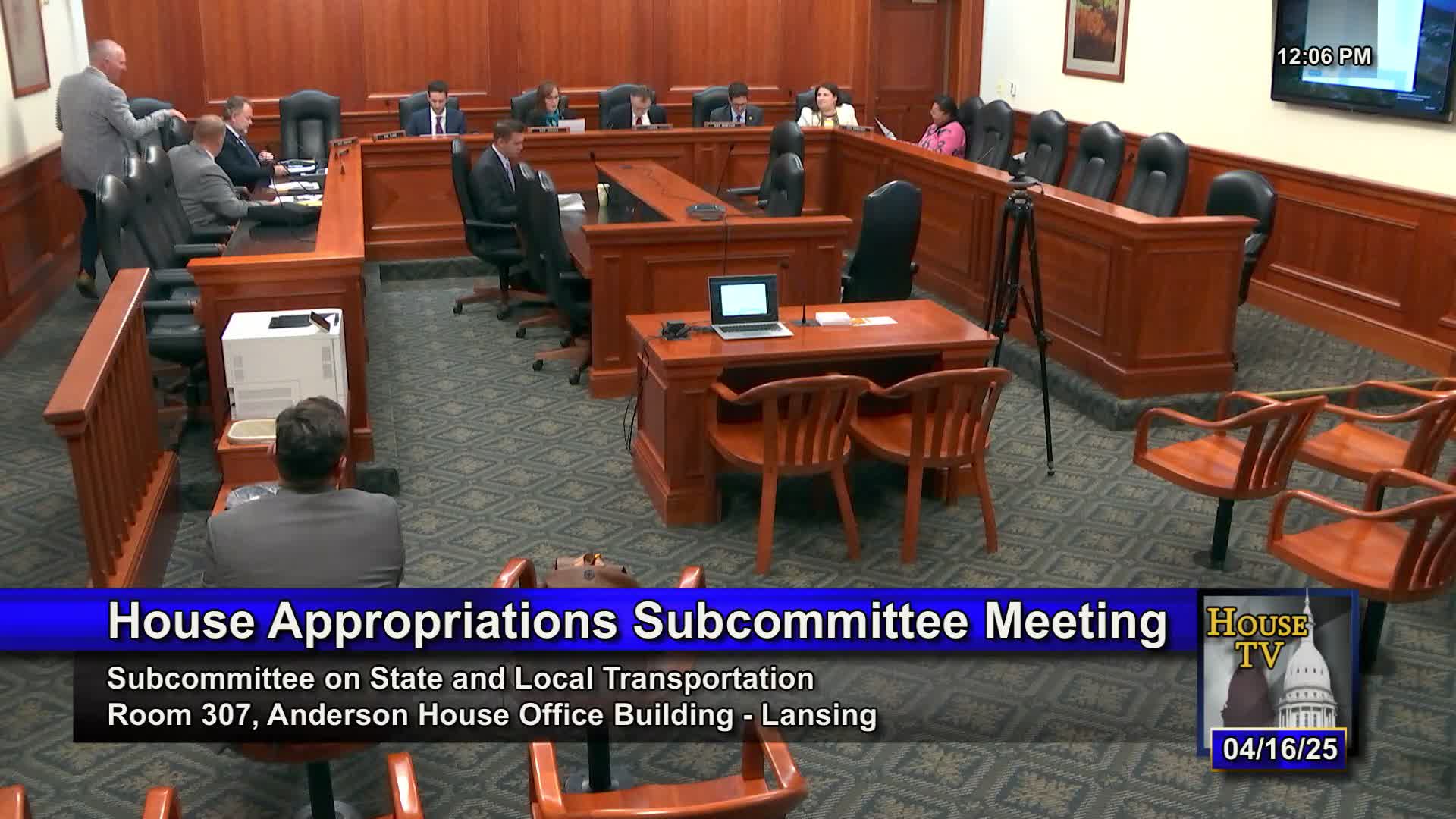
Summary
Michigan Department of Transportation officials briefed the Appropriations Subcommittee on State and Local Transportation on aeronautics funding sources, airport improvement planning, state-owned airport options and expanding uses for drones in inspection, emergency response and beyond-visual-line-of-sight pilots projects.
LANSING — The Michigan Department of Transportation’s aeronautics division told the state Appropriations Subcommittee on State and Local Transportation on Wednesday that the division is funded largely by aviation-related taxes and fees, supports airport capital projects across the state and is expanding drone operations to speed inspections and deliver goods in hard-to-reach locations.
MDOT aeronautics division head Brian Buds said the department oversees capital grants and engineering for public-use airports and performs safety inspections, airspace analyses and licensing of flight schools and aircraft operators. “We are in a, a generally pretty good spot currently,” Buds said of the department’s ability to provide matching funds for federal airport grants, “pending the parking tax comment.”
The briefing focused on several funding streams that support the aeronautics fund: an aviation fuel excise tax of 3¢ per gallon, a portion of aviation fuel sales tax and aircraft registration and licensing fees; and revenues from an off-site Detroit Metro Airport parking tax that currently contributes roughly $35 million statewide, of which about $6 million supports MDOT debt service and capital development. Buds told lawmakers that those parking-tax revenues are tied to bonds that he said will expire in roughly five years, creating a funding gap that will require attention.
Why it matters: MDOT’s capital program — the Airport Improvement Program — drives runway, taxiway and terminal projects at dozens of community and commercial airports. Committee members emphasized budgetary details: the subcommittee requested forward-looking five-year capital plans for general aviation airports and materials showing how state funds are spent at specific airports.
Most important facts
- MDOT manages grants and planning for roughly 220 licensed public-use airports and about 100 private airstrips, Buds said. Fifteen support scheduled air-carrier service; nine are supported by the federal Essential Air Service program. Buds said aviation in Michigan moves about 39 million passengers and 600 million pounds of cargo and supports an estimated $22 billion in statewide economic impact.
- The department described internal staffing and budgets: an approximately 48-FTE cap for the aeronautics office and an “air service program” line item (described in the presentation transcript as roughly “7 and a 50 thousand dollars”); the larger capital outlay Airport Improvement Program fluctuates between about $120 million and $180 million annually depending on the year and federal funding.
- Revenue sources include a 3¢ per-gallon aviation fuel excise tax with a partial rebate for interstate commercial carriers, aircraft registration and licensing fees, and a share of a Detroit Metro off‑site airport parking tax. Buds said the parking-tax share that supports MDOT will drop when related bonds retire, creating a funding cliff in the near term.
Operations, safety and projects
Buds outlined two primary program areas in the aeronautics division: airport planning and development, and aviation operations. He said MDOT is one of 10 states that receives FAA airport development funds through a block-grant arrangement, and that the department administers engineering, environmental review and grant distribution for locally administered projects. Buds noted that federal grants typically require local matches, and MDOT provides half of the local match so communities generally need to provide about 5% of a project’s total cost.
MDOT also licenses and inspects flight schools (about 65–70 non-collegiate flight schools, Buds said), inspects roughly 600 aviation facilities and conducts about 6,000 tall-structure reviews per year to protect airport approach surfaces. The division operates 42 automated weather observation stations and is upgrading those systems following a legislative appropriation so data is more accessible and not reliant on outdated technology.
State aircraft and staffing
Buds said MDOT owns four aircraft: three used for passenger transport on state business and one single-engine plane used for inspections. Those aircraft are normally operated for state agency use on a first-come, first-served chargeback basis, but Buds told the panel the service is currently paused for “staffing challenges in terms of HR related issues.” He said the division is allocated two pilots for fleet operations and that the department is working through civil-service processes to resolve personnel issues and return the fleet to service. "We are on a daily basis trying to make progress on the personnel related issues," Buds said.
State-owned airports and local sponsors
Buds confirmed MDOT owns three airports — Romeo Airport (Macomb County), Ken Plymouth Meditall (Wayne County) and Houghton Lake State Airport (Roscommon County) — and that MDOT uses contract managers to operate them. For Romeo Airport Buds said the current management contract is ending next year and MDOT is exploring options, including finding a local sponsor to take over operations.
Drones and advanced air mobility
MDOT described a growing UAS (drone) program supporting department operations and statewide projects. Buds highlighted flights that supported emergency response after an ice storm and pilot projects for beyond-visual-line-of-sight operations in partnership with private companies and the shipping industry, including a Detour Village/Interlake Steamship Company demonstration to move critical goods between shore and underway vessels.
He said drones are already used for airport inspections, bridge inspection, surveying and pre/post-construction work, and that they can be a cost-saving substitute for some inspections. “We’ve been able to acquire a number of drones that we’re talking in the in the 3 to $5,000 range that can go out and perform that entire inspection much more efficiently,” Buds said, while noting boots-on-the-ground verification is still required.
Questions and follow-ups
Committee members asked for additional data that Buds said he would provide: the five-year capital improvement plan for general aviation airports (to be emailed to committee members), licensed-pilot statistics, and more detailed cost-comparison information about drone use on the highway and airport sides. Buds also offered to provide additional materials on airport capital expenditures listed in the packet.
Formal action
Representative Borton moved to adopt the minutes of the March 19 meeting; the motion carried by unanimous consent. With no further business, the chair adjourned the meeting.
Ending
Lawmakers on the appropriation subcommittee pressed MDOT for clearer forward-looking budget materials and said they expect follow-up documents on five-year plans and specific cost and staffing figures. MDOT staff said they will provide the requested documents and continue working to restore flight operations and address an anticipated funding shortfall when airport-parking bond revenue sunsets.