
Tampa Bay seagrass shows net gain, but Old Tampa Bay still losing ground, experts say
Get AI-powered insights, summaries, and transcripts
Sign Up Free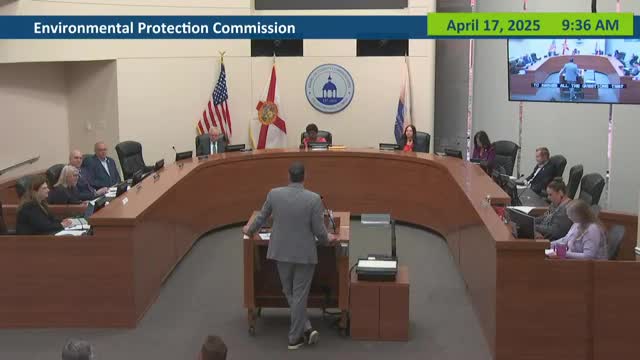
Summary
Tampa Bay Estuary Program reported a 2024 seagrass assessment showing about 1,400 more acres than 2022, but Old Tampa Bay continues to lose seagrass. The program urged more stormwater projects, septic-to-sewer work and habitat restoration; the EPC received the report 6-0.
The Tampa Bay Estuary Program reported April 17 that the latest regional assessment showed roughly 1,400 more acres of seagrass in Tampa Bay compared with the prior survey, but panelists warned the upper Old Tampa Bay segment continues to decline and needs targeted action.
Ed Sherwood, executive director of the Tampa Bay Estuary Program, told the Hillsborough County Environmental Protection Commission, “We did receive some good news ... we've had, about 1,400 more acres of seagrass coverage in Tampa Bay relative to the prior assessment back in 2022.” He said the gain is encouraging but not uniform across the bay.
Sherwood said seagrass is a foundational estuarine habitat that needs sunlight, and declines can accelerate harmful algal blooms and affect fisheries and species such as manatees and sea turtles. He described progress since mid-20th-century pollution reductions — noting a long-term goal (the meeting referred to a regional target) to maintain roughly 40,000 acres baywide — but warned that Old Tampa Bay remains the largest area of continuing loss.
The program and county staff identified stormwater nutrient loads as the chief current source of new nitrogen reaching Old Tampa Bay. Sherwood said the region sees decreases in point, atmospheric and groundwater nitrogen sources, while stormwater loads have increased with heavier rainfall events, and that Old Tampa Bay experiences a recurring summertime algal bloom and low-oxygen events.
Interventions discussed and funding commitments mentioned in the presentation and Q&A included:
- A commitment of roughly $1 million from the estuary program to Hillsborough County for septic-to-sewer conversions and stormwater and floodwater improvements in priority areas. - A $9.5 million RESTORE grant from the Florida Department of Environmental Protection to study water quality and flood protection for vulnerable communities in Old Tampa Bay, covering work from the MacDill/Interbay peninsula around toward Pinellas County. - Habitat restoration and oyster-protection projects; the program said it will push for expanded oyster restoration in Old Tampa Bay (a target of about 175 acres was discussed). - Consideration of structural changes to causeways and bridges to improve circulation; Sherwood said additional breaches can help circulation but that Department of Transportation investments would be voluntary and that a large western causeway alteration could cost on the order of $100 million. - A recommendation under discussion within the Tampa Bay Nitrogen Management Consortium to further reduce nitrate loads to approximately 486 tons per year for Old Tampa Bay — a target Sherwood said would require additional reductions of roughly 84 tons per year beyond current measures, primarily from stormwater.
Several commissioners pressed for funding and interagency coordination. Commissioner Wolston and others suggested re-examining tourist development reserves and resilience dollars to prioritize water-quality projects. Commissioners discussed dredging, canal maintenance, additional causeway breaches, and leveraging federal and state resilience and mitigation funds.
Sherwood and commissioners also discussed monitoring: the Water Management District conducts biennial baywide aerial surveys for acreage, while the Estuary Program’s voluntary transect monitoring adds species-level and distribution detail annually.
The commission voted 6-0 to receive the Tampa Bay Estuary Program report. Commissioners who moved and seconded the motion were recorded as Commissioner Wasser (mover) and Commissioner Miller (second).