Get Full Government Meeting Transcripts, Videos, & Alerts Forever!
Get email alerts on the Utilities And Infrastructure topic
No spam. Unsubscribe anytime.
Santa Fe-area leaders weigh water and sewer routing; informal preference emerges for 1764 route
Summary
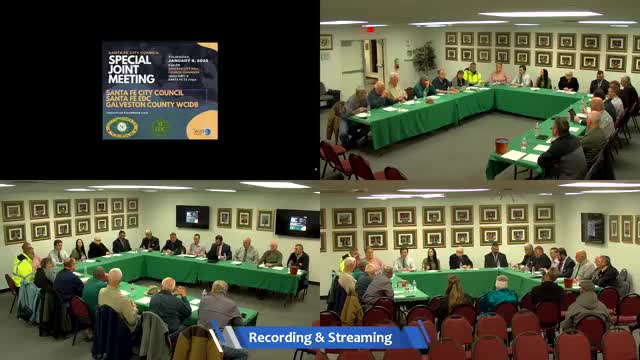
Officials from the City of Santa Fe, Galveston County WCID No. 8 and the Santa Fe EDC discussed competing options to extend water and sewer infrastructure on Jan. 9, 2025. Participants flagged costs, easements and future growth; a show of hands favored pursuing projects along FM/CR 1764 rather than State Highway 646.
Officials from the City of Santa Fe, the Galveston County Water Control and Improvement District No. 8 (WCID 8) and the Santa Fe Economic Development Corporation met Jan. 9, 2025, to discuss options for extending water and sewer infrastructure to support planned residential and commercial growth.
The discussion centered on two primary corridors: State Highway 646 (running north–south through parts of the district) and Farm‑to‑Market/County Road 1764 (the corridor toward La Marque/Lamar). Participants cited a Gulf Coast Water Authority transmission line that crosses 646 near Second Street as an important asset, but several speakers said running sewer and water down Cemetery Road and 1764 would be easier to permit and require fewer easement negotiations than running lines along 646.
Why it matters: timing and route selection will shape where developers locate new housing and commercial parcels and which projects are feasible within the budgets of multiple local entities. Speakers said the choice will affect where infrastructure investment occurs and which jurisdictions attract new businesses as League City, Dickinson and Alvin expand westward.
Key technical points and constraints discussed
- Existing transmission and backup lines: Participants noted a Gulf Coast Water Authority (GCWA) line crossing 646 near Second Street and described a GCWA system of mains and a Thomas Mackey water plant that supply parts of the region. The presence of that line was described as a “game changer” for potential connections near 646.
- New local water plant planned for Arcadia Station property: Tommy (role not specified in the transcript) described a planned on‑site water plant near 646 that would include pumps, a ground storage tank, pressure tank and chlorination. Tommy said the plant is intended to provide local pressure and can be expanded later with larger tanks or an elevated storage tower as demand grows.
- Sewer routing and lift stations: Speakers described a plan to run sewer up Cemetery Road with lift stations to cross a canal, and to extend water from a take point at Second Street/646. The sewer trunk line under discussion was described as large (participants referenced a 30‑inch trunk in a separate trunk project) and the project will involve multiple lift stations in some layouts.
- Easements and property access: Several participants stressed that obtaining private easements along 646 is difficult because houses sit close to the right of way; by contrast, 1764 was described as involving fewer property owners and therefore fewer individual easement negotiations. A WCID representative said typical easements sought are about 20 feet.
- Costs and sequencing: Multiple speakers cautioned that routing along 646 would require larger diameter pipe and more lift stations and therefore “significantly more” money and time, while routing along 1764 would be a smaller initial bite and easier to phase. Participants did not produce a formal cost estimate in the meeting; one speaker characterized any alternate route along 646 as costing “much more” but did not provide a precise figure.
- Connections and customer offers: WCID staff said the district will not offer sewer service to customers without water service initially; the plan is to extend water lines and then offer sewer tie‑ins where feasible. Speakers also described hydrant spacing standards (a code cited in discussion said roughly every 500 feet) and the need to locate meters and hydrants in coordination with Gulf Coast Water Authority requirements.
Positions and practical next steps
- Arcadia Station and nearby projects (including a modular home community called Hill Creek Crossing in discussion) are driving near‑term demand for water and sewer on the east side of the study area; developers have been working with WCID and city staff on easements and plant siting.
- Participants agreed to perform additional analysis comparing available commercial property along 646 versus 1764 and to coordinate on a shared direction for design, easement acquisition and funding. In a nonbinding hands vote near the end of the meeting, attendees indicated a preference for starting with projects along 1764.
Voices from the meeting
- Mayor Brandon Noto (City of Santa Fe) opened the joint exchange and framed the discussion around community growth and the region’s recent 1764 project experience.
- James (role/title not specified in the transcript) and Tommy (role/title not specified) provided technical descriptions of proposed alignments, water take points and the planned on‑site water plant for Arcadia Station.
- Developers and property owners, including Corey Boyer, were named in the discussion as having active projects on 1764 that motivated some of the routing decisions.
What was not decided
No formal vote or interlocal agreement was adopted in the meeting. Participants agreed to pursue more detailed analysis, continue outreach to property owners for easements and coordinate a potential lead agency for any project. Several speakers said somebody needs to take the lead on a combined project; the group discussed the idea that a water project should be led by the water experts (WCID) with documented authorization from partner entities.
Ending note
Officials said follow‑up meetings and more detailed cost and easement analyses will be necessary before any construction or formal contract authorizations. The parties emphasized that any routing decision will need phased funding, private easements, and cooperation among the city, WCID 8 and the EDC.