Get Full Government Meeting Transcripts, Videos, & Alerts Forever!
Get email alerts on the Land Use Development topic
No spam. Unsubscribe anytime.
Council approves Kosmoski neighborhood plan with cap on multifamily units after heated debate
Summary
After hours of public testimony and amendments, the Green Bay Common Council approved a planned unit development (PUD) for the Kosmoski family’s 67-acre Red Smith area project, removing an open R‑3 multifamily overlay and limiting multifamily to 160 units after motions and votes changed the original proposal.
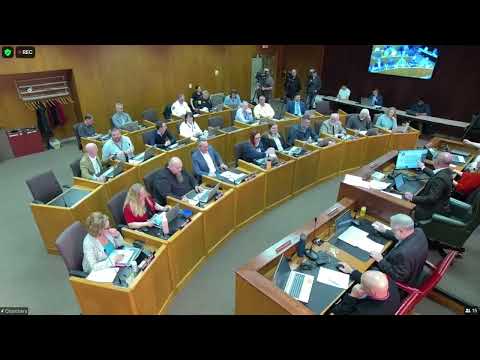
A divided Green Bay Common Council approved a planned unit development (PUD) for the Kosmoski family’s proposed 67‑acre Red Smith subdivision on April 15, 2025, after months of neighborhood meetings and a lengthy public hearing.
The PUD as approved leaves a mix of single‑family lots, duplexes and commercial land in place, and permits multifamily development on a specified parcel — but the council adopted an amendment limiting multifamily to 160 units. The cap was adopted after a failed attempt to remove the multifamily (R‑3) overlay entirely and a separate failed amendment to replace the overlay with only single‑family zoning.
Why it matters: The project would add housing supply to a part of the city where residents and the developer disagree over scale, environmental constraints and traffic. Supporters said the PUD creates housing options and follows the comprehensive plan’s guidance for a mix of housing types; opponents said the R‑3 overlay would permit excessive density next to existing low‑density neighborhoods and raised concerns about wetlands, traffic and school enrollment.
Council debate and public testimony centered on density, wetlands permitting and access. Kent Bond, speaking for hundreds of neighbors, said the area should remain low‑density and that wetland permitting and endangered‑species reviews had not been completed. Developer Connor Kosmoski and representatives from Kosmoski Companies and its engineering team outlined a multi‑phase plan: early phases of single‑family construction, water‑pressure infrastructure and later multifamily development. Kosmoski said the multifamily portion likely would be built in phase two or three and that infrastructure work — including a pressure‑reducing valve to serve the site — must come first.
Environmental and permitting concerns were raised by neighbors. Bond said the developer had not yet completed necessary DNR wetland approvals and U.S. Fish and Wildlife consultations, and warned the final plan could change after permitting. The developer’s representative said wetland delineations had been done and buffers were shown on submitted plans, and that the project would be phased over many years.
Council members pressed the developer and staff on traffic, access and the possibility of converting a private internal road to a public street in the future to enable for‑sale townhomes rather than rental apartments. The council also debated whether to give staff authority to accept certain land‑use mechanisms that could enable future redevelopment (for example, air rights discussion appeared later in the meeting on a different item).
Votes and outcomes: A motion to remove the R‑3 multifamily overlay failed on a 6–6 tie. A subsequent amendment to cap multifamily at 160 units passed on a roll call (9–3). The PUD was then approved as amended. Council members who supported the cap said it preserved options while responding to neighborhood concerns; members who opposed caps said they would constrain future design flexibility and the project’s ability to meet local housing demand.
Next steps: The developer may proceed with permitting and phased infrastructure work under the approved PUD. The council directed staff to continue working with the developer and the neighborhood; any material amendments to the PUD or site plan must come back to the council for approval.