Get Full Government Meeting Transcripts, Videos, & Alerts Forever!
Get email alerts on the Housing topic
No spam. Unsubscribe anytime.
MSHDA outlines statewide housing production, lawmakers and advocates press supply-side reforms
Summary
At an April House Appropriations Subcommittee hearing, Michigan State Housing Development Authority Executive Director Amy Hovey detailed MSHDA funding, programs and recent production gains while a Mackinac Center witness and lawmakers urged state action on permitting, zoning and code changes to increase housing supply and reduce costs.
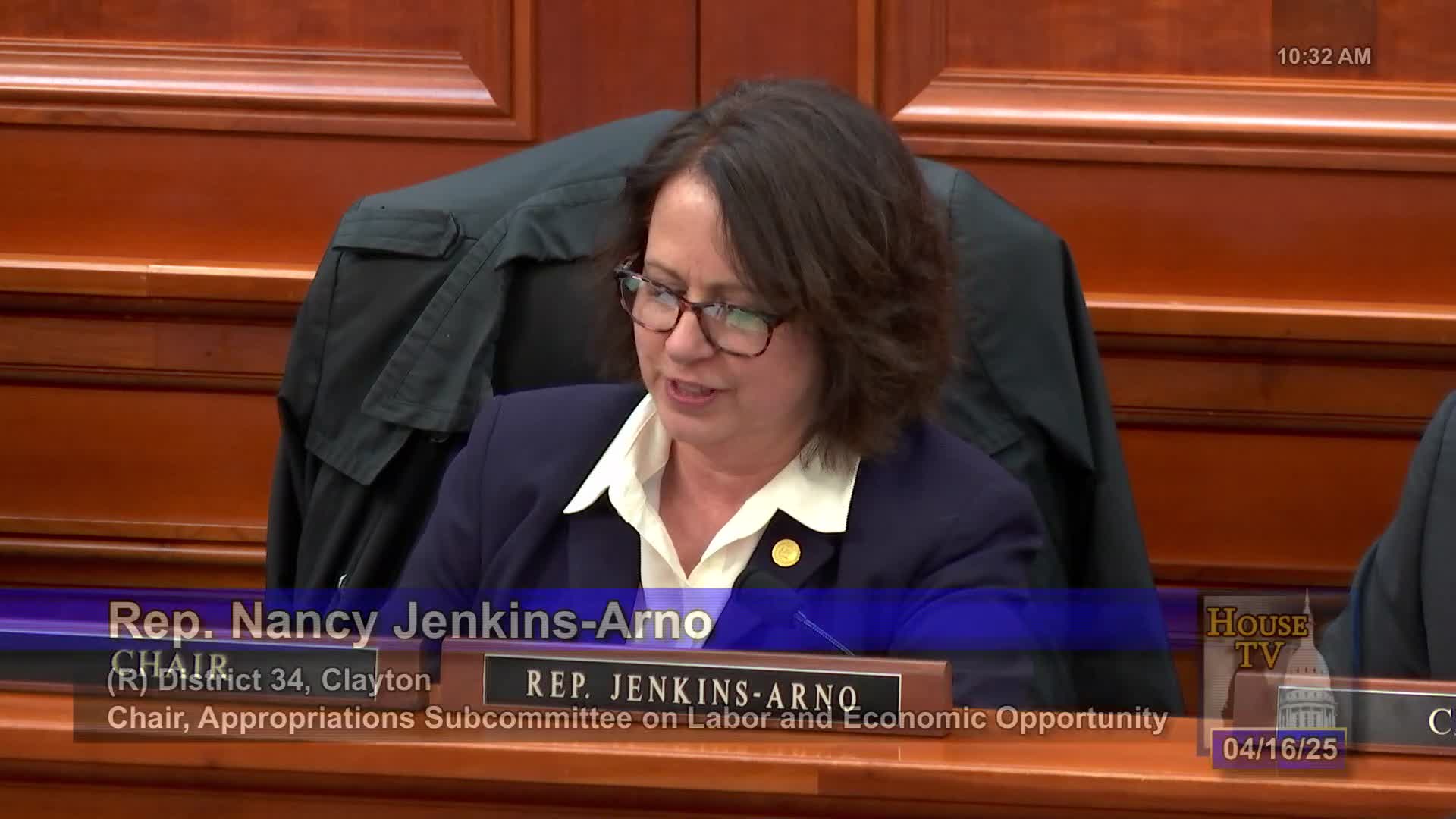
Amy Hovey, executive director of the Michigan State Housing Development Authority, told the House Appropriations Subcommittee on Labor and Economic Opportunity on April that MSHDA has substantially increased its funding and activity to address housing shortages across Michigan.
Hovey said the agency put “over $2,100,000,000 into housing” in the last fiscal year and described a mix of federal and state dollars being used to support homeownership, rental production and homeless services. She highlighted the agency’s mortgage products, down-payment assistance pilots and state-funded incentives aimed at leveraging private investment into more housing units.
Hovey told the panel the state’s five-year production goal set by the governor was 15,000 units and said MSHDA is “hitting close to 67,000” on the metric the agency tracks using building permits. She said MSHDA’s recent activity has leveraged federal programs and private capital: the authority’s recent investment levels and state appropriations have supported multifamily development through the Low-Income Housing Tax Credit program and helped fill financing gaps in the 4% LIHTC category.
MSHDA emphasized several specific programs and figures. Hovey said the agency’s mortgage-rate-relief product is being offered statewide at about 5.5 percent and that the authority’s standard mortgage product includes a $10,000 down-payment assistance option. She described a new “first-generation” $25,000 down-payment assistance pilot funded in the fiscal year 2025 budget; the pilot was initially capitalized with $8,000,000 and Hovey said that funding was being spent at roughly “a million dollars a week.”
Hovey also described employer-focused efforts and locally tailored programs. She said MSHDA administers about 30,000 Housing Choice Vouchers, and the agency launched a $10,000,000 Employer Assisted Housing Fund to match private employer contributions; she reported that about eight completed applications had drawn roughly $8,000,000 of the pilot funds within five weeks of launching. Hovey thanked legislators for prior state appropriations to the Housing Community Development Fund and noted that one-time ARPA allocations and other state flexibility helped leverage larger projects.
Jarrett Skorup, vice president of marketing and communications at the Mackinac Center for Public Policy, characterized Michigan’s regulatory environment as a constraint on housing supply. “It’s the government kinda breaking your legs and then trying to hand you crutches afterwards,” Skorup told the committee, arguing that permitting timelines, zoning restrictions and other local regulations raise the cost of new housing and slow production.
Skorup urged supply-side reforms, including statutory limits on review timelines, preapproved building plan sets to speed permitting (citing South Bend, Indiana, as an example), and reduced local restrictions on housing types such as bans on small multifamily forms and minimum parking requirements. He contrasted regulatory approaches in other states, saying Texas’s lighter regulation has supported faster building while California’s strict regulatory regime has constrained supply despite large subsidies.
Committee members asked Hovey and Skorup where the legislature could act. Representative Annette VanWoerkom pressed for specifics on regulatory costs, noting a figure she had seen—"about $94,000 per unit" in regulatory costs—and asked what measures could lower those costs. Hovey said some federal reporting and compliance requirements drive cost increases and that MSHDA is compiling data to show where requirements could be right-sized for smaller projects. She said zoning, permitting and allowing for alternative construction methods (modular, manufactured, 3-D printing) are state and local levers that could reduce costs.
Both witnesses urged greater flexibility in state funding to target “missing middle” housing (units above typical 80% area median income limits), and Hovey said MSHDA would seek statutory flexibility for the Housing Community Development Fund to allow that use. Hovey also described the housing TIF program as an emerging lever bringing new developers into ownership housing for families at or below 120% area median income.
The subcommittee took one formal action at the start of the meeting: Representative Annette VanWoerkom moved to approve the minutes of the March 26 meeting; the chair noted there were no objections and the minutes were approved.
The hearing closed with committee members indicating they would consider Hovey’s funding requests and legislative options to encourage supply-side changes, including streamlined permitting and zoning reforms, and with MSHDA offering to provide district-level data and tours of projects funded by the authority.