Baltimore officials note emergency winter-shelter procurements as directors defend rapid staffing and safety steps
Loading...
Summary
The Board of Estimates reviewed a package of Mayor's Office of Homeless Services emergency procurements for winter-shelter staffing, food and related services. Director Ernestina Simmons described demand, vendor roles and safety oversight; the board noted the items and members pressed for procurement-process changes and stronger oversight.
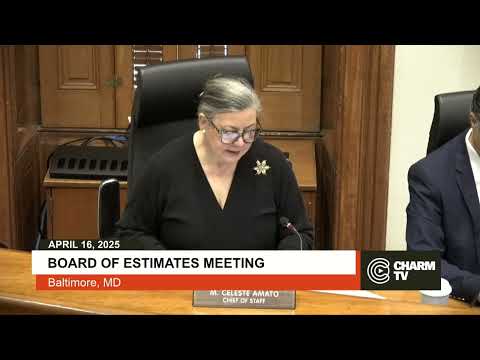
The Board of Estimates on April 16 reviewed a package of emergency procurements by the Mayor’s Office of Homeless Services (MOHS) to staff and operate winter shelters as Baltimore experienced unpredictable cold-weather events.
MOHS Director Ernestina Simmons told the board the city uses Athena Consulting Group to supply shelter staff and the Franciscan Center to provide food at overflow winter sites and that additional vendors—TaylorMade Transportation, MIT Cleaning, POI Installation Group LLC and others—support transport, cleaning and temporary room dividers. "We are charged with making sure that during the winter shelter season everyone that needs a bed is able to receive a bed," Director Simmons said, describing staffing and food arrangements.
The presentation included use data and capacity figures. Simmons said that, counting July 1, 2024, through April 1, 2025, MOHS triaged 1,753 households through emergency shelters and 770 households through winter-shelter activations; a broader count of clients over that interval showed 2,391 individuals served. Simmons described winter-shelter activations as unpredictable: code purple activations run from 4 p.m. to 9 a.m. when temperatures fall at or below 32°F and code blue declarations by the Health Department require 24/7 sheltering when temperatures are far colder.
Comptroller Bill Henry acknowledged that MOHS followed existing procurement rules but urged a process review so the board and the public are notified when an agency must use emergency procurement rather than the standard solicitation route. "We tried this the right way and it didn't work," Henry said, arguing for a mechanism to bring such situations to the Board of Estimates promptly and publicly. Mayor Brandon Scott and other board members said they supported system improvements and noted the administration is trying to solicit some contracts earlier to avoid emergency procurement in future seasons.
Board members pressed on oversight and safety. Director Simmons said MOHS assigns an emergency services manager and a seasonal manager to oversee contracted staffing and training; frontline safety is managed by floor monitors and, at some sites, contracted security firms. "We are not seeing a high level of safety issues at our locations as it's related to people being assaulted, harmed, raped," Simmons said, while adding she would share incident data for each shelter on request.
The board’s action was to note the emergency procurement items—listed on the nonroutine agenda under multiple SB numbers—rather than to take further approval or amendment. Several board members directed MOHS and city procurement to pursue nonemergency solicitations for recurring services next season and asked for follow-up discussions to consider formal changes to the procurement process to reduce reliance on emergency purchases.
The items noted on the nonroutine agenda include multiple emergency procurements for staffing, food, transportation, cleaning and room dividers for winter shelters that were described at the meeting. The board did not amend or deny the procurements during the session; members asked staff to pursue better advance contracting where feasible and additional transparency around emergency procurements.
The board also discussed the regional context and longer-term housing strategy. Simmons cited the HUD 2024 report showing a 30% decrease in homelessness in Baltimore since 2019 but said the city is seeing more people enter the system for the first time in 2025 and that many new entrants are not eligible for permanent supportive housing targeted at chronically unsheltered people.
The board concluded the discussion by noting the emergency items and asking MOHS, the Department of Finance Procurement Bureau and the City Administrator's Office to pursue a process that brings such procurement choices to the board earlier in the timeline.