Get Full Government Meeting Transcripts, Videos, & Alerts Forever!
Get email alerts on the Appropriations Medicaid Funding topic
No spam. Unsubscribe anytime.
Appropriations committee hears that Medicaid health-plan rates left FY2024 $55M short; plans urge book‑closing supplemental
Summary
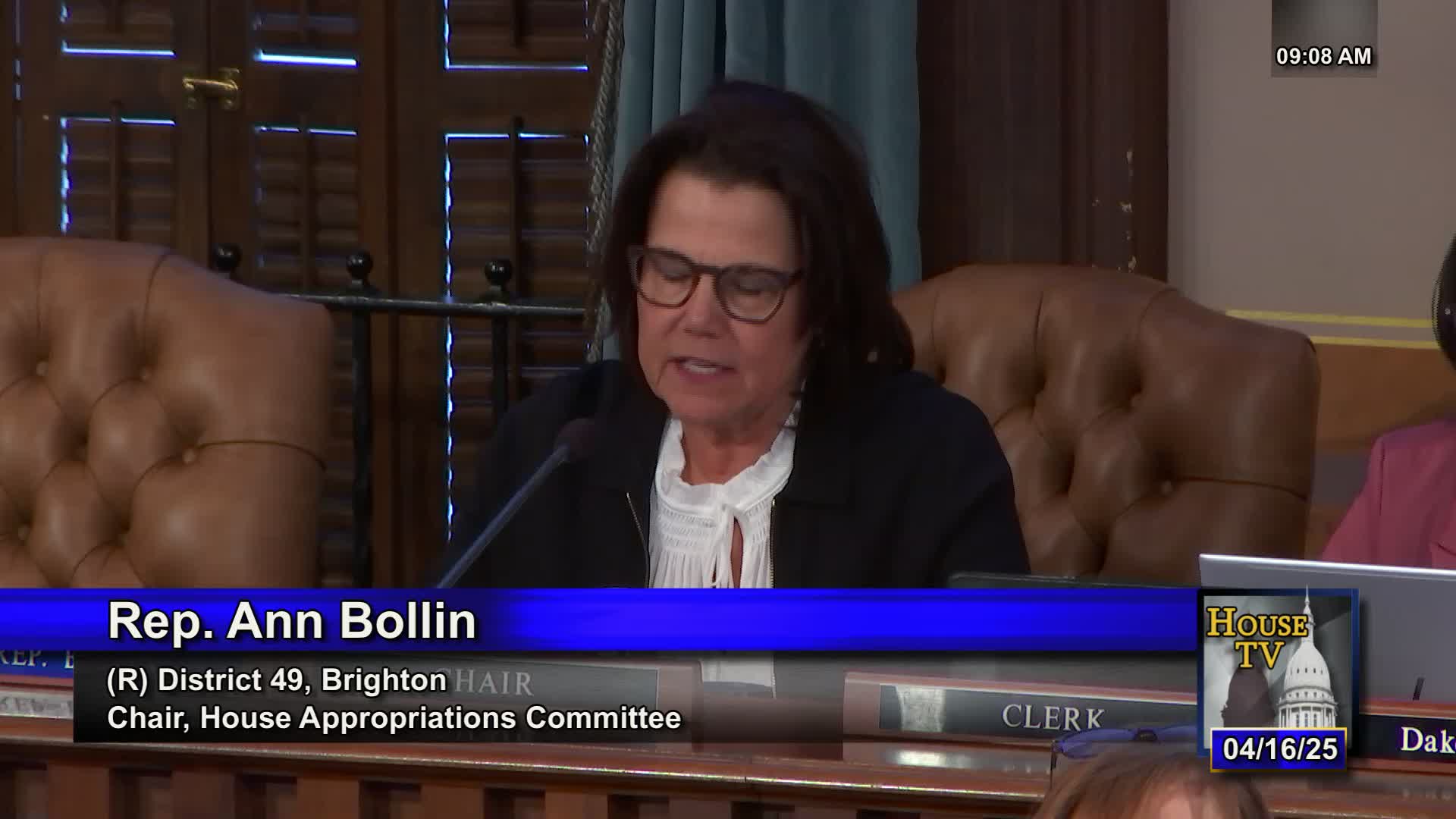
Lansing — On April 16 the Michigan House Appropriations Committee heard testimony that actuarial rate adjustments for fiscal 2024 left the Medicaid health plan services appropriation short roughly $55 million in general fund (about $250 million total), and that midyear retroactive rate changes and rising pharmacy, dental and acuity costs drove the shortfall.
Lansing — On April 16 the Michigan House Appropriations Committee heard testimony that actuarial rate adjustments for fiscal 2024 left the Medicaid health plan services appropriation short roughly $55 million in general fund (about $250 million total), and that midyear retroactive rate changes and rising pharmacy, dental and acuity costs drove the shortfall.
“My name is Dominic Pallone. I’m the executive director of the Michigan Association of Health Plans,” Pallone told the committee as he outlined how the state’s rate‑setting and budget calendar can produce gaps between authorized appropriations and actuarially sound rates. Pallone said waiting for complete claims data before finalizing rates is standard practice but can produce under‑authorization when experience differs from projections.
The testimony framed the shortfall as a timing and experience problem rather than a single policy error. Pallone walked the committee through the fiscal‑year 2024 timeline: the fiscal‑year omnibus appropriation (PA 119 of 2023) originally built in funding to cover up to a 2.5% actuarial adjustment; finalized rates issued before Oct. 1 called for a composite increase of 3.8%; a six‑month prospective adjustment filed in April 2024 added 4.1% (2.05% annualized); and a later six‑month retroactive adjustment of 6.2% (3.1% annualized) pushed FY24 experience to about an 8.95% increase over FY23 levels. Those retroactive adjustments, Pallone and other witnesses said, created the need for a book‑closing supplemental to “gross up” the health plan services and related line items.
Todd Anderson, market president for Blue Cross Complete, said managed‑care plans provide services to hundreds of thousands of Michigan residents and that most dollars paid by plans go directly to providers. “Ninety‑three percent of the dollars that Blue Cross Complete spent last year went to providers,” Anderson said, adding that Blue Cross Complete paid more than $1.3 billion in claims in the prior year and warned that plans can carry arrearages only for a limited time.
Witnesses and committee members identified three primary drivers of higher costs in FY24: rising pharmacy prices and utilization, a higher‑acuity remaining Medicaid population after federal redetermination (which removed many healthier enrollees), and unexpectedly high preventive adult dental utilization after the benefit was moved into managed care. Pallone said the dental result was, in his view, “a good thing” for access to preventive care, even though utilization exceeded actuarial projections.
Several members urged prompt legislative action. Representative Rogers said the committee should “take a hard look at SB 55” (a Senate bill that Pallone noted had been introduced to provide the $55 million general‑fund gross‑up). Pallone and Blue Cross representatives urged the committee to consider the book‑closing supplemental and to coordinate further with the Michigan Department of Health and Human Services (MDHHS) and the state’s retained actuary, Milliman, to determine whether additional midyear rate adjustments are warranted for FY25.
Committee members asked about causes and consequences. Members repeatedly pressed witnesses on actuarial accuracy and selection of actuaries; Pallone described state and plan actuarial processes, including that plans share claims data with a common actuarial vendor (Wakely) and that the state uses Milliman to set uniform rates. Representatives also asked about downstream consequences if payments are not made: Pallone warned plans could eventually exit the market if arrearages persist, reducing competition and choice.
No formal committee vote on a supplemental occurred in the hearing. The only recorded committee action during the session was approval of the Feb. 19 minutes: “Representative Green moves to approve the minutes of February 19 meeting. There being no objections, the minutes are approved.”
The committee was told that the state has an obligation for services rendered but that legislative appropriation timing and the lag in claims data make exact budgeting difficult. Witnesses agreed to continue working with MDHHS, Milliman and the committee to refine projections and to provide enrollment and caseload details requested by members. The committee will consider SB 55, the book‑closing supplemental, and any FY25 midyear adjustments in follow‑up proceedings.
Questions from committee members and witness responses focused on (1) why the rates diverged from projections, (2) the role of redetermination in removing healthier enrollees and increasing average acuity, (3) the magnitude and timing of retroactive adjustments, and (4) the risk that unpaid arrearages pose to plan finances and market competition.
The hearing concluded with Blue Cross scheduled to provide additional technical actuarial testimony later in the session and with the committee moving to other items.