Get Full Government Meeting Transcripts, Videos, & Alerts Forever!
Get email alerts on the Organics And Waste Policy topic
No spam. Unsubscribe anytime.
MassDEP begins midcourse review of 2030 waste plan; officials flag capacity shortfalls, composting decline
Summary
John Fisher, MassDEP staff, opened an April meeting to begin a midcourse review of the Commonwealth's 2030 Solid Waste Master Plan and told attendees the agency is evaluating whether to tighten the commercial food-waste disposal threshold as part of a broader look at capacity and program effectiveness.
John Fisher, MassDEP staff, opened an April organic subcommittee meeting by saying the agency is conducting a midcourse review of the Commonwealth's 2030 Solid Waste Master Plan and that food waste remains a major target for diversion. "This is a really important transition point as we think about our work to advance food waste reduction, recovery and diversion here in Massachusetts," Fisher said.
The meeting covered three linked areas: the state's progress toward the 2030 target for food-waste diversion, the practical capacity for processing separated organics, and potential next steps including whether to lower or eliminate the commercial food-waste disposal threshold. MassDEP reported that food discards represent "over one-fifth" of municipal trash (about 930,000 tons annually in the department's current estimate) and that the state's 2030 goal seeks roughly 780,000 tons diverted annually. As of 2023 MassDEP said diversion stood at about 380,000 tons.
Why it matters: MassDEP has already tightened the commercial disposal ban twice'initially in 2014 (1 ton/week threshold) and again in 2022 (0.5 ton/week), expanding the number of regulated business locations from about 2,000 to roughly 4,000. The agency is now reviewing whether further action is appropriate and how to align policy with available processing and collection infrastructure.
Key numbers and enforcement: Fisher summarized the state's enforcement and outreach to regulated entities. MassDEP reported 145 enforcement actions tied to food-material disposal and 14 higher-level consent orders with penalties for repeat violators. The agency also has sent informational letters to roughly 60 companies covering about 900 locations and relies on its Recycling Works in Massachusetts program to deliver technical assistance; Recycling Works has provided direct assistance on roughly 750 occasions, according to the presentation.
Capacity trends and processing pathways: The subcommittee heard that reported tons to anaerobic digestion (AD) have risen markedly while composting tonnage has declined in recent years. Participants attributed the decline in some composting operations to nuisance/odor and siting challenges. Fisher said the state estimates roughly 500,000 tons of near-term permitted capacity for organics processing in Massachusetts but described that figure as "elastic" because operational constraints, facility closures and inter-state flows change utilization. Several participants urged MassDEP to survey operators to better understand actual operational (versus theoretical) capacity.
Urban systems and wastewater AD: Several municipal and institutional representatives described relying on depackaging and wastewater-treatment AD (including the CORE/Greater Lawrence Sanitary District arrangement) to manage high-contamination urban organics. Mike (Cambridge municipal representative) said, "we simply just can't divert food waste without the CORE," describing operational limits and collection logistics in dense cities. Other participants cautioned that co-digestion with sewage sludge raises separate questions about residuals and environmental outcomes and asked MassDEP to disaggregate tonnages sent to wastewater AD versus composting or farm-based AD.
Finance, permitting and siting: Multiple speakers said larger AD projects have been easier to finance because they can secure energy revenues and attract institutional investors, while smaller compost sites struggle to access project-scale lending and face zoning and community acceptance barriers. Phil Goddard urged MassDEP to "interview the current operators of all types of facilities, understand their motivations and their processes for getting things done, and to coalesce and align the DEP's policies, procedures, permits, financing, grants, interagency cooperation" to smooth development pathways.
Municipal and residential programs: MassDEP said 160 municipalities now report some kind of food-waste collection program (about 82 drop-off programs, 14 curbside programs, nine mixed models, and 55 preferred-vendor agreements). Combined municipal programs reported roughly 22,000 tons collected in the most recent reporting period. MassDEP noted longstanding support programs including Recycling Dividends payments (more than $3 million annually statewide) and competitive grants; in recent years the agency has awarded loans (17 loans totaling about $4.6 million) and grants (17 grants totaling about $1.7 million) for organics-related projects.
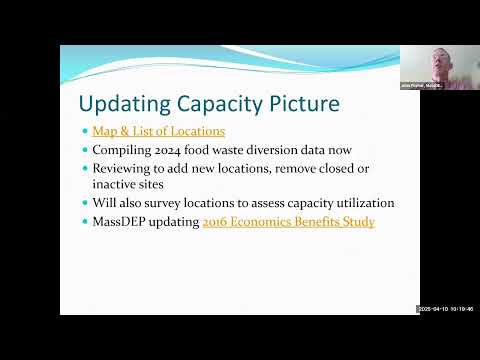
Next steps and open questions: Fisher said MassDEP will update its online GIS map of facilities that accept food material, survey those sites for capacity utilization, and publish refreshed waste-characterization data early in 2026. The department plans additional subcommittee meetings this year, and flagged open questions for future work: whether to lower or eliminate the commercial threshold, how to expand distributed processing without increasing contamination, how to support municipal programs, and how to align grants, permitting and siting to practical developer needs. Fisher said the department has not decided on changing the threshold and is seeking stakeholder input.
Voices from stakeholders: Phil Goddard, a participating stakeholder, said developers need clearer, step-by-step pathways to finance, permit and operate facilities and to secure long-term offtake agreements. John (Second Chance Compost) requested more municipal outreach and assistance to navigate local zoning and boards of health. Sarah, "zero waste manager for Boston University," said her institution uses both compost and AD and supports diversified options to keep contamination low.
What MassDEP will provide: Fisher said the department will post the slide deck and a recording of the meeting, share responses to questions raised on the call, update the facility map and follow up with additional data on grants by subcategory (e.g., AD, depackaging, collection, composting) and on the tonnage routed to wastewater-treatment AD systems.
Ending: No formal policy change or vote occurred at the meeting; participants and MassDEP staff agreed to continue the midcourse review and to schedule further subcommittee meetings for deeper discussion of siting, financing, municipal rollout strategies and waste-characterization updates.