Get Full Government Meeting Transcripts, Videos, & Alerts Forever!
Get email alerts on the Coastal Resilience topic
No spam. Unsubscribe anytime.
State DNR outlines inaugural Coastal Resilience Academy and local resources for Glynn County officials
Summary
A Georgia Department of Natural Resources official described a new leadership academy for elected officials, listed resilience planning documents specific to Glynn County and highlighted local adaptation projects including Lanier Boulevard and a city land purchase for flood mitigation.
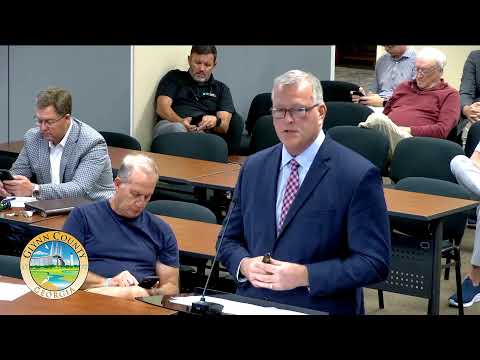
Jennifer Klein, Coastal Management Program, Georgia Department of Natural Resources, told the Glynn County Board of Commissioners on April 15 that the agency ran its first Coastal Resilience Leadership Academy this year to train elected officials from coastal counties.
"Most of that training has been towards for your staff, and not necessarily for elected officials until now," Klein said. She said the January academy, held on Jekyll Island, was designed to "equip locally elected officials with knowledge, tools, and resources and a network needed to build a stronger, more resilient Georgia coast." The academy is biannual and admitted 24 seats this year.
Klein outlined how the program defines coastal resiliency — "stability for a coastal community to adapt to changing conditions and be able to withstand and recover from anything from societal, physical, economic, and ecological disruptions" — and reviewed documents Glynn County can use when planning resilience efforts.
She cited local projects as examples of adaptation work, including a Lanier Boulevard effort in Brunswick that uses a mix of green infrastructure and elevation changes to address combined high-tide and stormwater flooding near Glenn Middle School. She also said the city used grant funding to buy a parcel previously slated for development; the site will be used for watershed delineation and storage to help mitigate flooding.
Klein said the academy drew 16 elected officials in its first cohort and relied on existing syllabi used by state legislative training programs to create consistent terminology across communities. She also said participants received guidance documents such as sea-level rise maps, the State Hazard Mitigation Plan and community-rating-system guidance for flood insurance discounts.
Commissioners asked questions about technical aspects such as whether tide gates would help the Lanier Boulevard flooding; Klein said tide gates are an option in some locations but may be restricted where they would affect marsh hydrology and that other responses—like bioretention rain gardens—have been used.
Klein concluded by noting academy participants will help select future classes, can take site tours of regional resiliency projects and will serve as local contacts for future DNR technical assistance.
The presentation was given at the commissioners' work session; Klein invited questions and stayed for discussion.