Get Full Government Meeting Transcripts, Videos, & Alerts Forever!
Get email alerts on the Land Use Rezoning topic
No spam. Unsubscribe anytime.
Planning commission recommends denying rezoning for concrete-block plant off U.S. 29
Summary
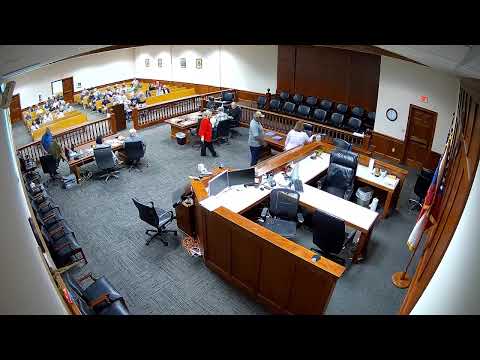
The Madison County Planning & Zoning Commission on an advisory vote recommended the Board of Commissioners deny a request to rezone about 12.64 acres along U.S. Highway 29 South from business to industrial so a concrete-block manufacturing facility could be built there.
The Madison County Planning & Zoning Commission on an advisory vote recommended the Board of Commissioners deny a request to rezone about 12.64 acres along U.S. Highway 29 South from business to industrial so a concrete-block manufacturing facility could be built there.
The petition, presented by engineer Brian Kinsey for LJ Erbork Inc., would have rezoned the rear portion of a commercially zoned parcel to allow construction of a roughly 25,800-square-foot block-manufacturing building, a 3,200-square-foot storage structure and outdoor aggregate storage. The company’s proposed hours are about 8 a.m. to 5 p.m., with a planned maximum of about 10 employees, an estimated 40 vehicle trips per day, and an anticipated potable-water use of about 2,000 gallons per day.
Neighbors and the applicant gave competing accounts of the project’s local effects. David Kerrick, speaking for the Bryce Landing Phase 2 Homeowners Association, asked the commission to deny the request and cited the Madison County 2020–2040 Comprehensive Plan and the plan’s designation of the Daldesboro area for commercial/retail uses. “This site adjoins a residential subdivision on two sides, a church on a third side, and that alone should prevent the rezoning of this parcel to industrialization,” Kerrick said. Several other residents raised concerns about dust, noise, truck traffic and stormwater runoff during the public hearing.
The applicant and company representatives said they had planned buffers and engineering controls to reduce impacts. Engineer Robert Skinsburg and company representative Steven Banks described a 50-foot vegetative buffer and berm between the facility and nearby homes, a retention pond, and dust-control measures. Banks said the plant would use paved exterior roads, dust collection systems and minimal exterior lighting; he also said an on-site silo would be the tallest structure, at roughly 50 feet. The applicant provided a sound study the company said showed noise of about 46 decibels at 1,000 feet from the building with exterior doors closed.
Commission members pressed the applicant on specifics the application had not yet finalized. Commissioners asked whether the applicant had secured potable-water and wastewater capacity letters (the applicant said water discussions had begun but a formal capacity letter had not been obtained), whether the outdoor aggregate yard would be paved (the applicant said front areas and access would be paved but bulk outdoor storage would remain gravel), and how the company planned to enforce dust controls on truck traffic. The applicant acknowledged the back area would include outside storage for raw materials such as sand and stone.
The comprehensive-plan compatibility was a focal point for several commissioners and many members of the public. Commissioner Bruce Gandy, who moved to recommend denial, framed the question as a tension between private property rights and the county’s adopted land-use vision. “The desire to maintain the county’s rural and natural qualities by preserving agriculture and environmental resources ... is the basis for us weighing in on the landowner’s request,” Gandy said during deliberations. Cynthia (last name not specified in the record) seconded the motion to deny. The commission then voted to recommend denial and told both sides to present their cases again to the Board of Commissioners at the next public hearing.
The commission’s recommendation is advisory only; final approval would rest with the Madison County Board of Commissioners. The commission chair reminded attendees that a second public hearing before the Board of Commissioners is scheduled for May 5 at 6 p.m. in this location and encouraged both the applicant and opponents to attend.
Votes at a glance
• Item 5 — LJ Erbork / 0 Highway 29 South: Mover: Bruce Gandy; Second: Cynthia (surname not specified). Recommendation: recommend denial to the Board of Commissioners (advisory). Vote: motion carried (commission recorded as recommending denial).
Context and next steps
Because the commission’s vote was a recommendation, the application will go to the Board of Commissioners for a final decision at the advertised second public hearing. The applicant has not provided a wastewater/water-capacity letter in the public record and the record shows outstanding questions about paving of the aggregate yard, final stormwater controls and enforceable dust mitigation for truck traffic. Several neighbors requested the board weigh comprehensive-plan consistency and cumulative impacts to neighborhood property values, traffic safety at the U.S. 29 left-turn location and long-term land-use changes if industrial zoning is permitted in the area.
Ending
The commission’s recommendation to deny does not bar the applicant from presenting additional studies or revised site plans to the Board of Commissioners; the applicant and opponents were told to attend the May 5 public hearing for the next decision stage.