Get Full Government Meeting Transcripts, Videos, & Alerts Forever!
Get email alerts on the Nih Funding Cuts topic
No spam. Unsubscribe anytime.
Governor Healey warns NIH funding cuts threaten UMass Chan research and regional economy
Summary
Governor Maura Healey visited UMass Chan Medical School in Worcester to warn that recent National Institutes of Health funding actions and proposed federal budget cuts are threatening research, jobs and patient care; university leaders and a Nobel laureate described hiring freezes, rescinded offers and paused grants.
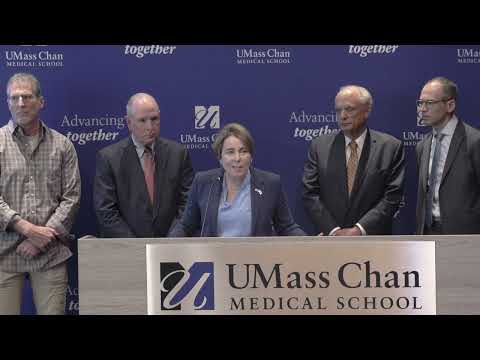
WORCESTER, Mass. — Gov. Maura Healey on Monday urged federal officials and Congress to restore National Institutes of Health funding after she and UMass Chan leaders described halted grants, paused faculty recruitment and rescinded offers that they say are already affecting research and patient care.
“Today, we stand with the scientists. We stand with the researchers,” Healey said during remarks at the Paul J. DeMare Center for Education and Research on the UMass Chan Medical School campus, where she toured facilities and met with faculty. She described federal actions that have led to withheld grant payments and funding uncertainty for laboratories and trainees.
The governor and university officials said the cuts are already concrete: UMass Chan received $193,000,000 in NIH awards last year; more than $30,000,000 in expected grant funding has been withheld so far this year and another $50,000,000 is at risk, Healey said. University leaders told the governor that the program reductions have forced class-size cuts, paused faculty recruitment and rescinded offers to prospective students and postdoctoral researchers.
Those developments, university leaders said, ripple through the local economy. Healey noted UMass Chan employs about 6,000 people in Greater Worcester and cited an estimated $2,000,000,000 in annual economic impact from the institution. She also noted the campus hosts a VA outpatient program serving nearly 20,000 veterans and that many clinical affiliates provide care across the Commonwealth.
Chancellor Michael F. Collins described the NIH process and the uncertainty that followed the agency’s administrative changes: “NIH funding was like the sun. It comes up every day,” Collins said, noting that previously fundable grant scores have not been converted into awards and that a reported change to institutional reimbursement rates over a recent weekend added to the disruption.
Chancellor Collins and others said those reimbursement-rate changes were challenged in court by state attorneys general and that courts initially issued a temporary injunction and later a permanent injunction; university leaders said they are awaiting clarity on how and when funds will flow.
Nobel laureate Craig Mello, who addressed the group, framed the consequences in human terms: “My heart breaks every day for the patients and the families who could benefit from the work that’s going on here,” he said, citing genetic therapies and other advances made possible by NIH-supported research.
Healey tied the NIH actions to other federal funding proposals that she said would further stress health care and research. She cited a congressional budget proposal and administration actions she said include proposed Medicaid reductions that could affect about 2,000,000 Massachusetts patients and layoffs at the U.S. Department of Veterans Affairs. Healey said the state cannot fully replace lost federal funding and urged federal action and public advocacy to restore research support.
University officials described specific operational effects: paused grant awards in the $25,000,000–$40,000,000 range that have already received fundable scores, layoffs, and offers to graduate and postdoctoral candidates that were rescinded or delayed. Collins said the NIH study-section review process has “more or less ground to a halt” for some awards and that uncertainty is prompting institutions to use internal funds where possible to retain staff temporarily.
Healey also warned of broader economic consequences, saying life-sciences research supports construction, real estate, supply chains and neighborhood businesses that serve campus staff and students. She said the result could be lost jobs and slower local growth if researchers relocate or are recruited by institutions in other countries.
The speakers urged a range of responses rather than a single local remedy: continued litigation and advocacy, congressional action to ensure appropriated funds are disbursed, and coordination among states, philanthropy and industry to support affected researchers and trainees. Healey said the state’s budget cannot fully absorb the shortfall and reiterated that her administration would back life-sciences programs and advocacy efforts.
No formal action or vote occurred at the event. University leaders, the governor and the Department of Public Health commissioner said they will continue to press NIH, the administration and Congress for clarity and restoration of funds.