Get Full Government Meeting Transcripts, Videos, & Alerts Forever!
Get email alerts on the Transportation Finance topic
No spam. Unsubscribe anytime.
Substitute SB 5802 would pause several transportation-related fund transfers; unions warn of trade-offs for operating budgets
Summary
Committee staff briefed lawmakers on a substitute to SB 5802 that temporarily suspends several scheduled transfers and sales-tax deferrals tied to major transportation packages and accelerates repayment of some deferrals; labor witnesses said the transfers would worsen operating budget shortfalls and risk cuts to services.
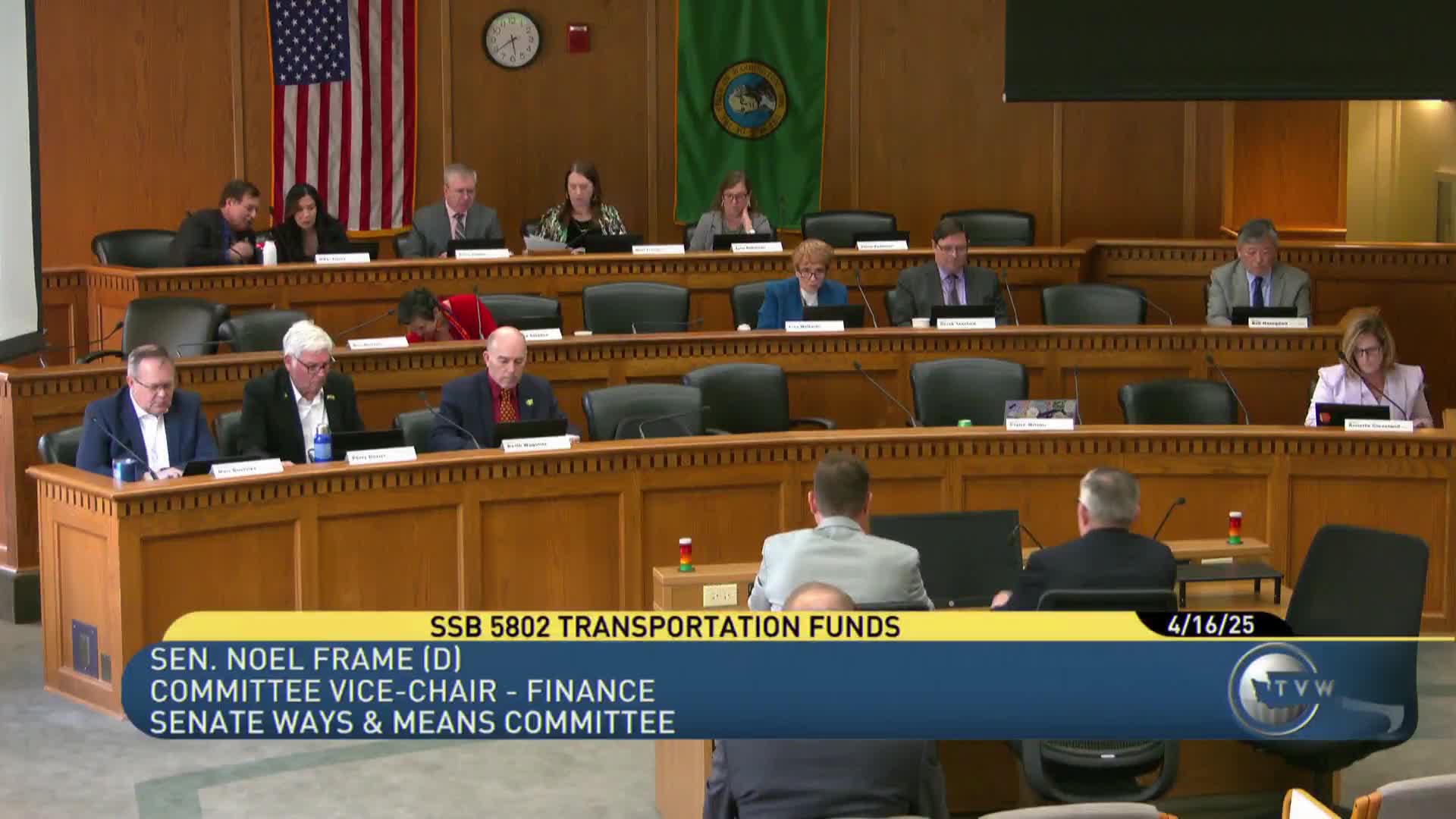
Committee staff told the Ways & Means Committee that substitute Senate Bill 5802 would revise multiple long-term fund transfers and sales‑tax deferrals that have supported transportation projects, pausing some transfers in the 2023–25 biennium and accelerating repayment of certain deferrals.
Brian Moore, transportation committee staff, explained that the bill pauses transfers tied to the 2016 Connecting Washington package and the 2022 Move Ahead Washington package for the 2023–25 biennium and would accelerate repayment on some sales‑tax deferral paybacks — including the Tacoma Narrows Bridge and SR 520 projects — so those repayments would be made by the end of FY 2026. The bill also temporarily suspends transfers from the Public Works Assistance Account and includes a permanent 0.1 percentage-point dedication of a portion of the state sales-and-use tax to the Multimodal Transportation Account.
Moore said the near-term effect is a gain to the general fund for the first three years followed by lower transportation revenue over the longer term. Staff presented a multi-year schedule showing roughly $609 million of budget relief spread across specified items through the 2025–27 biennium and assumptions that two annual payments of about $304.7 million would be scheduled for later years.
In public testimony, Katie Durkin of the Washington Federation of State Employees opposed the measure, saying that the Senate transportation budget already included more spending than the House and that the deferred transfers could make operating budget shortfalls worse in the next biennium. Andrew Villeneuve of the Northwest Progressive Institute also urged removing future general‑fund transfers from the bill, arguing that the transfers would divert hundreds of millions to transportation at the expense of the state's "paramount duty" for education and other services.
The committee heard no formal votes on the bill. Staff said a more extensive bill report and tables are available for members seeking line‑by‑line details.