Get Full Government Meeting Transcripts, Videos, & Alerts Forever!
Get email alerts on the Land Use Rezoning topic
No spam. Unsubscribe anytime.
Nevada council approves first reading to rezone former Story County Medical Center for 60 apartments amid heated neighborhood debate
Summary
The Nevada City Council voted to approve on first reading Ordinance 1064 to rezone 630 Sixth Street — the former Story County Medical Center north campus — from R‑3 to R‑4 to allow a 60‑unit apartment redevelopment called Nevada Flats.
The Nevada City Council voted to approve on first reading Ordinance 1064, a rezoning measure to change 630 Sixth Street — the former Story County Medical Center north campus — from R‑3 to R‑4 so the property can be redeveloped as a 60‑unit apartment project called Nevada Flats.
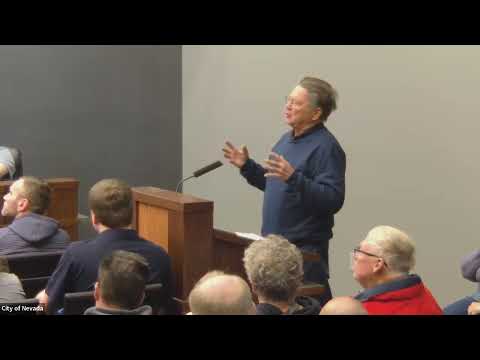
The measure cleared its first of three readings after a public hearing that drew more than two hours of testimony from residents, local business owners and project supporters. Mayor Condon opened the hearing and dozens of neighbors spoke for and against the rezoning.
The dispute centers on two competing priorities: the city’s long‑running need for more housing and neighbors’ concerns about density, parking and changes to the character of an established single‑family neighborhood. Sarah Clawson, who lives four blocks away, urged the council to approve the rezoning, citing the city’s slow population growth and the chance to repurpose a large vacant building. “I’m asking you to support ordinance 1064 and rezone the property we’ve all known as the Old Story County Medical Center and allow it to be repurposed for family dwelling,” Clawson said. She told the council Nevada’s population growth trailed nearby towns: “For example, from 2010 to 2020, Huxley grew 28 percent, Gilbert grew 7 percent. Nevada actually had a negative 2 percent growth.”
Business owners and economic development backers also supported the project. Tyler Smith, owner of Anytime Fitness, said a local developer had sought partnerships with businesses and that more housing would help keep employees in Nevada: “We need growth … the increase in property tax, increase in energy, while not gaining growth in the city is getting increasingly hard on small businesses.” Scott Henry, a Nevada Economic Development Council board member, told the council the project aligns with the Vision 2040 strategy and noted prior local approvals and grant awards that underpin the redevelopment effort.
Opponents focused on unit count, parking, traffic and neighborhood character. Tom Richards and multiple neighbors argued 60 units is too many for the block and described the surrounding area as predominantly owner‑occupied single‑family housing. Several residents cited street parking problems and expressed skepticism that proposed off‑site or angled parking would be reliably available to tenants: “A parking lot across the street from us … car alarms going off at any time of the day, revving engines, motorcycles,” Marsha Grama said. Neighbors also raised questions about whether the project’s grant conditions legally required 60 units and whether alternate plans were adequately explored.
Project representatives said they revised the site plan to add angled parking, will use permeable pavers to limit runoff and plan to restrict many units to single‑occupancy leases. Architect Steve Emerson said asbestos abatement bids are in hand and that removal — not encapsulation — is planned for residential safety standards. He said the management company recommended “one parking spot per bedroom” as a lease policy and that the design includes mostly one‑bedroom and studio units aimed at workforce and retiree demand.
Council members listened to the testimony and discussed neighborhood outreach and traffic studies. At least one council member explicitly said the neighborhood outreach should have occurred earlier. After discussion the council moved and seconded approval of the zoning ordinance; the motion passed on first reading. The ordinance will require two additional readings before final adoption.
Actions and next steps: Ordinance 1064 passed by the council on first reading; two more readings are required before final adoption. The council and staff signaled plans for further outreach and possible traffic/parking studies regardless of the final vote.
Provenance: Transcript public hearing began (topicintro) at 74.375 with the mayor introducing item 4 and ended (topfinish) at 4369.605 when the ordinance motion was taken and the first reading recorded.
Ending: With the first reading approved, opponents say they will remain engaged for the remaining two readings and pursue changes to parking and unit mix; supporters say the project will reuse a large vacant structure and add housing that local businesses need.