Get Full Government Meeting Transcripts, Videos, & Alerts Forever!
Get email alerts on the Coastal Rail Resiliency topic
No spam. Unsubscribe anytime.
California Transportation Commission approves emergency funding to shore up coastal rail at San Clemente
Summary
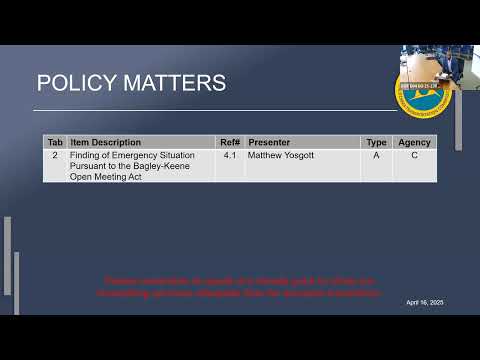
The California Transportation Commission on April 14, 2025 adopted an emergency finding under the Bagley-Keene Open Meeting Act and approved advanced, multi-program funding to allow immediate work on a damaged segment of the LOSSAN rail corridor in San Clemente.
The California Transportation Commission on April 14, 2025 voted unanimously to find an emergency exists under the Bagley-Keene Open Meeting Act and to approve advanced funding that will let emergency repairs begin on a damaged section of the Los Angeles–San Diego–San Luis Obispo (LOSSAN) rail corridor near San Clemente.
Commission staff member Matthew Yoscott told commissioners the finding “is necessary to hold today's emergency meeting” and that the action is intended to protect the public interest by allocating funds from the Trade Corridor Enhancement Program and the Transit and Intercity Rail Capital Program to allow work under Emergency Coastal Development Permit G5250013. He said repeated coastal bluff erosion, landslides and storm-driven beach and embankment loss have forced repeated shutdowns since February 2021 and pose an imminent risk to rail service, life and property.
The nut of the item: commissioners split a previously programmed $80,000,000 Coastal Rail Infrastructure Resiliency Project so an emergency component can be advanced immediately and the main construction scope can return later for allocation. Under the program amendment (Tab 3), the emergency component was shown as $4,992,000 while the main construction component remains programmed with the remaining $75,008,000. Separately, commissioners approved an advanced, multi-funded allocation request (Tab 5) of $9,984,000 to allow work authorized by the California Coastal Commission permit to proceed through a cooperative agreement between the Orange County Transportation Authority and the Southern California Regional Rail Authority (Metrolink).
Beverly Newman Burkhart, presenting the programming amendment and allocation packages, noted a correction to the posted materials: the Southern California Regional Rail Authority, not OCTA, will be the implementing agency for this stage of emergency work. She said staff reviewed the requests and recommended approval.
The staff presentation cited several operational impacts: past closures have “severed the only rail connection between San Diego County and the rest of the nation,” affecting millions of annual passengers and more than $1,000,000,000 in annual freight movement, and the corridor supports military logistics and other strategic freight and passenger connections. The California Coastal Commission issued Emergency Coastal Development Permit G5250013 on April 10, 2025; the Orange County Transportation Authority adopted Resolution 2025-25 on April 14, 2025 to authorize immediate action and to waive competitive procurement for emergency work.
Public comment was limited. Jennifer Bergner, deputy CEO of the Orange County Transportation Authority, thanked the commission for acting quickly and said OCTA appreciated the coordination that allowed the work to proceed. Vice Chair Falcone also thanked staff and partner agencies for rapid coordination.
Formal actions taken at the meeting included: (1) adoption of the Bagley-Keene emergency finding (Tab 2), (2) approval of a programming amendment to split the Coastal Rail Infrastructure Resiliency Project so an emergency component can be advanced (Tab 3), and (3) approval of an advanced multifunded allocation totaling $9,984,000 for the emergency component (Tab 5). Commissioners moved and seconded the motions on the record and the roll-call votes recorded unanimous approval for all three items.
The meeting record shows the work is intended to address immediate slope and embankment failures authorized by the emergency coastal permit; the staff presentations said further main-construction work remains programmed at $75,008,000 and will return to the commission for future allocation. No specific procurement contracts or construction schedules were presented in detail at this meeting. The commission adjourned after brief remarks thanking staff and agency partners for coordination.