Get Full Government Meeting Transcripts, Videos, & Alerts Forever!
Get email alerts on the Land Use Zoning topic
No spam. Unsubscribe anytime.
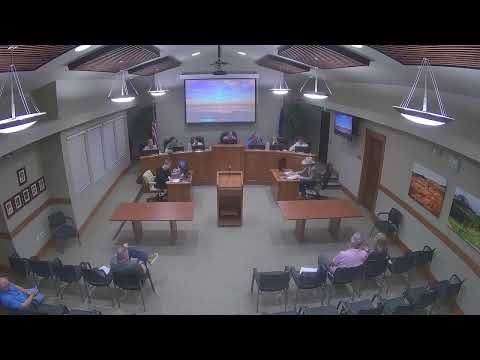
Parowan planning commission tables ‘Rural Done Right’ Title 15 zoning amendments after public questions on density, ADUs and manufactured housing
Summary
The Parowan Planning and Zoning Commission held a public hearing and detailed discussion of proposed amendments to Title 15 of the municipal code—branded “Rural Done Right”—and voted to table a recommendation to the City Council after residents and commissioners raised questions about lot sizes, accessory dwelling units and manufactured‑home rules.
The Parowan Planning and Zoning Commission held a public hearing and detailed discussion of proposed amendments to Title 15 of the municipal code—branded “Rural Done Right”—and voted to table a recommendation to the City Council after residents and commissioners raised questions about lot sizes, accessory dwelling units and manufactured-house definitions.
Residents pressed the commission on specifics during the public hearing, especially how the draft would treat short-term rentals, smaller lots in R1/R2/R3 zones, and whether manufactured homes would be limited to subdivisions. Staff and commissioners agreed to return with clarified language before forwarding a recommendation to the City Council.
The amendments in discussion would change permitted lot sizes, minimum dwelling sizes and how planned unit developments (PUDs) are handled in Parowan’s R1, R2 and R3 zones. Dan (city planning staff) said the code changes are intended to “find a balance” that preserves a rural, small‑town character while allowing more affordable housing options. “Rural Done Right is not meant to just upzone the city. It is meant to find a balance,” Dan said.
Why it matters: The package would alter what property owners can build without special approvals and what must come through conditional reviews. That affects housing affordability, subdivision design, infrastructure needs and how future annexations will be developed.
Most important details
- Public concerns and staff responses: Cindy Smith (resident) asked how a proposed short-term rental rule that would limit rentals to owner‑occupied properties would operate in practice. Dan said short-term rental rules are a separate piece of work and will be developed after the zoning changes; the owner‑on‑site requirement is intended to limit corporate investors from buying up housing stock.
- Lot-size and minimum dwelling changes: Under the draft, R1 single‑family minimum lot and house-size rules would remain largely unchanged (10,000‑square‑foot lots and 1,000‑square‑foot minimum as discussed). The draft would allow smaller lots by right in R2 (proposed 7,500‑square‑foot lots for single‑family homes) and R3 (6,000‑square‑foot lots), and would raise the number of duplex/twin‑home options relative to the current code. One commissioner proposed lowering the minimum single‑family dwelling in R2 to 700 square feet and to 300 square feet in R3; that motion was made but received no second and did not advance.
- Planned unit developments and cottage/cluster subdivisions: The draft would sharply limit PUDs but keep them as a conditional tool for specific cases—mixed‑use buildings, commercial subdivisions with separate ownership, and cottage‑courtyard/cluster subdivisions that share common open space. Dan said cottage‑courtyard or cluster developments would remain allowed via the PUD/conditional‑use process and would be capped by density: roughly 4 homes per acre in R1, 6 per acre in R2 and 10 per acre in R3, with required plans for common areas, design variation and maintenance.
- Manufactured homes: The draft treats manufactured housing similarly to site‑built housing once a unit is permanently affixed and recorded with an affidavit of fixture. The code would require a conditional‑use review for a subdivision made up of 80% or more manufactured homes, to ensure variation in design and compliance with subdivision standards.
- ADUs (accessory dwelling units): City staff said the internal ADU code (15.45) and external ADU code (15.49) exist and that external ADUs should be explicitly added as permitted uses in residential zones to align the zoning text with the ADU chapter. The commission directed staff to insert the permitted‑use language.
- Infrastructure and water: Several speakers asked whether developers must install streets, water, sewer and other infrastructure. Dan said developers must provide the subdivision‑level infrastructure their project requires; the city can negotiate system‑level improvements that exceed the project’s direct impact only through voluntary agreements, consistent with state law on exactions.
- Parking and gas pumps: Commissioners noted the code’s cross‑references to parking requirements are vague. Staff recommended leaving parking review with the Planning and Zoning Commission for the moment and to consider a separate, comprehensive parking code later. Gas stations and pump setbacks were discussed as uses that merit special review.
Public comment highlights
- Cindy Smith, resident: Asked how an owner‑on‑site short‑term‑rental requirement would work in practice and urged clearer definitions for “cottage/courtyard” subdivisions and what the marketing phrase “cookie‑cutter” means in code.
- Larry Zajac, resident and former Planning Commission member: Urged clearer formatting of the draft, asked that external ADUs be explicitly allowed in zoning sections, and pressed for precise cross‑references for uses such as gas pumps and parking.
- Brian Whitmore, resident: Said he was worried Parowan could grow too fast and become like larger nearby towns if density and multiunit housing were allowed without careful limits.
Commission action and next steps
- The commission did not forward a positive or negative recommendation to the City Council at this meeting. A motion to give a negative recommendation was made and failed for lack of a second.
- The commission adopted a motion to table the Planning and Zoning Commission’s recommendation to the City Council on the Rural Done Right Title 15 amendments so staff can (1) clean formatting and cross‑references, (2) add explicit zoning references for external ADUs, (3) clarify manufactured‑home definitions and the 80% threshold for manufactured‑home subdivisions, and (4) return with a concise summary page that shows before/after changes for R1/R2/R3. Commission staff said they will return with clarified language and an updated summary before the council deadline.
Votes at a glance
- Approve minutes (04/02/2025) — Motion made and seconded; approved (voice vote).
- Move into public hearing on Title 15 amendments — Motion made and seconded; approved (voice vote).
- Close public hearing and reenter regular meeting — Motion made and seconded; approved (voice vote).
- Motion to propose changing R2 minimum single‑family dwelling to 700 sq ft and R3 minimum to 300 sq ft — Motion made; no second; motion failed (died for lack of second).
- Motion to give a negative recommendation to the City Council on the proposed Title 15 amendments — Motion made; second not provided; motion failed for lack of second.
- Motion to table the commission’s recommendation to the City Council on the Rural Done Right amendments — Motion seconded and approved.
What comes next
Staff will return with cleaned formatting, clarified cross‑references and a short summary comparing existing and proposed standards for R1, R2 and R3. The commission directed staff to prepare the language for external ADUs to be listed as permitted uses in the residential zones and to bring back clarifications on manufactured‑home definitions and the conditional‑use threshold. The commission said it wants to resolve remaining questions before forwarding a recommendation to the City Council.