Get Full Government Meeting Transcripts, Videos, & Alerts Forever!
Get email alerts on the Our Lady Of The Snows Ownership topic
No spam. Unsubscribe anytime.
Alta residents urge ACE ownership as council weighs purchase of Our Lady of the Snows
Summary
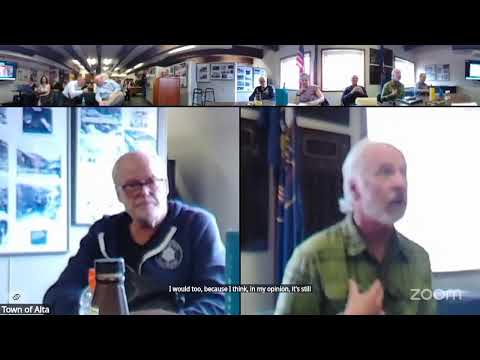
Alta Town Council members and more than 50 public commenters debated whether the town should buy Our Lady of the Snows, the small chapel and community building on U.S. Forest Service land that has long hosted Alta Community Enrichment (ACE) events.
Alta Town Council members and more than 50 public commenters debated whether the town should buy Our Lady of the Snows, the small chapel and community building on U.S. Forest Service land that has long hosted Alta Community Enrichment (ACE) events.
At the April 15 special meeting, dozens of residents, current and former ACE staff and board members, and volunteers urged the council to let ACE — the nonprofit that runs most programming at the site — buy OLS rather than the town. Council members said they had conducted closed, legally permitted real-estate discussions and were still considering whether to submit a formal public offer. No formal council vote or final purchase agreement was announced.
The decision matters because OLS is a primary home for ACE programming, community events and some religious services, and the property sits on a special-use permit on U.S. Forest Service land. Supporters said ACE ownership would protect the organization’s programming and donor commitments; opponents and some council members said the town owning the building could preserve public access, make capital improvements and protect a scarce community asset.
Residents and ACE representatives described years of use and fundraising tied to OLS. Connie Marshall, an early organizer and long-time manager of OLS events, urged the council not to forget ACE’s service: “I favor recommending ACE to be the owner because of their long years of usage and their familiarity with ability and respect and care shown purposes,” and later said, “Without a doubt, the town would be truly an excellent steward for the future of that space.” Sarah Gibbs, identified in public remarks and by commenters as ACE’s executive director, told the council she had been told “our rent will not change,” and said ACE needed certainty to continue programming.
Several speakers described technical and financial constraints tied to the property. Connie Marshall said bookings have historically supplied “over 90% of the building’s upkeep.” Multiple commenters noted deferred maintenance items — including stairs and patio repairs and winter access — that will require capital spending regardless of owner. A longtime resident and former ACE treasurer, Evan Tobin, urged the council to withdraw a competing letter of intent and allow ACE to be endowed with the building, calling the structure “on a special use permit” with limited real-estate value and noting that ACE has long-term programming that the town cannot easily replicate.
Council members and staff repeatedly explained the legal process they followed. Cameron Platt, the town attorney, said governments must follow public-meeting rules for binding real-estate offers: “Governments cannot function that way. We cannot submit an offer that is binding until it's done in a public meeting,” he said, explaining why the council had discussed strategy in closed session. Platt and other staff said those closed discussions were permitted under state law for real-estate negotiation and that any binding offer would be disclosed and debated in an open council meeting.
Council members acknowledged competing priorities. Staff presented the town’s capital projects balance (reported in the meeting as roughly $1.7 million) and warned a purchase would draw down reserves substantially. Several speakers, including Council member John Byrne during public remarks, and commenters cited other capital needs — upgrades recommended in a town facilities study, a marshal’s office, water-system work and public restrooms — as higher-priority uses for town funds. One council member suggested a compromise: the town could buy the building but enter a long-term master lease (for example, 30 years) with ACE to preserve ACE’s operational control while keeping the property in public ownership.
Public commenters urged transparency and quicker clarity because ACE’s current lease and the diocese’s timetable create deadlines. ACE representatives and supporters said the diocese notified multiple parties in December that it planned to sell; ACE submitted a bid, and, at one point, the diocese indicated it preferred the town’s letter of intent over ACE’s. Commenters said ACE faced calendar and revenue uncertainty — ACE’s seasonal lease/arrangements were described as running through late June — and some ACE staff said they have been unable to schedule bookings beyond the end of June while the future remains unsettled.
Several residents proposed specific compromise language the council could consider in an open meeting: a town purchase with a long-term master lease and nominal rent to ACE; a right of first refusal for ACE if the town later sells; or a minority-town participation (10%) in return for protections such as a first-right-of-refusal. Council members said those and other options would be considered in public as part of a forthcoming decision process.
Next steps announced in the meeting: council members said staff would assemble documents and present binding terms in an open public meeting before any final commitment. The council did not announce a date for that meeting at the session; town staff acknowledged time constraints created by ACE’s event calendar and the diocese’s schedule but said they intended to bring an open meeting decision as soon as practicable. ACE’s representatives asked the council to consider written assurances of continued ACE use if the town bought the property; the town attorney said such terms would be part of the public contract discussion.
For now, the council has not approved any purchase. The diocese has already indicated it favored the town’s letter of intent, ACE has a donor offer and a submitted bid, and community members remain sharply divided about which ownership path best protects OLS and ACE’s programming. The council suggested further work sessions and an open public meeting to resolve the next formal steps before any binding offer is finalized.