Get Full Government Meeting Transcripts, Videos, & Alerts Forever!
Get email alerts on the State Budget School Funding topic
No spam. Unsubscribe anytime.
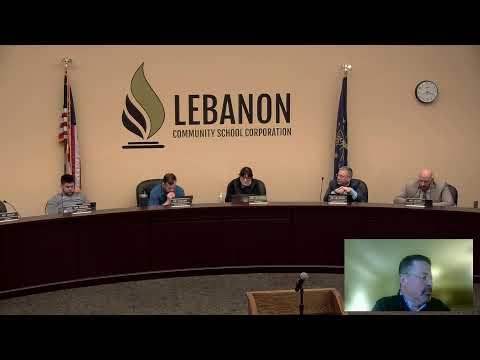
Lebanon superintendent defends public schools, warns state budget and vouchers will squeeze local funding
Summary
Superintendent Dr. Milliman told the Lebanon Community School Corp. board that standardized-test comparisons and recent state budget changes are mischaracterizing public schools and will reduce local school funding; he defended Hattie B. Stokes and outlined likely budget hits from the 2025 state budget and Choice Scholarship (voucher) program.
Superintendent Dr. Milliman told the Lebanon Community School Corp. school board that recent rhetoric and legislative action are mischaracterizing public schools and that changes in state funding will have serious financial consequences for districts across Indiana.
Milliman said the district’s mission — “we challenge everyone every day to reach a new best” — and its commitment that “all means all” underlie local practice, and he urged the community not to treat a single standardized test as the sole measure of school quality.
The superintendent said the Choice Scholarship program — commonly called vouchers — and the state budget passed at midnight produced several outcomes he described as harmful to public education. “If the Choice Scholarship Program was its own line item in the state budget, it would be the fifth highest line item in the entire state budget,” Milliman said. He said the voucher program has shifted taxpayer obligations without noticeably changing the statewide share of students enrolled in public schools.
Nut graf: Milliman framed the comments as a defense of district staff and students after what he described as public rhetoric favoring private or specialized schools. He also summarized key provisions in the 2025 state budget that he said will reduce revenue for public schools and change how local governments may respond.
Milliman cited three budget and policy points that he said matter locally: (1) a phased elimination of the business personal property tax, which he said historically contributes about 12% of the district’s operations levy; (2) a $300 homeowner tax credit added late in the session; and (3) a statutory carve-out preventing public schools from receiving local income tax revenues cities and counties might increase to offset lost property tax revenue. He said his office’s conservative estimate is that public schools statewide could lose at least $744 million in revenue over the next three years and estimated Lebanon schools could lose about $950,000 next year because of the homeowner credit.
Milliman also described operational differences between public and private/choice schools. He noted that some private “choice” schools, including a named example — Premier Soccer Academy in Noblesville — can set selective admission criteria (for example, athletic aptitude). He said that distinguishes choice schools from public schools, which must accept students regardless of aptitude or need.
On assessment, Milliman stressed that standardized tests are an important data point but not the primary determinant of teacher or school quality. “There are great teachers and great administrators that love their kids in all types of schools,” he said, adding that the district emphasizes growth and multiple measures in teacher evaluation.
He also defended Hattie B. Stokes Elementary against public criticisms, noting that small differences in third-grade iLearn scores can reflect a handful of students and the presence of self-contained special-education programs. He said Hattie B. Stokes has experienced leadership and staff and that the district includes special-education students in leadership and planning efforts.
Milliman recommended community members review long-running public-opinion data and assessment research he cited by name (Gallup; James Popham; John Tanner, BraveED) to understand how assessment should be used in public discussion. He closed by reiterating his support for staff and offering to answer questions.
Ending: Board members thanked Milliman for the presentation and moved on to legislative updates and routine business.