Get Full Government Meeting Transcripts, Videos, & Alerts Forever!
Get email alerts on the Public Records Bodycams topic
No spam. Unsubscribe anytime.
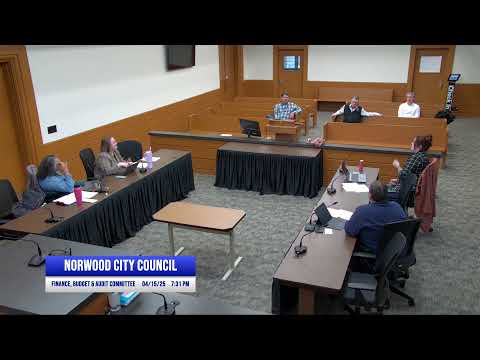
Norwood committee weighs fee for police body‑camera records, seeks more public input
Summary
The Norwood Law & Safety Committee discussed a proposed ordinance to charge $50 an hour for police body‑camera and other digital public‑records requests, citing staff burden and redaction costs; committee members pressed for indigency safeguards, clearer retention rules and additional community comment before further readings.
Norwood’s Law & Safety Committee debated a proposed ordinance to set a fee for police body‑camera and other digital public‑records requests, with staff saying the $50‑per‑hour charge is intended to cover redaction and processing costs and members raising concerns about indigency protections and record retention.
Committee members and staff said the change responds to a recent Ohio law that allows higher fees for certain public‑records requests and to growing demand that has created a backlog for police staff. “Body cams are an invaluable tool,” Lieutenant Klingelhoeffer said. “What a lot of the public might have thought was they’re going to find a lot of officers doing a lot of wrongdoing. What they actually found is a lot of officers are doing the right thing.”
The committee’s safety service staff and police presenters described hours of labor required to prepare footage for public release: viewing all video, performing frame‑by‑frame redactions to protect juveniles and private data, and responding to high‑volume commercial requests. “We are doing lower than that, which I think is great — $50 an hour,” said Mr. Powers, who described the department’s current proposed charge and noted commercial request volumes as a driver of the proposal.
Council members pressed for clearer exceptions and administrative safeguards. One member asked whether eligibility for a reduced fee could be tied to an indigency affidavit or public‑assistance proof; staff warned that collecting financial information would raise retention and privacy concerns. The committee’s safety service director framed the tradeoff bluntly: “What do we want the police department to be doing? Do we want them policing? Do we want them out interacting with citizens? Or do we want them responding to public records requests?”
No final vote was taken. Committee members agreed to bring the ordinance back to the full council for further readings and public comment and asked staff to prepare possible amendments addressing indigency exceptions, administrative processes for fee waivers, and notice language about common commercial requests. The clerk was directed to schedule a follow‑up law committee meeting and to publish notice so residents may comment before the ordinance proceeds to additional readings.
Background: speakers told the committee that Ohio’s recent statutory changes allow higher local charges (the state law cited in discussion permits fees up to $75 per hour and a cap referenced in committee discussion), and that municipalities across Hamilton County are wrestling with unusually high volumes of digital‑media requests. Staff said the proposed $50 hourly rate approximates the department’s standard detail/hour rate and is intended to reduce backlog without creating profit. The police presenters emphasized that criminal‑discovery and prosecutor‑directed disclosure processes would not be altered by the local ordinance and would remain subject to existing prosecutorial procedures.
The committee asked staff to return proposed language that (1) preserves access for people with legitimate financial hardship by identifying administratively feasible proof or presumptive eligibility options, (2) limits local retention of applicant financial data, and (3) clarifies the safety‑service director’s discretion to waive fees in specific circumstances. Those drafting tasks are to be completed before the next council reading.