Get Full Government Meeting Transcripts, Videos, & Alerts Forever!
State Water Board previews tighter, clearer water-measurement rules; public raises implementation questions
Summary
State Water Resources Control Board staff presented a proposed rewrite of SB 88 water measurement and reporting regulations and sought public comment on prescriptive data templates, new measurement tiers, clarified definitions and expanded alternative‑compliance options.
State Water Resources Control Board staff on April 16 presented a proposed rewrite of the board’s water measurement and reporting regulations, commonly known as SB 88, and invited public comment on a package of changes that would standardize data formats, revise measurement tiers and create new pathways for alternative compliance.
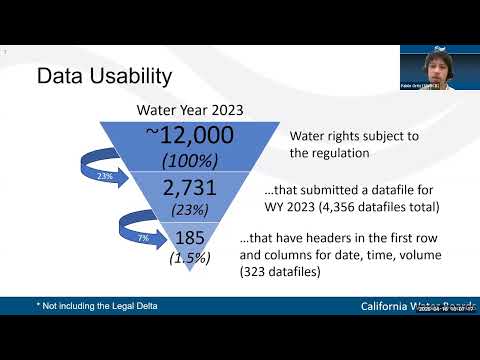
The hearing opened with Abby Warner, an environmental scientist at the State Water Board, who said the purpose of the meeting was to obtain public comments on the board’s proposal and that staff would not respond to comments during the hearing. Pablo Ortiz, an environmental scientist in the Division of Water Rights, summarized the board’s concern that data submissions since 2016 have been inconsistent and largely unusable: of roughly 12,000 water rights subject to the rules, only about 23% included at least one measurement data file in 2023 and fewer than 2% met the division’s formatting expectations.
Board staff and commenters said the core aims of the draft are to make measurement data machine‑readable and comparable and to prepare for a new reporting platform, CalWaters. Sierra Kennison, a water resource control engineer with the Division of Water Rights, said the draft reorganizes text into clearer definitions and describes what must be measured, how often and in what format. Key staff proposals included requiring email addresses for account access to CalWaters, aligning groundwater extraction annual reports to the water year (Oct. 1–Sept. 30), and adopting prescriptive data templates for uploads to be required in reports due Jan. 31, 2027.
Why it matters: Board staff said the lack of standardized, high‑quality diversion data inhibits water rights administration and makes mass analysis impossible. The proposed regulations would, if adopted, require most diverters above statutory thresholds to provide more granular, auditable data and would make weekly submissions for the largest diverters available through the board’s platform or an approved site.
Major proposed changes and dates - Applicability: The existing 10 acre‑feet per year…
Already have an account? Log in
Subscribe to keep reading
Unlock the rest of this article — and every article on Citizen Portal.
- Unlimited articles
- AI-powered breakdowns of topics, speakers, decisions, and budgets
- Instant alerts when your location has a new meeting
- Follow topics and more locations
- 1,000 AI Insights / month, plus AI Chat