Get Full Government Meeting Transcripts, Videos, & Alerts Forever!
Get email alerts on the Water Measurement Regs topic
No spam. Unsubscribe anytime.
State Water Board previews tighter, clearer water-measurement rules; public raises implementation questions
Summary
State Water Resources Control Board staff presented a proposed rewrite of SB 88 water measurement and reporting regulations and sought public comment on prescriptive data templates, new measurement tiers, clarified definitions and expanded alternative‑compliance options.
State Water Resources Control Board staff on April 16 presented a proposed rewrite of the board’s water measurement and reporting regulations, commonly known as SB 88, and invited public comment on a package of changes that would standardize data formats, revise measurement tiers and create new pathways for alternative compliance.
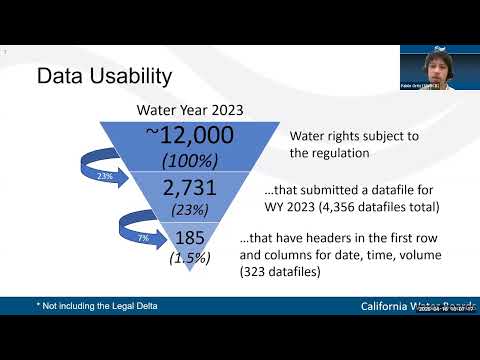
The hearing opened with Abby Warner, an environmental scientist at the State Water Board, who said the purpose of the meeting was to obtain public comments on the board’s proposal and that staff would not respond to comments during the hearing. Pablo Ortiz, an environmental scientist in the Division of Water Rights, summarized the board’s concern that data submissions since 2016 have been inconsistent and largely unusable: of roughly 12,000 water rights subject to the rules, only about 23% included at least one measurement data file in 2023 and fewer than 2% met the division’s formatting expectations.
Board staff and commenters said the core aims of the draft are to make measurement data machine‑readable and comparable and to prepare for a new reporting platform, CalWaters. Sierra Kennison, a water resource control engineer with the Division of Water Rights, said the draft reorganizes text into clearer definitions and describes what must be measured, how often and in what format. Key staff proposals included requiring email addresses for account access to CalWaters, aligning groundwater extraction annual reports to the water year (Oct. 1–Sept. 30), and adopting prescriptive data templates for uploads to be required in reports due Jan. 31, 2027.
Why it matters: Board staff said the lack of standardized, high‑quality diversion data inhibits water rights administration and makes mass analysis impossible. The proposed regulations would, if adopted, require most diverters above statutory thresholds to provide more granular, auditable data and would make weekly submissions for the largest diverters available through the board’s platform or an approved site.
Major proposed changes and dates - Applicability: The existing 10 acre‑feet per year applicability threshold remains in effect as the baseline; some registration criteria tied to storage were removed and certain small registration types (stock ponds, domestic, cannabis, livestock registrations) are exempt from this specific chapter. (Staff also emphasized that exemptions apply only to chapter 2.8; other permit terms still apply.) - Definitions: The draft expands and clarifies definitions, including “maximum allowable diversion amount,” “qualified individual,” “measuring device” and “measurement methodology.” Staff proposes raising the qualified‑individual threshold to 200 acre‑feet for professional qualification requirements. - Frequency tiers: Proposed measurement frequency tiers are 10–50 acre‑feet (monthly), 50–200 (weekly), 200–1,000 (daily), and greater than 1,000 acre‑feet (hourly). Hourly data may be aggregated into daily values in reported files if raw hourly records are retained. - Accuracy: Monthly/weekly measurements must meet ±15% (85%) accuracy; daily/hourly measurements must meet ±10% (90%). Devices installed before 2016 remain grandfathered at 85%. - Qualifying reservoirs: New concept of qualifying reservoirs with capacity greater than 5,000 acre‑feet; smaller reservoirs are generally exempt from certain measurement of withdrawals/releases. - Large‑diversion (formerly “telemetry”) requirements: Applicability is set at points of diversion whose combined rights exceed 10,000 acre‑feet per year or 30 cubic feet per second; weekly provisional submissions are allowed, with year‑end apportionment and QA/QC required. Newly covered large diverters would have a delayed effective date to June 2026. - Data formatting and platform: Staff will require prescriptive data templates for measurement uploads and plans to permit API/direct transmission; the board said templates will be required for reports due Jan. 31, 2027. The board is transitioning reporting systems to CalWaters and will require an email address on file for account creation. - Exemptions and alternative compliance: The draft keeps an ACP (alternative compliance plan) pathway, expands eligibility and preserves a presumption of approval unless rejected in writing; time extensions for implementation remain available (up to 24 months), and device‑loss exemptions can be requested for up to 180 days.
Public comments and recurring concerns Commenters representing public agencies, municipal utilities, large diverters, engineering firms and landowners generally supported the aim of better, standardized data but urged changes on timing, clarity and technical feasibility.
- Data formats and supporting materials: Multiple stakeholders — including the Association of California Water Agencies, MBK Engineers, Wagner & Bonsignore Engineers and others — requested the board release the measurement methodology form, the data‑file template and the planned API specification for public review well before deadlines so water users and third‑party consultants can prepare. Several asked that the board extend the deadline for methodology reports and ACPs to Jan. 31, 2027 (staff indicated it intends to make that change).
- Weekly reporting and reservoir accounting: Public water suppliers, the State Water Contractors and several utilities urged reconsideration of weekly reporting for reservoir storage and called out a mismatch between the board’s traditional accounting (which treats water as “in storage” after 30 days) and a requirement to report accumulation to storage on short time steps. Commenters said weekly reporting of storage would produce speculative figures and recommended alternatives such as weekly inflow/outflow reporting or monthly submissions aligned with the 30‑day storage rule.
- Provisional weekly data: Several large diverters and PG&E questioned the utility of provisional weekly data that has not been fully QA/QC’d or apportioned to individual claimed rights, saying provisional submissions would be difficult to interpret and could create burdens without benefit.
- Security and lag time: Electric and water utilities, and other commenters, asked for lag time on near‑real‑time public postings, citing physical security and market concerns. Commenters urged careful consideration of which fields are published in near real time and of access controls via the CalWaters API.
- Implementation capacity and outreach: Individual diverters and representatives emphasized the need for additional assistance, training and staffing at the division to support compliance and answer technical questions. Several smaller diverters asked for recognition of limited access to qualified contractors and for continued options to use lower‑burden methodologies when appropriate.
Staff clarifications and follow‑up Division leaders clarified several points during the hearing. Eric Eckdahl, deputy director for the Division of Water Rights, reiterated that there are no late fees associated specifically with SB 88 metering at this time and that a recent late‑fee change applies to annual water‑use reporting rather than SB 88 metering requirements. Staff repeatedly noted they will accept provisional ACPs and methodologies as implemented unless explicitly rejected in writing, and they plan to publish templates and more guidance through the CalWaters rollout and email subscription list.
What the board did not decide No formal vote or adoption occurred at the hearing. Staff asked for public written comment through 5 p.m. April 23, 2025; staff said it expects to present a final package for board consideration later in 2025 with a possible effective date of Oct. 1, 2025 (to align with water‑year reporting), and that templates and reporting deadlines for data files would apply to water year 2026 reports (due Jan. 31, 2027).
Ending Board staff encouraged parties with technical or site‑specific questions to use the measurement inbox (dwr‑measurement@waterboards.ca.gov) and to subscribe to CalWaters or rulemaking email lists for updates. The board will accept written comment through April 23 and said it will provide written responses to comments in the final statement of reasons under the California Administrative Procedure Act.
"We hope this hearing was informative, and we thank you for your comments and your participation," Abby Warner said in closing.