Get AI Briefings, Transcripts & Alerts on Local & National Government Meetings — Forever.
City updates Mayor and commissioners on Vance AFB projects, school funding and land conveyance to Air Force
Loading...
Summary
City staff summarized multiple items tied to Vance Air Force Base: progress on a new Eisenhower Elementary, state bill vehicles for military-community funding, Senate bill language on foreign land purchases, a MILCON earmark for an operations facility and a proposed 60‑acre conveyance to the U.S. Air Force.
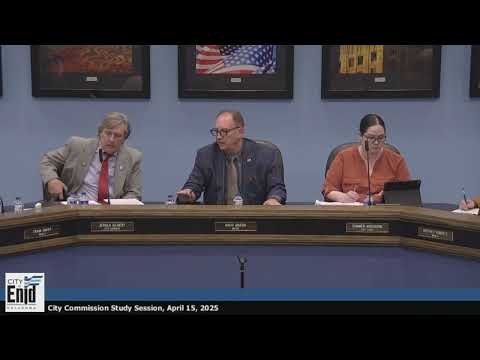
City staff briefed the mayor and board of commissioners on multiple military‑community infrastructure items related to Vance Air Force Base, including progress on a planned Eisenhower Elementary School, state legislation that could route funding to base‑area projects, an Oklahoma Senate bill addressing land purchases by foreign adversaries, federal military construction appropriations and a proposed conveyance of 60 acres to the U.S. Air Force.
Staff said the Eisenhower School project remains “on track” and is in the portal stage, which allows the project to file claims and draw previously allocated funds. Engineering is expected to be finished by the end of the year, after which construction can begin. The school is being planned as an 350‑student facility with an estimated total cost of about $30,000,000; if federal funds cover 80% of the cost, staff said that would equal roughly $24,000,000 and leave an estimated $6,000,000 local share.
Officials noted the Oklahoma Strategic Military Planning Commission committed $1,000,000 toward the school; about $750,000 of that had been paid, leaving one additional payment expected. Staff said there are active House bills described to the board as “flow through” vehicles to route state appropriations to military‑community projects; those bills were described in the meeting as “Oklahoma House bills 25 16, 20 5 18” (as referenced by staff) and were characterized as mechanisms that could carry funds to local projects pending final appropriations.
Separately, staff discussed Oklahoma Senate Bill 893, described in the briefing as legislation restricting land purchases by certain foreign adversaries near military installations. The speaker said earlier versions of the bill listed many countries but that the version discussed in committee narrowed the list to “Russia, China, Iran and North Korea” and that staff had worked with lawmakers on several revisions to address local infrastructure dependencies; the speaker cited concerns about a proposed 10‑mile exclusion radius and noted changes were made to avoid unintended limits on equipment and infrastructure procurement.
On federal military construction (MILCON) funding, staff reported the city previously received an earmark for engineering work on a new operations facility and said the city was waiting for the funds to be transmitted to the base so engineering can begin; the figure mentioned for that engineering earmark was about $8.6 million. Progress on engineering is expected to allow the military to request later appropriations to complete construction.
Staff also described a proposed conveyance of about 60 acres at the southeast corner of the outer runway to the U.S. Air Force to prevent future encroachment. The city previously appropriated $200,000 and holds title to the property; staff said title and environmental reviews are underway and that the transfer process requires standard documentation and level 1 and level 2 environmental studies before the military will accept the property.
Finally, the commission discussed local priorities submitted for the Defense Community Infrastructure Program (DCIP), including a proposed power‑redundancy project. Staff said the city expects to apply for about an $8,000,000 DCIP grant to add a substation and feed so the base could switch to an alternate power path during outages, noting the base already has water redundancy and that the new work would increase electrical resilience.
No formal votes were taken during the briefing; speakers described ongoing legislative activity and administrative steps. Board members asked staff questions about mineral rights, environmental studies and timing of appropriations, and staff said they are pursuing additional legal and title opinions to ensure a clean transfer.
Why it matters: the projects and bills discussed affect the city’s ability to fund and protect base‑adjacent infrastructure, influence local school capacity tied to military population changes, and determine whether state and federal funds can be routed to Enid and neighboring military communities.